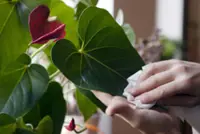
Social media is part and parcel of our modern lifestyle but it is also a frequent source of misinformation, which is something Jason Tor can attest to.
The co-founder of Plant and Pot Studio in Puchong, Selangor, said in mid-June, he experienced a spike in demand for snake plants, also known as mother-in-law’s tongue.
“Suddenly, many people started calling me asking whether I had this plant. I received up to 10 calls a day about it from people who wanted to buy it for its air purifying qualities.
“However, you need a certain number of plants per square feet to effectively purify the air,” emphasised Tan, 33, adding that all air purifying plants release oxygen day and night.
In a recent Forbes.com article, it was written that indoor plants like the snake plant, peace lily and spider plant help purify the air from a wide range of commonly found toxins in the household such as benzene, formaldehyde, trichloroethylene, xylene, and ammonia.
However, before you make a beeline for the nursery, the article added that you need to have at least two plants per 100sq ft (9.3sq m) of living space to increase the potential for indoor air quality improvements.
Nonetheless, there are other benefits of having indoor plants.
A Japanese research, published in the journal HortTechnology by the American Society for Horticultural Science, found that psychological stress levels of office workers dropped significantly after three minutes of gazing at plants placed at their desks.
For Tor, looking at lush green plants after a long day or after staring at his computer for a long time relaxes him.
He is also glad to reopen his store – which looks and feels like a mini rainforest – and serve his customers again since May.
During the movement control order (MCO), many of the plants in his three-lot studio did not survive as no one could go there to take care of them. Then in mid-April, they kickstarted their online platform and soon, online sales matched those of pre-MCO days.
Also read: Why Malaysian millennials are obsessed with indoor plants
The top five bestsellers during the MCO, revealed Tan, were the peace lily, monstera, spider plant, snake plant and the watermelon peperomia. Except for the watermelon peperomia, the others are also considered plants that are the easiest to maintain.
“We consider the peace lily the easiest to grow because you only need to water it when the soil is really dry. It also blooms, one of the few plants that does so indoors,” explained Tan, whose studio is four years old. The spider plant also only needs watering every nine days or once a week, he added.
Currently, his studio stocks over 20 species of snake plants.
“In the Malaysian Chinese culture, people do not really like snake plants because they have sharp edges but in Taiwan, Korea and Japan, they represent fortune and are very popular as gifts – as with the lucky tree – for housewarming or office openings,” said Tan, a business information engineering graduate from Universiti Tunku Abdul Rahman (Utar) who also runs a pet salon and hotel in the Klang Valley.
The two other top sellers – the monstera which ranked second, and the watermelon peperomia, in fifth place – both became popular due to social media.
“The watermelon peperomia was an Instagram hit; we sold over 200 pots within a week during the recovery MCO. But it’s very hard to take care of and if there’s a little bit of extra water, it will die.”
Tan added that there is a downside to plants popularised by social media platforms.
“Many people do not know the proper way of taking care of those plants. Most of the time, the plants featured on social media are placed at a particular location for the photoshoot. After the shoot, they are actually put somewhere else but people do not realise that and place their plants at the location as seen in the photos.
“That’s why when our customers want to buy a certain plant, we always ask them where they want to place it because we need to know the lighting and humidity levels,” said Tan.
“For example, bathrooms will be more humid and are not suitable for snake plants. For the office, the monstera, money plant, peace lily and snake plant are good because they are very hardy,” he said, adding that the thicker the leaf of a plant, the more water they can absorb and the less often it needs to be watered.
An increasingly popular trend now is species collection.
“We have quite a number of customers who like to keep a collection of the same species. The sansevieria (snake plant), which has over 100 sub-species, is one example.
“Air plants, with over 500 species, is another popular one, as with the philodendron,” said Tan as he points to a rare philodendron species costing RM250.
“We have also seen ‘old-fashioned’ plants popular in the 90s like the peperomia coming back in vogue. Another is the bird of paradise, which was very popular in the 1980s and 1990s,” he shared.
Also trending are aqua terrariums. These self-sustaining ecosystems do not need air filtration or water change. The glass is cleaned by snails and one just needs to feed the fish every three to four days.
“But you must understand what kinds of plants and fish are suitable, and the number of fish is limited,” said Tan, whose aqua terrarium in his shop is two years old.
Already a subscriber? Log in
Get 20% OFF The Star Digital Access
Cancel anytime. Ad-free. Unlimited access with perks.

Tor says where you put your plant in the house is important to ensure the right light and humidity levels for it. Photos: The Star/Azman Ghani
The watermelon peperomia was an Instagram hit not too long ago, but it is not an easy plant to take care of, says Tor.
The top five bestsellers during the MCO were (from left) the watermelon peperomia, snake plant, spider plant, monstera and peace lily.
The sansevieria rhino horn, a unique sub-species of the snake plant.
The interior of Plant and Pot Studio is like a relaxing mini rainforest.
Aqua terrariums are self-sustaining ecosystems that do not need air filtration or water change.
Coming back in vogue recently are the birds of paradise (right) and the peperomia plants.
There are over 100 sub-species of the snake plant or sansevieria.
From left are the sansevieria spp, sansevieria mansonianavar, sansevieria black diamond, sansevieria moonshine and sansevieria cylindrica patula.