Hip fractures are closely associated with falls among older people, and unfortunately come with a high risk of disability and death.
It is predicted that by 2050, six million hip fractures will occur yearly, with half of them in Asia due to the silver tsunami that is expected to hit this region in the next decade.
Fragility fractures affect older people all over the world.
However, because Asians in general have a smaller bone frame and less bone mass, we’re more susceptible to them.
“We’re also lacking in our awareness of bone health because we are not interested in looking at bone disease (i.e. osteoporosis or weakening bones) as a chronic non-communicable disease.
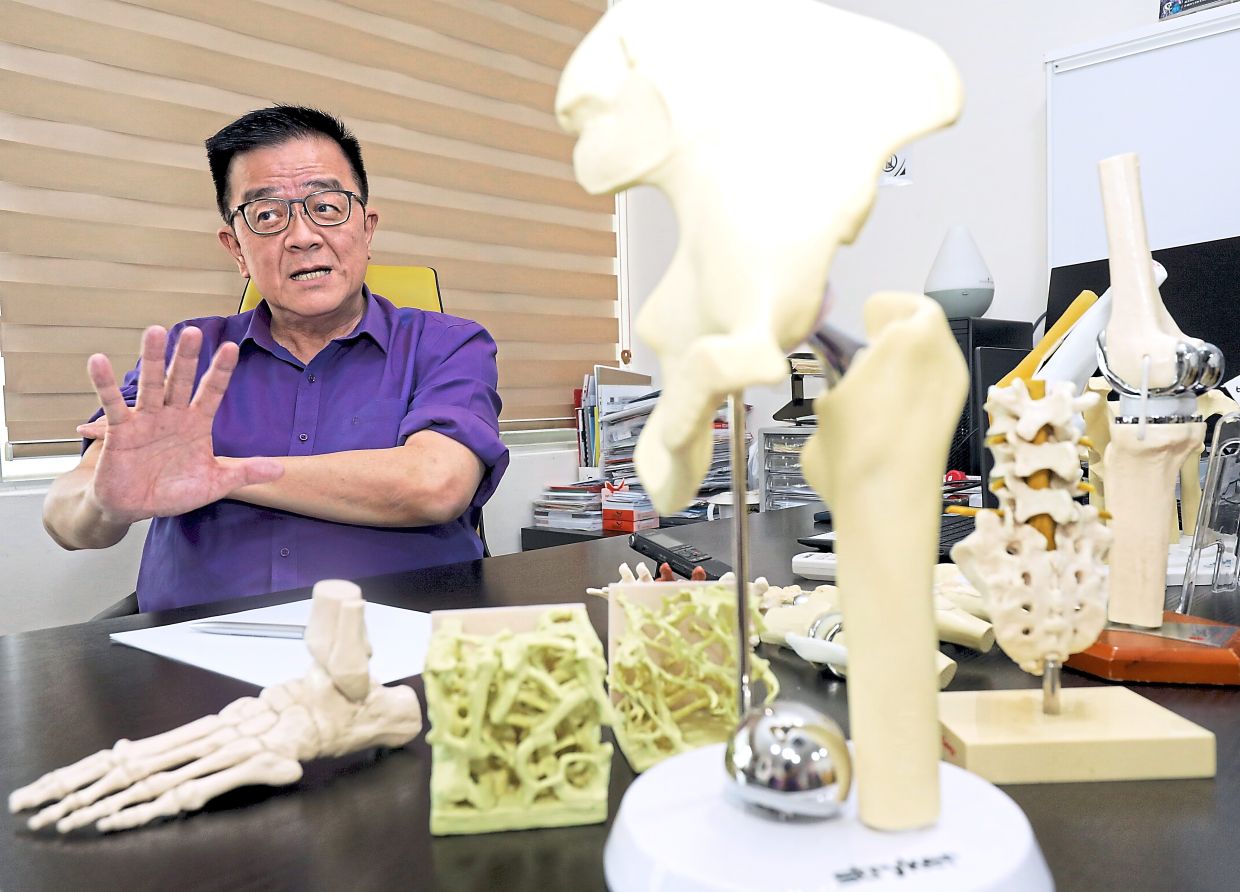
“Most governments are concerned with diabetes, cardiovascular health, hypertension, cancer, even dengue, but fractures in older people are not the focus, even though we are seeing increasing numbers of older people with them,” laments consultant orthopaedic surgeon Datuk Dr Lee Joon Kiong.
What people are unaware of is that vertebrae fractures are actually the most common fracture among the elderly worldwide.
What’s more frightening is that they can occur without a fall.
Says Dr Lee: “It’s scary that 80-90% of vertebrae fractures can happen when you sneeze, cough, bend forward to lift your grandchild or carry something light.
“Suddenly, ‘kraak’, you have severe back pain – it’s not the same as a slipped disc.
“Or in the slightly younger 50s age group, they start getting shorter or develop a hunchback (also known as a dowager’s hump) without any injury.
“The backbone is brittle, the vertebra starts to collapse in multiple segments and back pain sets in, although it may not be acute.”
Often, the patient self-medicates and accepts this as part of the ageing process.
If patients go to the hospital, they are mostly treated as an outpatient and given medicines or a corset, or are sent to the physiotherapist.
Once their pain subsides and they can walk, they don’t return to the hospital, so they are “neglected” because no one is checking on their bone health.
They don’t know they have osteoporosis.
Data shows that vertebrae fractures carry the same disability and death rate as hip fractures, but the latter die earlier.
“Hip fractures need surgery – that’s why the statistics is captured easily,” points out Dr Lee.
“With vertebrae fractures, the impact is not seen until a year or two later, when the patient has a fall and sustains a hip fracture.
“Her hip is fixed, but sadly, her underlying osteoporosis is not treated.
“After we operate, we also need to make their bones stronger.”
Optimising wellness
This is where orthogeriatric care – an approach that focuses on the comprehensive assessment, treatment and rehabilitation of elderly patients who have sustained orthopaedic injuries – comes in.
The multidisciplinary healthcare team should comprise the orthopaedic surgeon; geriatrician or family medicine physician; dietician; rehabilitation specialist or physiotherapist; and other specialists as needed, to ensure the patient’s wellness is optimised before and after surgery.
When the elderly come to the hospital for fractures, they already have multiple illnesses, which puts them at high risk for surgery.
Say an 80-year-old has persistent bone pain and consults the orthopaedic surgeon who tells her she needs surgery.
“The patient is admitted, and ideally, she should also be seen by a physician or geriatrician because they need to sort out and stabilise all her medical problems to reduce post-surgery complications.
“The longer she stays in the ward and lies down, the faster her health deteriorates.
“She is also stressed, affected psychologically and gets depressed.
“She needs to be immediately mobilised to prevent complications and sent home to the environment she is familiar with.
“However, all these things can be prevented by the combined care from the orthogeriatric team,” says Dr Lee.
The concept is common in western countries, but new in Asia as there are very few geriatricians around.
Orthogeriatric care is currently available only in a handful of public hospitals in Malaysia as many hospitals do not have geriatric departments, although some orthopaedic surgeons and internal medicine doctors are trying to fill the gap.
Some private hospitals are also working on setting such a unit up.
He admits: “Many of us orthopaedic surgeons know older patients have underlying osteoporosis, but sadly, we don’t treat it, saying we’re too busy, have no time, etc, and that’s bad.
“This has been the problem worldwide and I feel it’s my duty to change their mindset.
“If they’re busy, it doesn’t matter, at least refer the patient to the physician or geriatrician for further management.
“Don’t keep the patient to yourself, pass them on!
“This is one reason why elderly patients succumb to repeated fragility fractures.”
And when it comes to elective surgeries like joint replacements on non-fracture patients, surgeons should do a bone density scan first.
“If patients have osteoporosis, they should be put on medications immediately and wait for a year before doing the surgery.
“If the pain is bad and they cannot withstand it, we operate first, then treat the underlying condition.
“The implant needs a healthy, strong bone to sit on, otherwise it will loosen.
“If the patient falls, they will get a fracture around the implant and we would have to redo the whole surgery again,” explains Dr Lee.
These patients also need orthogeriatric care.
Getting doctors on board
A few years ago, Dr Lee and several orthopaedic surgeons established the Malaysian Bone Health Optimisation Network (MyBone) to educate all orthopaedic surgeons on the importance of treating osteoporosis and advocate the responsibility of assessing bone health.
“We hope that through the promotion of this concept, every orthopaedic surgeon will be more proactive in paying attention to and treating osteoporosis, thereby increasing the treatment rate and reducing the occurrence of fractures and secondary fractures,” he says.
According to the International Society for Clinical Densitometry guidelines, which Malaysia follows, women above 65 and men above 70 should go for a bone density scan (known as a Dexa scan) to measure bone mineral density and bone loss.
Younger patients with rheumatoid arthritis and were on steroids before, or those who have a history of hip fractures and a body mass index (BMI) of 19 and lower, should also get their test done earlier.
If the scores are low, doctors will prescribe drugs for osteoporosis, which fall into three categories:
- Drugs to stimulate bone growth (i.e. bone-forming agents or teriparatide, which is a synthetic form of the parathyroid hormone)
- Drugs to reduce bone loss (i.e. anti-resorptive medications)
- Dual-action drugs that both stimulate bone forming and reduce bone loss.
The suitability of the drugs, which come in tablet or injection form, depends on the patient’s profile.
Those on teriparatide and dual-action drugs are switched over to anti-resorptive drugs after a period of time, which is usually less than five years, because there is a low risk of making the bones so hard that they might crack.
Many medical specialities can start a patient on these medicines, but Dr Lee says that it’s best that primary care physicians continue monitoring the patient.
“Whatever drugs you introduce, ensure the patient has adequate calcium and vitamin D levels, or else, these medicines won’t work the way you want them to.
“Their nutritional intake must also include protein.
“After a year, we repeat the Dexa scan to check the progress, but patients usually report less pain after a few months,” he says.
As for exercise, Dr Lee recommends slow movement such as tai chi or qigong, in combination with strength training, tailored according to the individual’s ability.
Patients have to accept that they have to be on these drugs for the rest of their life.
“They cannot stop as the bone density will drop again.
“Interestingly, they don’t complain about taking drugs for diabetes, heart problems or stroke, but when you tell them osteoporosis drugs must be taken long term, they protest.
“They assume fractures are a natural part of ageing and drop out of treatment.
“That is a very wrong perception which we have to correct,” he says.
While these drugs are expensive, pharmaceutical companies sometimes offer special deals, e.g. buy two, get one free, and there are also generic versions available.
Dr Lee concludes: “Ultimately, we don’t want our elderly to die bedridden with sores.
“We want them to also enjoy the last five to 10 years of life.
“Osteoporosis is preventable, so let’s do our work together.”
Already a subscriber? Log in
Get 20% OFF The Star Digital Access
Cancel anytime. Ad-free. Unlimited access with perks.