


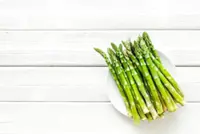
As far back as 1781, United States statesman Benjamin Franklin complained about a certain "disagreeable odour" caused by asparagus.
Centuries later, little has changed, sadly.
We may have since put a human on the moon, eradicated smallpox and saved millions with antibiotics, but the phenomenon of asparagus wee remains as widespread as ever.
To blame here is the asparagusic acid contained in both white and green varieties of the vegetable, which gives the urine its typical asparagus smell. An enzyme releases sulphur-containing compounds, which are then excreted in the urine.
But according to the Federal Centre for Nutrition (BZfE) in Germany (arguably the world's most asparagus-obsessed country), only about one in two people has this enzyme in their genes. That's why not everyone's urine smells so strong after eating asparagus.
Those lucky enough to not have the enzyme that breaks down asparagusic acid don't have to struggle with the foul-smelling asparagus urine that Franklin once had.
And yet, the phenomenon has not been completely clarified by science. According to the asparagus wee experts at the BZfE, there's another theory that some people are simply less sensitive when it comes to the smell of their own urine.
What we do know, however, is how to mitigate the smell: strawberries.
There is evidence that the strong smell can be reduced if you follow up your asparagus with a few strawberries, and researchers in Norway discovered (quite by chance) that urine then smells less strongly of asparagus and even slightly like strawberries.
The reason for this, researchers posit, is a chemical reaction between secondary plant substances of the strawberries and protein fragments of the asparagus. This inhibits the formation of sulphur-containing compounds.
The exact science at play here may not be entirely understood just yet, but for those fearing the cursed asparagus wee, it should suffice to know that a large portion of strawberries for dessert or even before the asparagus will have things come up smelling like roses.
It's also worth knowing that, since asparagus has a dehydrating effect, there are also dietary supplements containing asparagus extract. These products can also show up in the urine – but in a different way: by turning the urine orange or blue-green. – dpa
Already a subscriber? Log in
Get 20% OFF The Star Digital Access
Cancel anytime. Ad-free. Unlimited access with perks.
