
Newly identified Indonesian frog species Limnonectes larvaepartus is not unique for its fangs, but the way it makes babies.
This little amphibian from the rain forests of Indonesia’s island of Sulawesi is the only one of the world’s 6,455 frog species to give direct birth to tadpoles, eschewing the common froggy practice of laying eggs, say scientists.
“Reproduction in most frogs could not be more different from human reproduction. In this case, what is most interesting, ironically, is that the reproductive mode is more similar to our own,” said herpetologist Jimmy McGuire of the University of California, Berkeley, whose research appears in the scientific journal PLOS ONE on Dec 31, 2014.
This frog, usually grey or brown, measures about 40mm, weighs less than 5g and belongs to the Asian group of fanged frogs. Males possess two fang-like projections from the lower jaw that are used in fighting.
The frog lives along small streams and puddles in rainforest habitats, doing its best to avoid being eaten by larger fanged frog species as well as snakes and frog-munching birds.
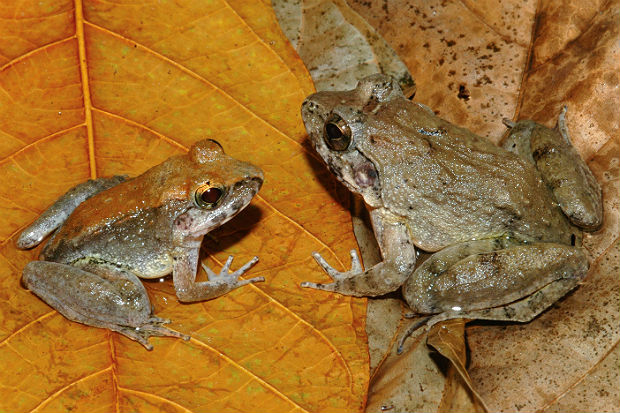
But the thing that really sets this tiny frog apart from the rest is its mode of reproduction sets. “The vast, vast majority of frogs have external fertilisation. For mating, the male grips the female around the waist and releases sperm as she releases her eggs,” says McGuire.
Those eggs mature through stages including the aquatic tadpole larval phase, typically limbless with a tail that propels it through the water.
About a dozen frog species rely on internal fertilisation, says McGuire. All but the newly identified one either deposit fertilised eggs or give birth to froglets, essentially miniature versions of an adult that already passed through a modified tadpole stage while still in an egg capsule inside the female.
Bucking the popular trend, however, the female Limnonectes larvaepartus – meaning “marsh swimmer that gives birth to larvae” – gives birth to tadpoles.
There have been frogs that swallow their eggs and brood them in their stomach, a species in which the male broods the eggs in his vocal sac, and many species that carry eggs and tadpoles in pouches on their backs and sides, says McGuire.
“It’s totally unclear why this mode of reproduction has not evolved more frequently,” McGuire adds. “My favourite topic when it comes to frog evolution and diversification is the bewildering variation in reproductive modes that occur. Frogs exhibit all sorts of interesting twists.” – Reuters
Already a subscriber? Log in
Get 20% OFF The Star Digital Access
Cancel anytime. Ad-free. Unlimited access with perks.