At first glance, there is nothing extraordinary about the three gentlemen seated around a small rattan coffee table, a tray of Chinese tea set between them.
The three have their own distinct styles: One looks serious in a beret, printed shirt and khaki trousers. Another is decidedly laidback in a black polo shirt, chinos and a baseball cap. The third wears a Nusantara-style tunic with dark grey slacks, also topped with a farmer’s flat cap.
Yet, beneath this unassuming scene lies a story of a friendship that has endured over time, and a coming together over a shared passion.
What ties Lee Cheow Hee, Abd Rasid Yusof and Sivasangaran Nair together is a friendship that began when they were young creatives working at advertising agency Trang Creative in 1975.
Five decades later, it is art that has brought them together again.Sitting together now, the trio are completely at ease – no trace of the awkwardness that can creep into a conversation between people who haven’t met for years.
Instead, they talk as if merely resuming a conversation left off only recently – listening intently, interrupting occasionally, and bursting into laughter that fills the small art gallery in a mall in Petaling Jaya, Selangor.
The three were among the 15 artists featured in KITA, a recent exhibition at Artspace Gallery in Atria Shopping Gallery that brought together Malay, Chinese and Indian artists in conjunction with Malaysia’s Merdeka and Malaysia Day celebrations.
For the former colleagues, however, KITA is more than an exhibition.
It is a reunion – and perhaps a continuation of something that began half a century ago, when they were young men working late into the night, creating advertisements the old-fashioned way – by hand – with pencils, brushes, typesetting, Cow Gum and plenty of teh tarik.
“Basically, muhibbah in art,” says Abd Rasid, 77, when asked what KITA means to him.
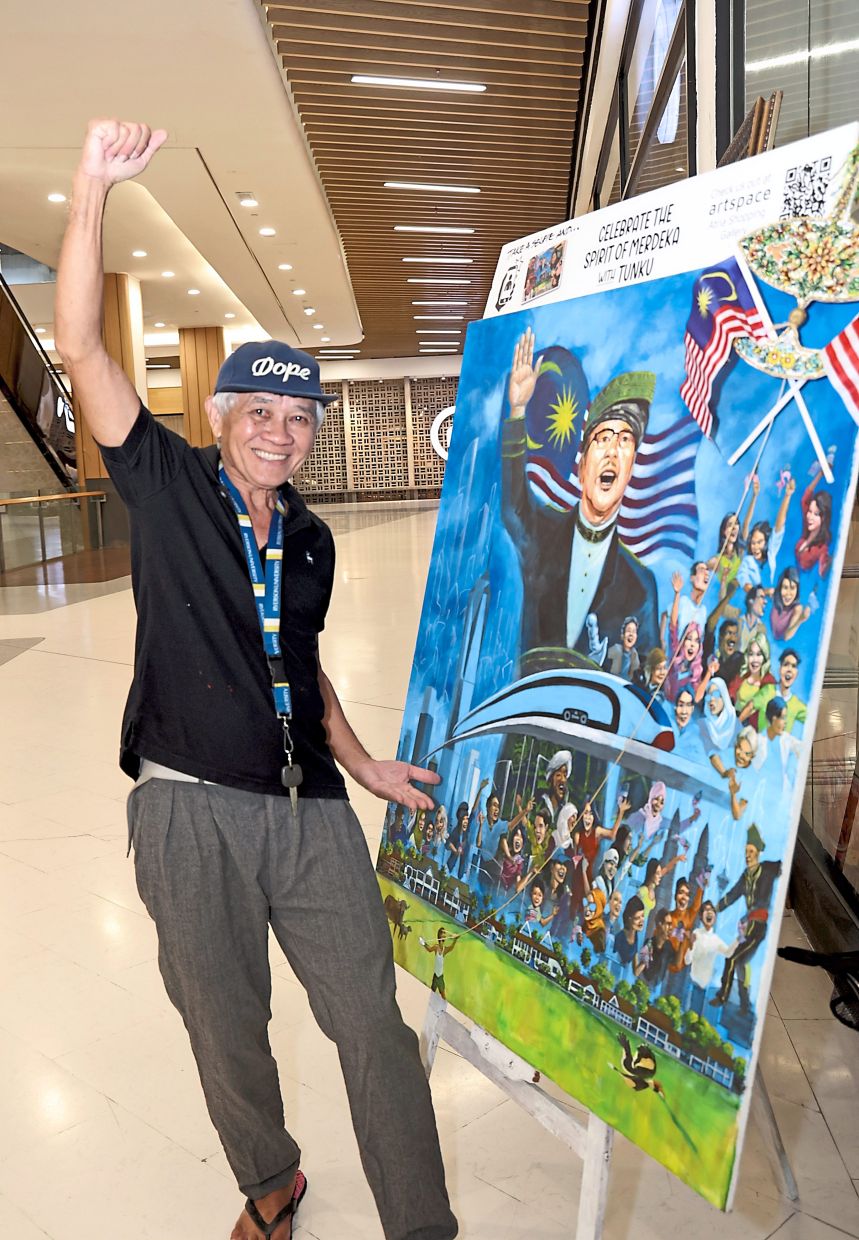
For Lee, 73, who is based in Petaling Jaya, the exhibition represents a new station in their colourful lives.
“We are Malaysians first and foremost – and are friends to boot,” he says.
Siva, as he is fondly known among his peers, 77, sees an even deeper connection.
“Since Merdeka signifies unity, it was indeed a great idea that the three friends of Trang Creative days banded together to celebrate the nation’s Independence Day in the spirit of unity, peace and harmony,” he says.
“This is truly what Malaysia means to us – peaceful, progressive and joyfully together.”
Back to where it began
To understand why their reunion feels so natural, the trio share their story dating back from back to 1975.
The now-defunct Trang Creative was where three young men, each with a different role, found themselves working side by side.
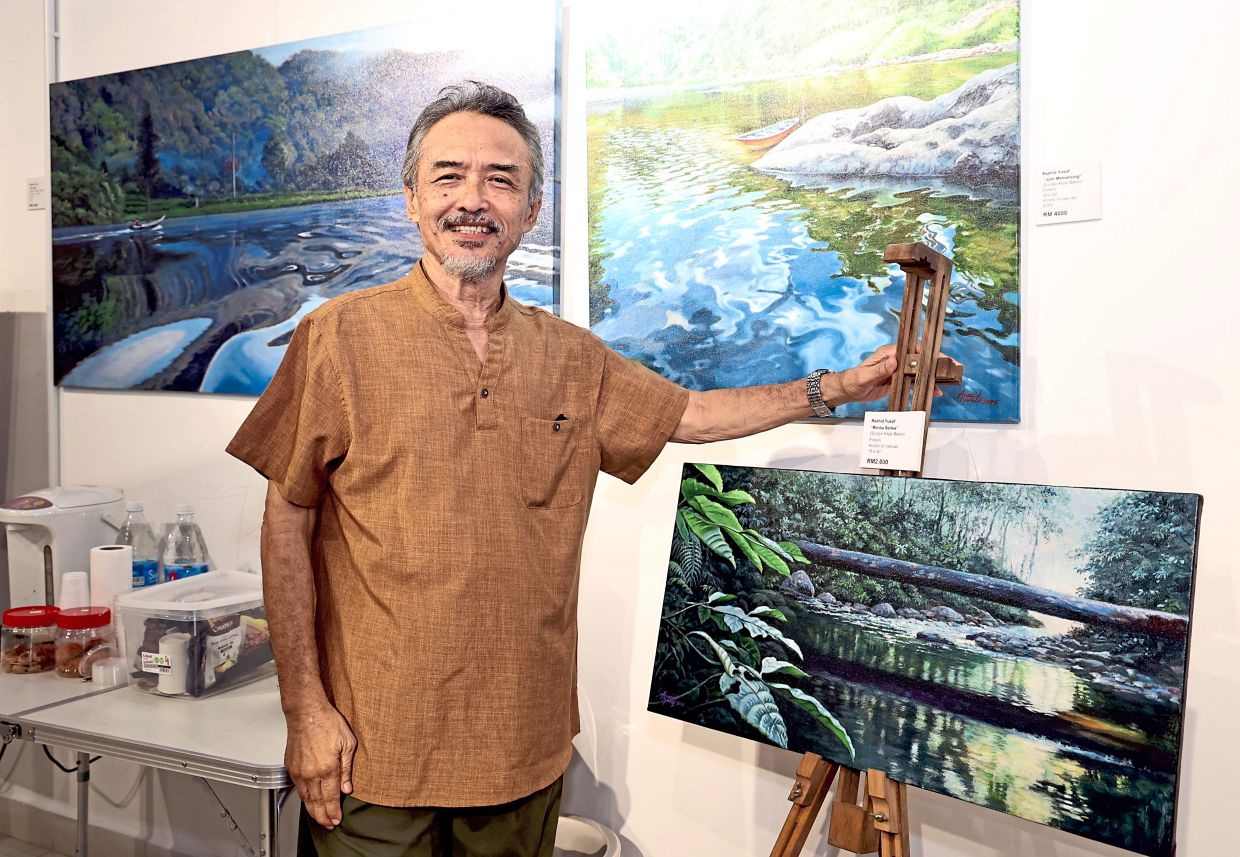
Abd Rasid, now based in Ampang, Selangor, was a graphic artist, then known as an FA (finished artwork) artist, in the studio headed by Lee, who was a visualiser – a role that Siva jokingly envied most because it meant drawing every day.
Siva was a copywriter cum account executive who loved to draw but, as he put it, drawing simply “wasn’t his job”.
“I was very envious about what Stan did,” he says, referring to Lee and his role.
“He said it is not fair I get to have all the fun,” Lee recalls of those days.
Siva eventually became creative assistant to the managing director, overseeing the creative output of the studio.
That naturally led to the occasional squabbles with the “art boys” – Lee and Abd Rasid, he recalls. But disagreements did not stop the colleagues from becoming good friends.
Siva wrote the copy. Lee produced the visuals. Abd Rasid cut drawings, pasted typesetting and put everything together with Cow Gum, an adhesive whose distinctive smell added to the already surreal atmosphere of working through the night.
Midnight teh tarik helped keep them going – and bonded them together.
Three paths, a shared creative vision
After Trang Creative, their careers led them in different directions. Abd Rasid moved on to the corporate sector as a graphic designer, while Lee went freelance after another agency he joined with Siva folded.
In 1982, Lee discovered airbrush painting, a relatively new tool at the time, and found himself in what he describes as a “blue ocean”, with virtually no competition.
“He became Malaysia’s number one airbrush artist,” Abd Rasid says proudly. “Nobody else was doing better than him.”
Lee’s work soon attracted projects from international advertising agencies, before he moved into architectural impressions and eventually embraced computers, 3D modelling, animation and editing.
The transition was steep, but Lee has never been one to shy away from learning. His philosophy remains much the same today.
“There is always something new to learn, if you can swallow your pride and learn from the young,” he says.
He and his gallery partner, Lum Weng Wah, an old advertising hand himself, even attended an AI class where their classmates were in their 20s. “There is a lot the young can teach us.”
Siva took another route. After leaving Trang in 1978, he worked in different fields before forming his own advertising agency, but left the business in the mid-2000s, after the pressures of running an agency began taking a toll.
He slowed down, taking on freelance corporate writing and scriptwriting. But the creative itch never disappeared.
The artist inside
For Siva, the return to painting took the longest.
Although he had loved art since he was five and painted in his younger years, advertising left little time for it.
“For 45 years, I never touched a brush,” he says.
Then came retirement. And boredom.
Lee, meanwhile, kept inviting him to exhibitions.
“This one always came and pulled me,” Siva says, pointing at Lee. “Come. Go for this exhibition, that exhibition.”
Eventually, something clicked. He began looking at what other artists were doing and wondered: Why not him?
By 2019, he had bought canvases, oil and acrylic paints and started painting again. It was not an instant success.
Then the Covid-19 pandemic arrived. For Siva, the enforced slowdown turned out to be a blessing.
With nowhere to go and television becoming tedious, he immersed himself in painting.
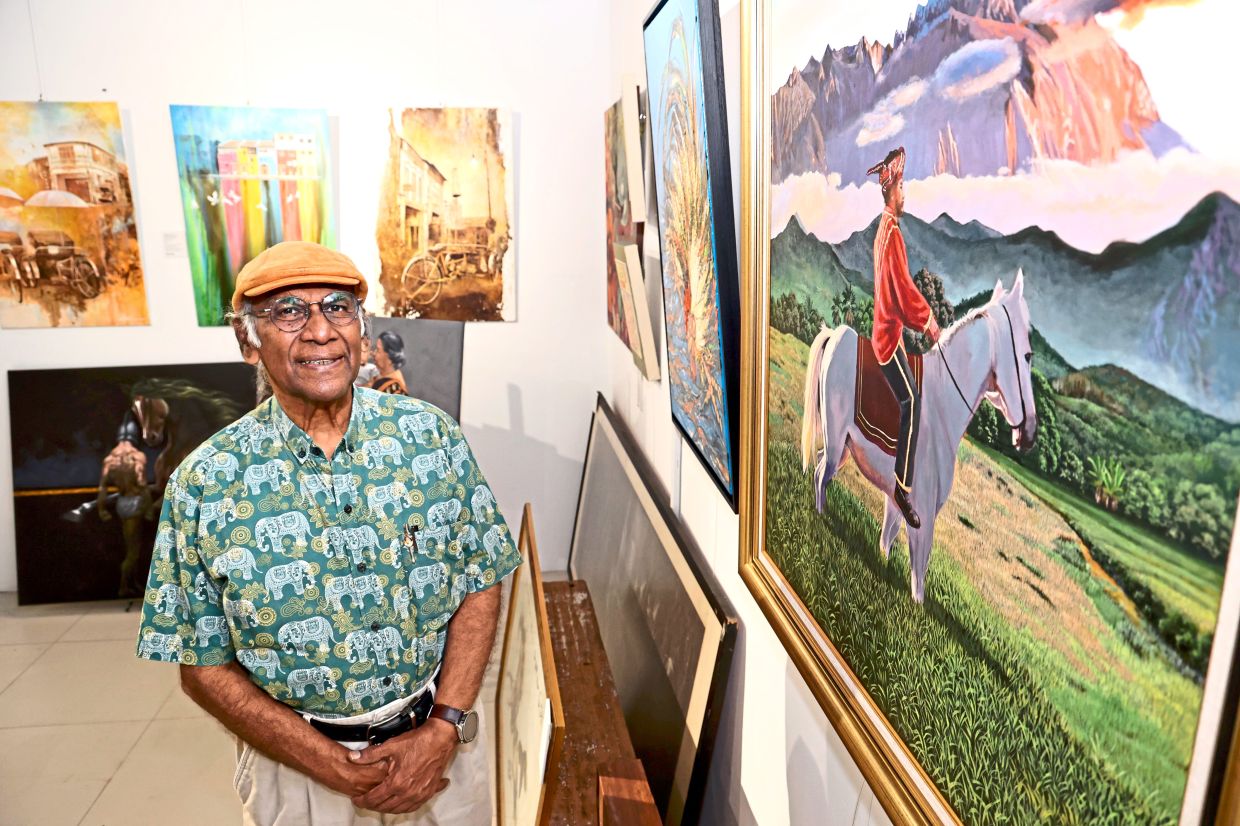
He posted his work on Facebook and WhatsApp and began receiving positive responses and enquiries, including from Australia. What began as a hobby eventually became a full-time pursuit. Exhibitions followed. Then commissions.
Today, Siva works from his home studio and paints at his own pace.
“If clients say, ‘I need it back this time’, I’ll say, ‘If you want that time, then you go somewhere else,’” he jokes. “I prefer to do it in my own relaxed way.”
The former copywriter is now a full-time artist, painting the landscapes and heritage buildings of the Kinta Valley that have stayed with him since childhood.
Setting their own pace
Abd Rasid, meanwhile, has been painting for much longer and describes himself as a full-time artist for almost 25 years.
One who enjoys painting outdoors, he loves to start his day by taking his pad and easel into the forested areas near his home in Ampang.
There, away from deadlines and commercial demands, he listens to the birds and paints.
“It is very therapeutic,” he says.
That word comes up repeatedly when the three talk about art today. The pressures of advertising may have been replaced by the freedom of creating for themselves.
“Those days, when we did advertising, it was very stressful,” Lee says. “Now, art is almost like a therapy. It is therapeutic.”
Their friendship, too, has changed. There are no more arguments over deadlines and layouts.
“Now no more fighting all day and night,” Lee says, laughing. “We relax.”
“At our own pace,” Siva adds, and Abd Rasid echoes: “At our own pace.”
The trio also joke about the different ways they approach their art. Lee sketches almost everywhere he goes and is particularly interested in life sketching.
Siva paints from photographs and is meticulous about detail – so meticulous, he says, that he will paint every tiny feather stroke by stroke. Abd Rasid, meanwhile, enjoys the immediacy of painting outdoors. The differences do not divide them. If anything, they feed the friendship.
“A musician can play on his own. Quite nice. But when they get into a jam session, it becomes more spontaneous and you feed off each other,” Lee says, describing the dynamic of their friendship.
Artists, he believes, benefit from the same exchange.
Finding each other again
While art kept Lee and Siva in touch over the years, Abd Rasid only completed the three-man pack recently.
About two years ago, Siva had organised an exhibition at Universiti Malaya, with Lee present and sketching visitors.
As he was doing his round in the exhibition, someone tapped him on the shoulder. It was Abd Rasid.
“I only recognised him by the voice,” he says, adding that he could not immediately recognise his old colleague.
Seeing Siva in an entirely different setting – as an artist – was a revelation to Abd Rasid.
“He never saw me paint,” Siva says.
The reunion of the former colleagues was spontaneous. There were hugs, laughter and plenty of surprise.
For Abd Rasid, seeing his old friends again made him feel young.
“I was feeling young again, excited to know that they are still doing what they like best – making art,” he says.
Lee describes the feeling differently.
“Time did not change us, nor how we relate to each other,” he says. “We missed out on the years apart but made up for it – we just took off where we left off like we were never apart.”
The three have since collaborated on exhibitions and kept in touch through WhatsApp, Facebook and phone calls.
KITA is the latest expression of that renewed friendship.
For Lee, the exhibition represents a new station in their colourful lives.
His own works at KITA include Tribute to Tunku, a montage spanning Malaysia’s past, present and future, as well as The Long Road to Merdeka, a series originally commissioned in 1990 for a calendar depicting events leading to independence.
Abd Rasid is showing his landscape works, while Siva’s paintings reflect his long-held love of Malaysia’s landscapes and the spirit of Merdeka.
For all three, the exhibition also reflects something bigger than their individual careers.
While Abd Rasid gives only one big word – grateful – to express his feeling, Siva sees KITA as a celebration of the Malaysia they believe in.
Lee is equally direct about the role of art in bringing people together.
“Art brings us together. Still can bring us together,” he says.
Fifty years on, three old colleagues have found their way back to the thing that connected them in the first place – art.
The friendship came along with it.
And at 73 and 77, none of the three appears ready to stop creating anytime soon.