Christel Krueger peered through thick glass and murky water at the Berlin Zoo, staring in awe at a mother hippopotamus and her child sleeping on a sandbar.
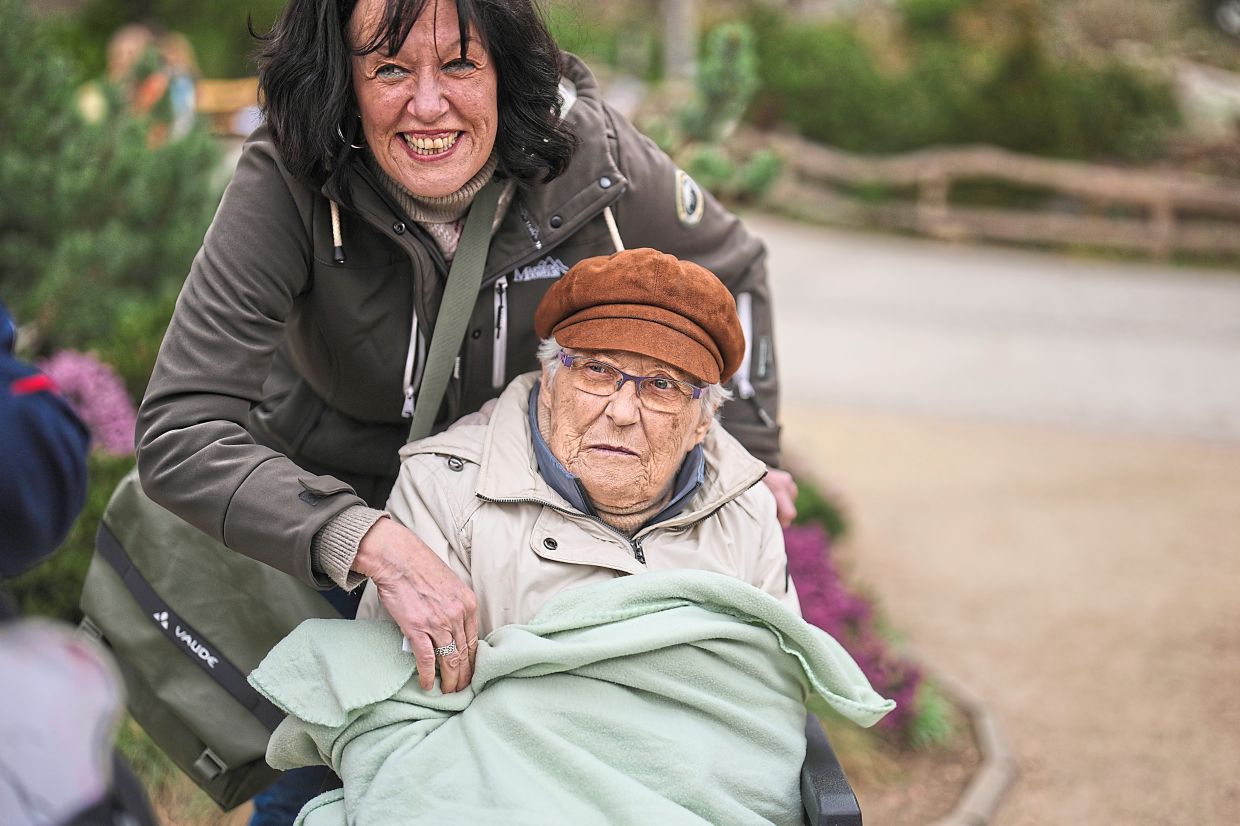
Krueger, 86, and her daughter were on a specialised zoo tour recently for people who live with dementia that was organised by Malteser Deutschland, part of the international aid organisation Malteser Order of Malta.
On the tour with Krueger, Ingrid Barkow watched from her wheelchair as the elephants roamed their habitat, while Monika Jansen balanced on her tiptoes to get a better view of a rhinoceros.
“When I get home, I’ll still be thinking about it,” said Jansen, 85. “Maybe even at night, while I’m sleeping and dreaming about it.”
The three women are among roughly 1.6 million people living with dementia in Germany, according to the Office of the National Dementia Strategy. The figure is expected to rise to 2.8 million by 2050.
Museums and other cultural institutions across the globe have added specialised, barrier-free tours and guides to their repertoire in recent years, some made possible by advances in technology.
These include sign-language tours for people who are deaf and hard of hearing, touch-based events for those with blindness or low vision and programmes for people on the autism spectrum.
The Berlin chapter of Malteser Deutschland last year designed a cultural programme in the capital catering to people with dementia.
“People with dementia aren’t very visible in our society. It’s still a major taboo subject, yet it actually affects a great many people and it’s important that they continue to be at the heart of society,” project coordinator Christine Gruschka said. “They have a right to participate, just like everyone else.”
A wonderful experience
Millions of people around the globe have some form of dementia, a progressive loss of memory, reasoning, language skills and other cognitive functions.
People can experience changes in personality, emotional control and even visual perception. Alzheimer’s is the most widely recognised type, but there are many others, with their own symptoms and underlying biology.
Malteser Berlin’s tours for people with dementia occur at the zoo, the Museum of Natural History, Britzer Garden and Charlottenburg Palace, with hopes of expanding to other locations.
“Normal tours are often too fast, too loud, with too many people and too many distractions,” Gruschka said.
“That’s why we’ve made it our goal to create programmes specifically for people with dementia: Where they still feel seen, where they feel comfortable, and where they can still show that they’re still here and can still be part of it.”
Krueger, Jansen and Barkow followed Malteser Berlin tour coordinator Carola Tembrink around the Berlin Zoo, accompanied by their daughters and a caregiver.
Tembrink skipped the majority of the zoo’s vast offerings to focus on the hippo, rhino and elephant habitats so the participants would not get too tired or overwhelmed.
“The zoo is a wonderful place for tours like this because almost everyone who grew up in Berlin has been here as a child,” Tembrink said. “And especially for people with dementia, childhood memories are often still present – they just need to be jogged a bit – and that happens naturally when they see the animals, smell the air as they enter the zoo, or when they go into the rhino house and catch a different scent.”
Lifeline for caregivers
For the caregivers and families, the tours are a lifeline. During long and sometimes frustrating days of caring for someone with dementia, a specialised tour lets them connect with others who understand the journey.
Krueger was formally diagnosed last year with dementia, but her daughter, Kerstin Hoehne, said the symptoms appeared more than two years ago.
“What’s nice is that it’s also with, let’s say, like-minded people, that you’re not alone, but that you have a sense of belonging because everyone else might have the same problem,” Hoehne said.
Barkow’s daughter, Manuela Grudda, said the tour brought them closer together. Grudda pushed Barkow’s wheelchair through the zoo, her hands caressing her mother’s shoulders or pointing out the animals.
“I can’t really communicate with her in a normal way, of course, but I see that when I show her something, she looks at it, she’s paying attention, and that’s important,” Grudda said. “And it just makes me happy that she’s not just in her own world, but also in this one.” – AP