
Two years after his last exhibition at Wei-Ling Gallery, London-based multidisciplinary artist Rajinder Singh returns with Saffron Crossings.
For the erudite artist, research and history are integral to his practice, informing a visual language that extends beyond the canvas into questions of memory, identity and belonging.
If Saffron Surrender (2024) confronted the historical imprint of British colonialism on the Sikh diaspora, Saffron Crossings shifts the exploration inward, examining how histories of migration and displacement are carried, remembered and reimagined.
On view at Wei-Ling Gallery through Sept 26, the series – timely for the Malaysia Day season – reveals an artist equally invested in historical excavation and the possibilities of art as a means of translating research into visual form.
Is there a thread running through the current works, going back to Saffron Songs in 2022?
“In a way it is, and in a way, it isn’t,” says Rajinder, 62, when asked about the sense of continuity in the new exhibition.
“I consider myself a poet first. Poetry enters my art through these ideas of meta-themes, big themes.
“My theme, my particular kind of activism, is how I want to change the world a little bit for the better, in any way I can. Whatever is available to me, I use to bring attention to the vulnerable body of the migrant. My life has been shaped by migration,” he adds.
'Everything is together'
It is this idea of migration and crossing that provided Rajinder with two points of departure.
The first was the British steamship SS Rajula, which once carried passengers and goods between India and Malaya.
Built in Glasgow in 1926, it carried Indian families across the Bay of Bengal on the Straits Service between Madras (now Chennai), Penang, Port Klang and Singapore.
For the Ipoh-born artist, with Malaysian-Irish roots, the vessel also holds a deeply personal resonance: as a young boy, he travelled aboard the Rajula to visit family in India – the same route once taken by his grandfather and father.
The second source of inspiration was phulkari, the traditional embroidered textile craft practised by Punjabi women.
Once an integral part of Punjabi cultural life, the craft has, in Rajinder’s view, all but disappeared.
“The phulkari is part of my inheritance. Phul means flower, and kari means textile. These textiles were made by women who gathered together over months, sometimes years, creating embroidered pieces to commemorate births and marriages, as well as for everyday life,” says Rajinder, who was recently back in Kuala Lumpur.
“It’s kind of like a quilt making, they didn’t plan, they just went at it. So I’m not interested in the patterns but I am interested in what they thought. It has disappeared and I wanted to mine that language.”
When Rajinder speaks of “language”, he is referring to a traditional way of approaching art, rather than the modern or Western traditions that often dominate contemporary practice.
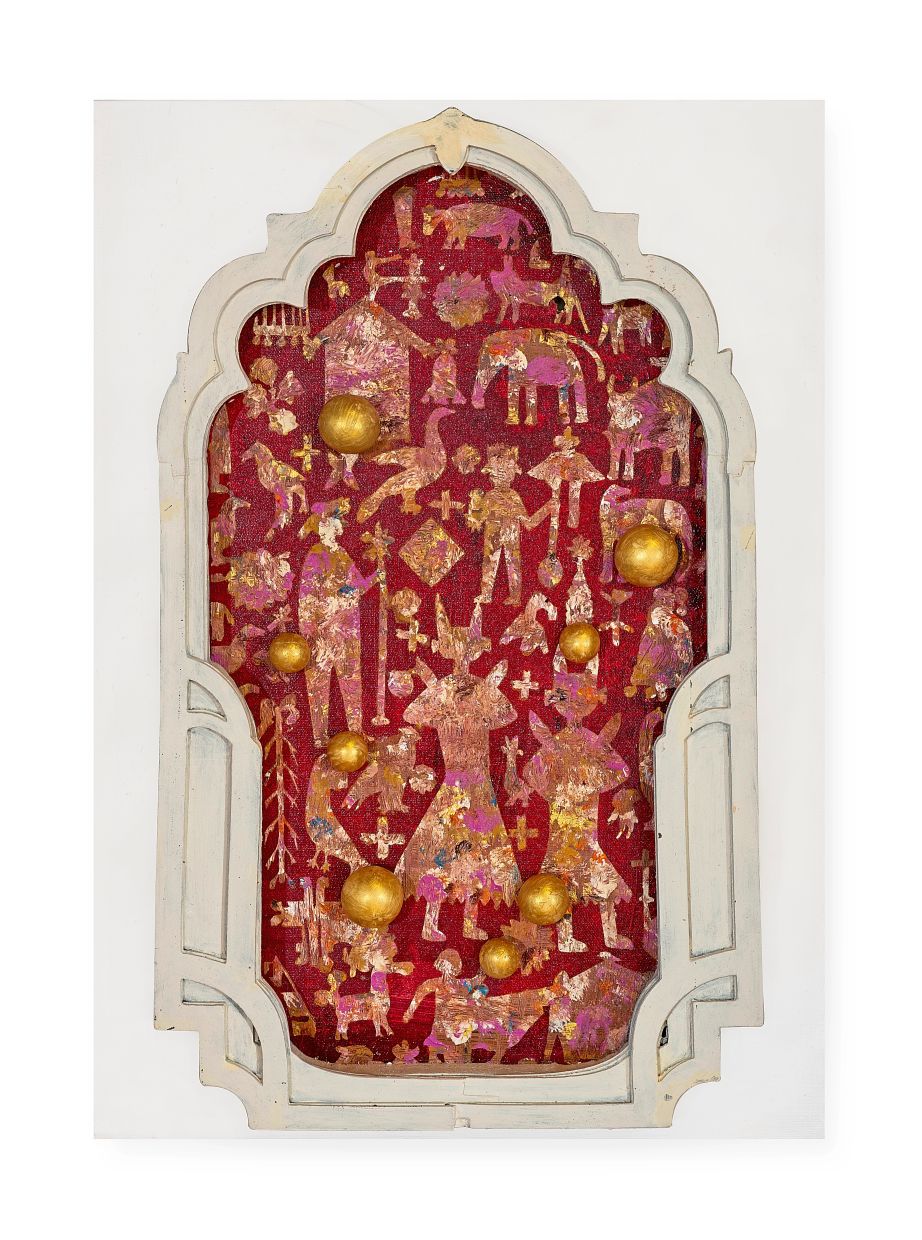
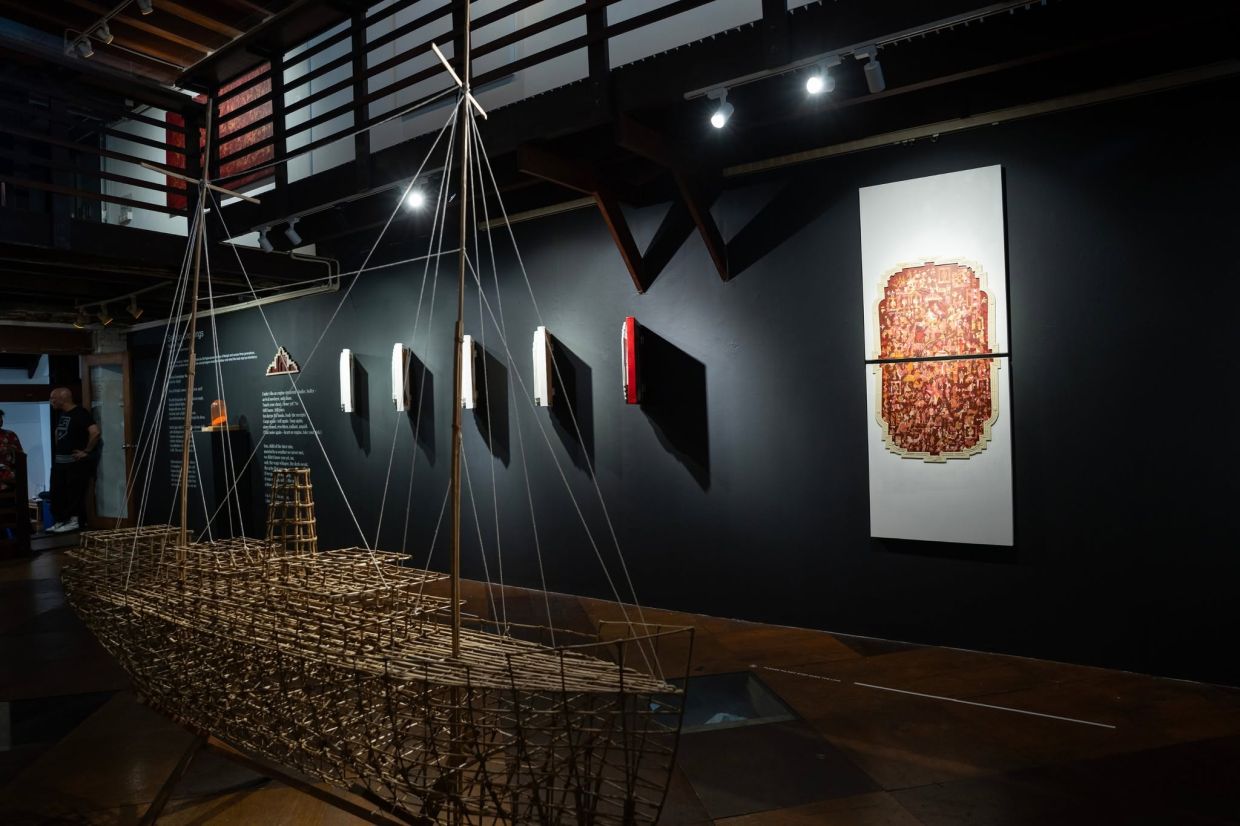
Rajinder’s new five-part Passage series, spanning canvas, EVA foam, acrylic and found materials, carries the exhibition’s central themes, while its cream-coloured frames, loosely modelled on the portholes of the SS Rajula, evoke the artist’s childhood memories of migration and passage.
“The paintings are about migration. The paintings are the crossing, the frames around them are the ship. And I have used the language of phulkari. There’s no centre for the eye," says Rajinder.
“There’s no hierarchy in terms of the building of motifs. Everything is in one place, everything is together. In painting, there is a hierarchy of images. You always guide the eye, but in phulkari, everything has the same importance,” he adds.
A memory of a crossing
While the paintings draw on the history of a decommissioned steamship and an ancient craft, Rajinder, whose background spans engineering and art, identifies four ways of looking at the works.
“The aesthetic changes a little bit throughout the paintings, there are four different types of paintings. They are the same series but four different ways of talking about migration.
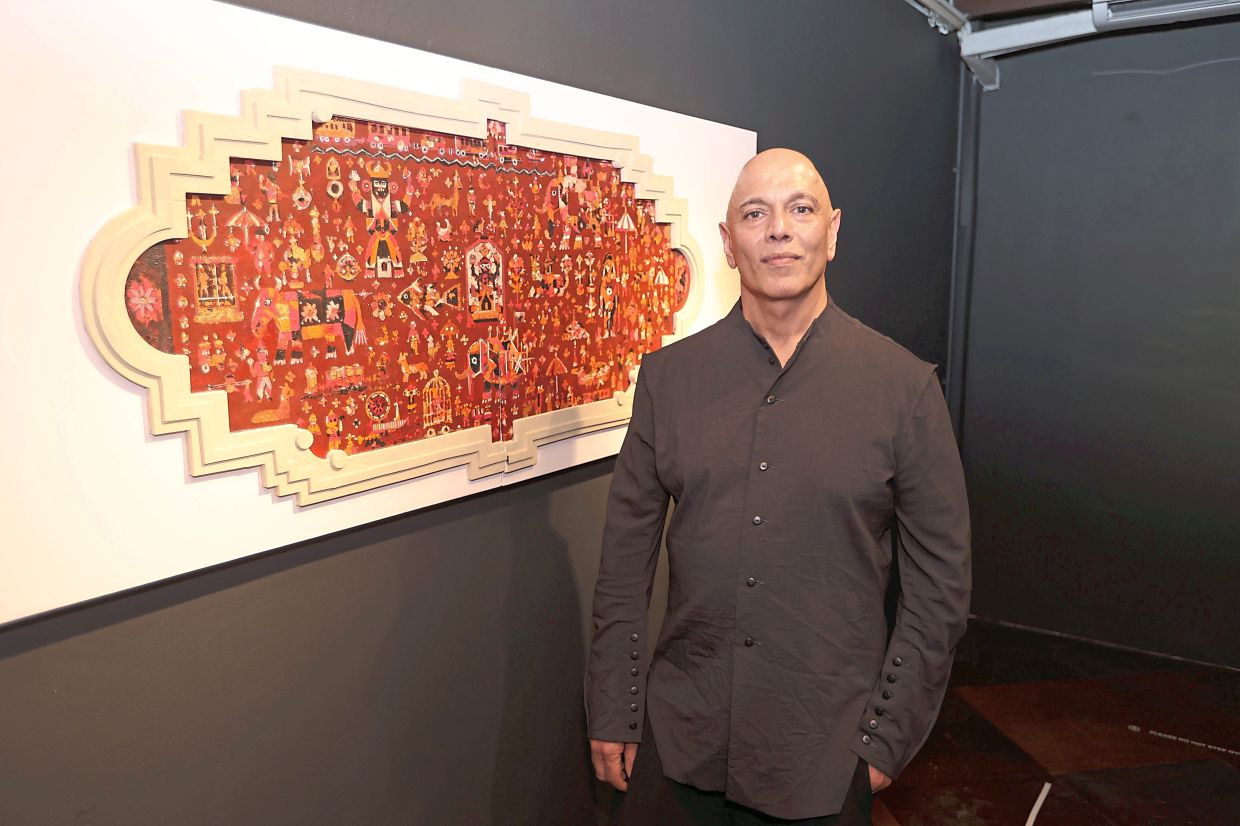
“The crossing changes you which is what I’m trying to say. So the big question in this show is, and you have to sit down and think about this carefully, ‘what actually crosses when people migrate?’"
Beyond their physical form, Rajinder’s paintings explore the inner experience of seeing and understanding the world, and how that perspective shifts when we uproot ourselves.
“I don’t think it’s like one pure world from one side to the other. It’s never like that. Yes, people cross, families cross, labourers cross, merchants cross, objects cross," he says.
“But there’s also other things that cross ... souls, prayers, the way people make sense of the world, memories, but these things piece together via encounters. The crossing itself changes what is, essentially, your make up.”
For the gallery visitor, there is much to discover. Rajinder conveys this transformation by combining elements from South Asia – animal, plant and architectural forms – to create new, hybrid entities.
In doing so, he reflects how identity is reshaped through encounters with different cultures, languages and ways of life.
At a time of growing hostility towards immigrants, his current work is necessary in keeping these conversations alive.
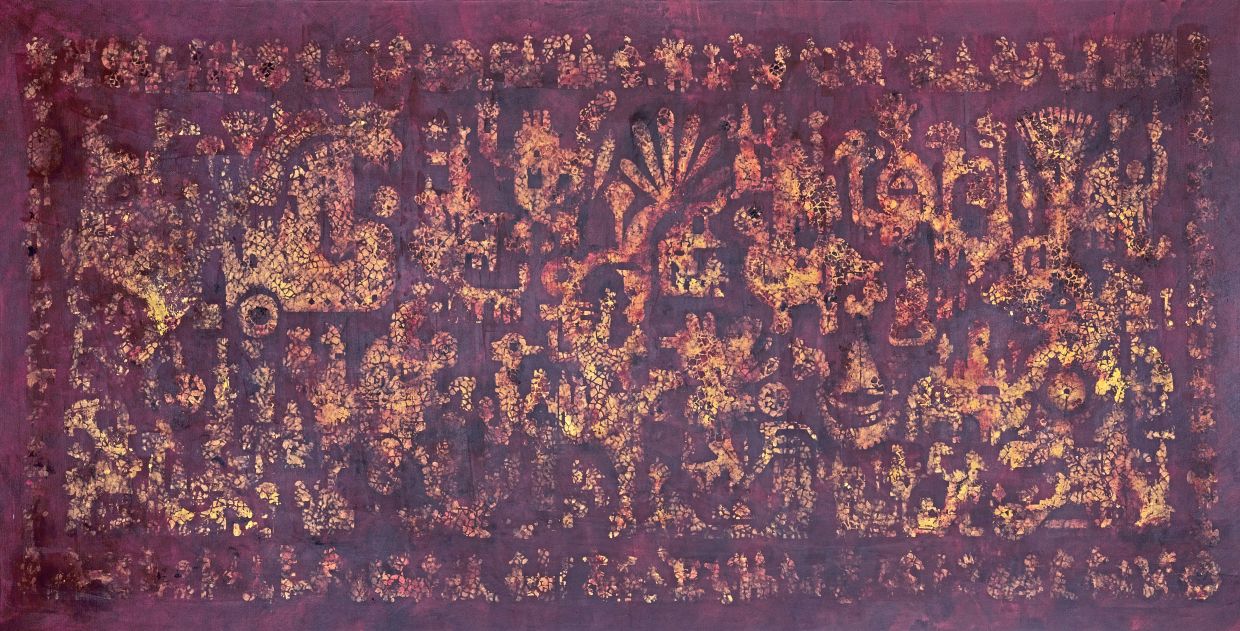
Alongside the paintings, Saffron Crossings also features a bamboo vessel inspired by, but not replicated from, the SS Rajula.
“I worked with another artist (Lee Mok Yee) here to create the bamboo ship because I live in London and couldn’t have made it there and brought it over.
“It was made here by bamboo effigy makers, the Chinese effigy makers. It was a difficult process because they don’t usually make things like this. We went through several versions before arriving at this one. I think it has a semblance of the ship – it’s a sketch of it, a memory of a crossing.”
Saffron Crossings is also the artist’s third Saffron series, which began in 2022, with a colour that holds deep significance in Sikh tradition.
“It is a devotional colour, it is a colour of courage, of sacrifice, of worship and prayer but mine is more than that. For me it’s a migrant colour,” says Rajinder.
Saffron Crossings may also mark the final chapter of Rajinder’s Saffron series. Having explored migration and colonialism through multiple perspectives, he is ready to move on, pursuing new ideas and possibilities across his practice.
This impulse reflects the breadth of an artist who works not only as a painter, but also as a photographer, choreographer, performance artist and poet. His latest book, The Fugitive Gesture, is available at Wei-Ling Gallery and selected bookshops in Kuala Lumpur.
“I get bored really easily. I want to keep exploring. I don’t want just one way of looking at the world,” says Rajinder with a laugh.
“I adhere to and cling diligently to my larger themes and my activism as a migrant, as a border-crosser. But I don’t want the details of how I bring that message across to interfere with my life and my ideas, you know what I mean? I think, with my next exhibition, I’ll use a new method of making images,” he concludes.
Sea Passage: Ships, Migration And The SS Rajula, an online conversation, is part of the exhibition’s public programme. It will be held this Thursday (Sept 10) at 8pm. Registration is required. Saffron Crossings is showing at Wei Ling Gallery, Jalan Scott, Brickfields in Kuala Lumpur until Sept 26. More info here.