Lee’s new book traces a Korean family’s upheaval from Korea to Australia and Southern California during the Asian financial crisis. – AP
Min Jin Lee's first novel since her million-selling Pachinko is a long book that grew out of a basic question: What do Koreans care most about?
"We’re obsessed with education, and it became my obsession over why Koreans care so much,” says Lee, whose American Hagwon, scheduled for Sept 29, will likely be one of the year's most anticipated books.
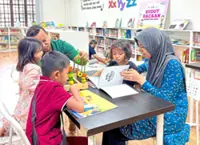
Hagwons are for-profit tutoring centres – sometimes likened to "cram schools” – where Koreans of all ages receive instruction for everything from English to guitar to cooking.
Any language school or organisation that gives private lesson music classes” can be considered a Hagwon, Lee says.
The author, 57, calls herself an "accidental historian,” a novelist who uses broad narratives to unearth the past, make sense of the present and explore race, gender and class among other issues.
American Hagwon is the third of a planned quartet about Korea and the Korean diaspora that began with Free Food For Millionaires in 2007 and continued a decade later with Pachinko.
Cardinal, a Hachette Book Group imprint, is calling her new release a deep look into "what happens when the rules shift, the world order becomes suddenly unrecognisable and benchmarks of success are no longer a guarantee.”
In American Hagwon, Lee sets her story everywhere from Korea to Australia to Southern California as she tracks the journey of a middle-class Korean family upended by the Asian financial crisis and hoping to regain its bearings.
A native of Seoul whose family emigrated to New York City when she was seven, Lee attended the elite Bronx High School of Science, studied history at Yale University and law at Georgetown University.
She knows well the importance of preparation, and laughs as she remembers that her father has nicknamed her "the turtle,” because she is slow – but "very steady.”
Her books take a long time, in part, because she puts so much work into them. Her stories are based not just on research and reflection, but on extended travel and interviews.
"I want to hold up a mirror to society, and, as the kids say, do a ’vibe check',” she says. – AP