Kide Baharudin's new exhibition explores relationship between art and reality


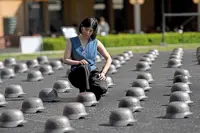
‘For me, the things I don’t see can sometimes be more interesting, because it’s a mystery, and that encourages me to be more creative when I’m in front of the canvas,’ says Kide, standing next to an artwork titled 'Jahang' in his studio in Seremban. Photo: Kide Baharudin

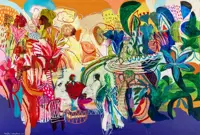
When it comes to contemporary artist Kide Baharudin’s work, it’s the colourful brushstrokes and vibrant hues that draw you in at first.

But once you step closer and really look at his pieces, you’ll find wonder in imperfections from the colours that stray over the lines and meaning in chaos from the thought-provoking details that belie the outward cheeriness of his work.

In his second solo exhibition Kulu Kilir, now showing at Galeri Puteh in Kuala Lumpur, Kide takes his personal observations of the world around him onto the canvas.

His new works – from large canvases to smaller pieces – exude a moodier, reflective tone.

This show is different from his nostalgia-inspired Sa Hari-Hari debut solo exhibition in July 2021 (which had a limited audience because of pandemic restrictions) and the multicultural rainbow Pe’el pop-up showcase in September 2020, which gave the masses a glimpse of a young artist coming into his own in the gallery circuit.

Kide's 'Termenung Di Tengah Jalan', a sculpture made from recycled plastic bottles and concrete. Photo: Kide Baharudin

“What I want to convey in this solo is my spontaneous response or reaction to society and everything around me in my travels around Malaysia and abroad,” says Kide, 33, about his latest exhibition.

There are plenty of pieces that strike viewers as both familiar and fantastical, reminiscent of pages from a Where’s Wally? book, but there is also a more grounded exhibition feel (with social issues, a whiff of politics and government bureaucracy) with certain works.

For example, public service gets a nod on Dalam Pejabat Tanah (At The Land Office), which was inspired by Kide’s own experience at the Land Office.

“The wait was so long and there were all kinds of people there. There were even some people fighting! So I started from that scene and interjected bits and pieces from my imagination,” he shared.

Smartphone addiction, sometimes known as “nomophobia” (fear of being without a mobile phone), is also featured in a piece titled Tunduk Hormat. It’s a piece that’s relatable to many Malaysians.

Public service gets a mention in 'Dalam Pejabat Tanah' (2023). Photo: The Star/Hanis Maketab

In his elaborate acrylic “colourscapes”, you’ll find yourself lost in the details of everyday scenes – roadside stalls selling piping-hot food, bargain hunters searching for a steal in a thrift shop, the class divide between the haves and have-nots.

Kide highlights that one new aspect in this exhibition compared to his previous shows is that it includes two sculptures: Termenung Di Tengah Jalan (Staring In The Middle Of The Road) and Keluarga Di Tepi Jalan (Family At The Side Of The Road), which were made from recycled plastic bottles and concrete.

Both works zoom in on subjects surrounding the homeless, and mental health issues.

Here, there, everywhere

If his previous solo exhibition Sa-Hari-Hari was an exploration of nostalgia through old stories and family photos, then Kulu Kilir, which features over 50 artworks, is a record of his experiences in the present and of him taking stock of his life, which saw him beginning as a print artist with quirky “Malaysiana” designs and pop yeh yeh music tributes more than 10 years ago.

Kide (right) taking time out to chat with visitors at his new exhibition 'Kulu Kilir' at Galeri Puteh in KL. Photo: The Star/Chan Tak Kong

Once an “outsider” in the art scene, Kide is now a fixture, with a multi-generational fanbase.

Kide, born in Kuala Pilah, Negri Sembilan, is also never far from including elements of his home state in his works.

His new exhibition’s title is taken from slang used in Negri Sembilan, short for “ke hulu, ke hilir” (to travel upstream and downstream).

Historically, the phrase was born from the Malay community’s deep connection to rivers, a major mode of transportation at the time, but according to Kide, it’s taken on a more negative connotation in modern times and is often used to complain about the youths who walk aimlessly about town, wasting time.

Kide, however, sees his walkabouts as taking the time and space to examine the world we live in.

“The pieces for this exhibition have also been inspired by current issues I’ve seen over the past couple of years in the newspapers, television and social media,” says the Seremban-based artist, who is married to fellow artist-printmaker Syafiqah Sharom – better known as Ika.

Kide's 'Kecoh PRU15' (acrylic on canvas, 2022), a work that reflects Malaysia’s troubled political climate. Photo: Kide Baharudin

“I’ve always had this deep desire to understand people from all walks of life – those in the present and from the past, as well as those in rural villages and bustling cities. The best way I know how to express myself is through art, so Kulu Kilir is a reflection of my thoughts and feelings.”

Kide adds that he doesn’t plan his pieces ahead, so once he’s in the flow while working on a piece, nothing stops him.

“I’m not a stickler for technique, so if my brush has broken, I’ll use anything else I have, like cotton buds or my hands. What’s important is telling the story I have in my head.”

A love for exploration

Speaking about the journey and process of creating works for the exhibition, Kide explains that this time, he wanted to challenge his powers of observation and imagination.

“There were times when I would go to some place and empty my mind to immerse myself in my surroundings – from the people, scenery and food to the culture, language and sounds.

A couple viewing one of Kide’s ‘gerai’ series works. Photo: The Star/Chan Tak Kong

“I would then hone in on what I sensed and how I felt at that moment in time, be it obstacles or successes, defeats or victories, the sad, the funny. There was death. And there were wonders,” says Kide.

But beyond what he could see with his own eyes, Kide also filled in the blanks for things unseen.

“For me, the things I don’t see can sometimes be more interesting, because it’s a mystery, and that encourages me to be more creative when I’m in front of the canvas.”

Kide, who was all smiles on the opening day of the exhibition, was glad to have been surrounded by family, friends and fans who came in person to see his works.

“My previous solo exhibition was done during the pandemic lockdown, so it could only be viewed online. This is the first one where I get to see everyone, and seeing them come from near and far, it’s been truly humbling,” he shares.

Kide's 'Busker' (acrylic, nails, and steel strings on wood and found objects, 2023). Photo: Kide Baharudin

Kide attributes his love of exploring to his upbringing, which saw him often moving between Kuala Pilah and Penarik beach in Terengganu, where his father operated holiday chalets.

“That’s how I first got a taste of doing art – I’d help my father decorate the chalets and signboards, painting coconut trees and the like,” he reminisces.

The Kulu Kilir exhibition includes several ball pen and charcoal sketches inspired by a trip to Europe that he went on last year with Ika. Their travels took them to the hallowed art museums of Berlin and Leipzig in Germany, Amsterdam (the Netherlands) and London.

Being able to see the works of artists he’s admired over the years such as Jean-Michel Basquiat, Max Beckmann, Neo Rauch and Ernst Ludwig Kirchner further lit the creative spark in Kide.

“I’m a fan of the Die Brucke Movement of German Expressionism, so being able to see the works of some of my favourite artists in person was truly life-changing,” he says.

Kide Baharudin’s Kulu Kilir is showing at Galeri Puteh, KL Eco City until Sept 10. More info here.

Get 20% OFF The Star Digital Access

Monthly Plan

RM 13.90/month

RM 11.12/month

Billed as RM 11.12 for the 1st month, RM 13.90 thereafter.

Best Value

Annual Plan

RM 12.33/month

RM 9.87/month

Billed as RM 118.40 for the 1st year, RM 148 thereafter.


Follow us on our official WhatsApp channel for breaking news alerts and key updates!

Next In Culture

West Bank arts festival kicks off for first time since Gaza war
Hemingway classic still inspires Americans to run with bulls in Pamplona
Welcome to 'FIFA Gully': the Kolkata lane transformed by a love for football
Asia’s first Durian Experience Centre opens in KL, featuring museum, theatre
HK bookseller, seized by Chinese authorities in 2015, dies in Taiwan at 70
Haruki Murakami says his novels are 'different' from AI literature
In Melaka, Peranakan heritage gets a killer twist with murder mystery weekends
Malaysian photographer-turned-artist gives the forest a voice
New Haruki Murakami novel 'The Tale Of KAHO', goes on sale in Japan, his first with female protagonist
Weekend for the arts: BookStreet hits 5, Seni Reog in KL, 'Jom Kita Ke Laut'

Others Also Read