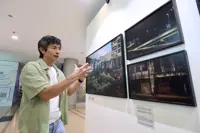
Theatre director Ho Lee Ching is starting off the year with an experimental film work Dead Water that examines the disconnect between the mind, body, and the external world.
“The way I would describe it is the state of consciousness where you’re alive but you feel quite the opposite. You feel foggy, numb, and disconnected from the world,” says Ching, as she’s known in the arts scene.
“Sometimes you can feel like you’re not real or everything is a dream. You may also have a distorted sense of memory and time,” she continues.
The 50-minute (pre-recorded) performance, filmed outdoors at the lawn of the Kuala Lumpur Performing Arts Centre (KLPac), will be screened at the Indicine, KLPac on Jan 15 and 16. It will also be streamed via CloudTheatre from Jan 20-23.
The story channels the power of rituals for its primal energy, with a cast of dirt-covered performers, monstrous creatures, and a commune around a camp fire. Dead Water, presented by Hermana Collective, is a collaborative effort involving dancers, theatre artists, musicians, and videographers.
It features Chloe Tan, stage actor/director Tung Jit Yang and Ching while Rezza Coebar Abel and Ian Francis Khoo (of experimental arts/music outfit Francoe) provide the ambient soundscapes.

Ching and Tan, who form Hermana Collective, began sharing their mental health struggles with one another in 2019.
“On one of the days, Chloe said she felt like dead water. There was an immediate excitement about those two words – dead water, and how much it can mean. That was how it all began,” recalls Ching.
Ching is no stranger to shedding light on mental health issues through the arts. In 2018, she staged her debut directorial show at KLPac called OCD which explored the experiences of those with Obsessive Compulsive Disorder and in 2019, she produced a physical theatre show about neurodiversity called In/Out.
Last year, she organised Commune For Arts, a free virtual programme to help people deal with the pandemic and manage their mental health.
Grief is another theme surfaces in Dead Water.
“I think it is probably because grief is the bridge to what is lost between the past, present, and future. When we dissociate, time is not linear. We grieve for that loss of linearity, loss of feelings, and loss of grounding and stability,” says Ching.

Originally, Dead Water was to be presented on-site at KLPac. However, due to the pandemic situation, Ching chose the filmic route. Online rehearsals began in the middle of last year, and the team reconvened in October for in-person rehearsals.
“Coming up with the narrative was a back and forth thing where we performers came up with something and gave the freedom to the musicians to interpret it and come up with their own thing.
“Ravin, our videographer, joined us more in October. He would also come up with ideas and suggest different angles and ways of shooting specific scenes. It was fun to have such input,” says Ching.
The team spent two weeks filming Dead Water.
She reveals that Dead Water would be especially relevant and relatable to audiences as the pandemic forced many to “sit with a lot of heavy emotions, mainly grief, and feeling stuck and hopeless.”
“Feeling stuck does not just mean feeling stuck in our homes, but more of feeling stuck in our circumstances. I think it’s pretty much a piece that also says, the only way out of this is through it,” concludes Ching.
Dead Water is supported by the Cultural Economy Development Agency (Cendana), MyCreative Ventures and PENJANA.
Already a subscriber? Log in
Get 20% OFF The Star Digital Access
Cancel anytime. Ad-free. Unlimited access with perks.