Conversations on climate change and tipping points often revolve around science, technology, policy, economics and law.
But is there one underlying theme that cuts across these disciplines?
At the Global Tipping Points 2026 Conference (GTP 2026) at Sunway University, one possible answer emerged: faith.
Faith offers a common ground for people of different beliefs to recognise their shared responsibility for the planet. As Universiti Malaya’s Centre for Civilisational Dialogue advisor Datuk Prof Azizan Baharuddin put it during a plenary: “We may have different perspectives in terms of how the planet came to being, but the fact is, this is the only planet.”
Hosted by the Sunway Centre for Planetary Health in October, GTP 2026 gathered scientists, policymakers, health leaders, financiers, business leaders and youth advocates from around the world to explore how positive change can be accelerated as the planet’s systems approach critical thresholds.
Some of the conversations ventured beyond scientific and policy frameworks to examine how culture, values and faith shape societies in ways data cannot and potentially tip the world towards a better future.
The discussions culminated in the launch of a faith-based toolkit, which draws on eight faith traditions to help faith leaders, organisations and communities engage with planetary health issues.
Co-chaired by Sunway Centre for Planetary Health, the Global Systems Institute at the University of Exeter and the Potsdam Institute for Climate Impact Research, the GTP took place in Asia for the first time.
It drew more than 500 participants from 37 countries, who attended 12 plenaries and contributed to 20 action workshops.
A carefully curated narrative unfolded over the four days, beginning with the science of
tipping points and the emergence of positive change on day one, followed by exploration of how values, culture and faith shape societies on day two.
Day three examined the roles of finance, law and governance in sustaining change amid growing uncertainty, while day four turned to practical solutions for cities and bioregions.
GTP 2026 co-chair Tan Sri Dr Jemilah Mahmood, who is the executive director of Sunway Centre for Planetary Health, said of the conference: “It is not just about converts talking to each other. It is not an echo chamber; it is a narrative that we need to include everyone if we are going to change for future generations.”
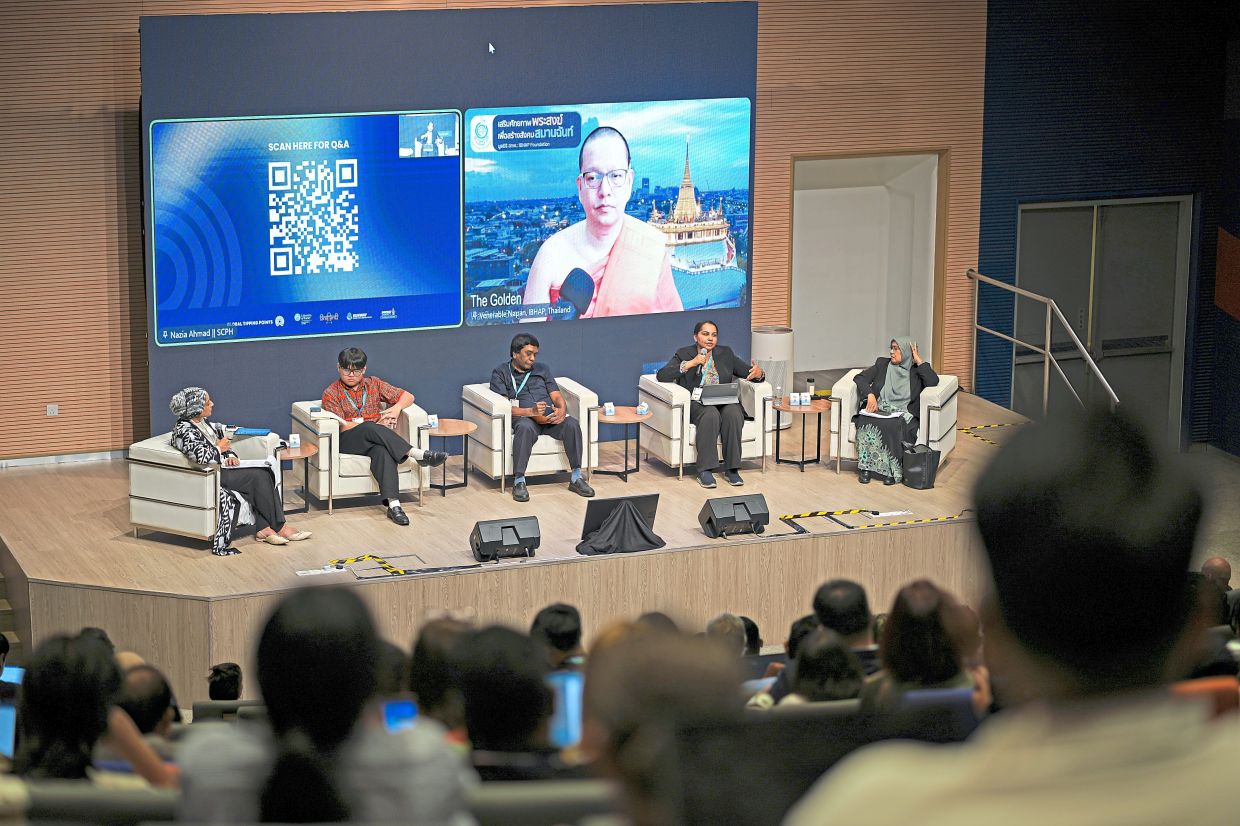
Faith, values and culture
“The forest is my bible,” declared Samuel Nullai Sawa, a research analyst at Sunway Centre for Planetary Health who hails from Borneo. “The mountain is my pilgrimage. The water is my family. That’s where my grandmother spent most of her time and if I want to continue the lessons I learned from her, then that’s my responsibility (to protect nature),” he added.
Speaking from an indigenous perspective, Samuel Nullai brought a personal dimension to the plenary on “Faith, Values and Culture as Enablers of Tipping Points”.
The session, which brought together representatives from different faiths, explored how cultural belief systems, faith traditions, education and storytelling shape collective behaviour at scale.
Prof Azizan called for a greater link among faith, knowledge and action.
“Faith tradition should step up in terms of bringing together their faith, scientific knowledge and the intention of their deeds.”
Inter-faith Coalition for Peace secretary-general Rev William P. Ebenezer Joseph shared a similar sentiment, pointing to a disconnect between what we know and our actions.
“All the knowledge, the science, the research, all what we have heard makes our brain full.
Our head is full of knowledge, but faith takes you down to the heart. The compassion, the things that push you, that enable you to take a risk even if it is not rational.
“In religious communities, I find the heart at work. Not that they don’t have knowledge, but they don’t have the knowledge that we are speaking about here today. So there needs to be a connection between the knowledge and what will push you into action.”
Peace train to a living planet
All kinds of people, all kinds of people, all kinds of people make up my life.
All kinds of faces, all kinds of faces, all kinds of faces show me their love.
All kinds of lanterns, all kinds of lanterns, all kinds of lanterns light up the dark.
But there’s only one God, only one God, who has a place in my heart.
Cat Stevens crooned, strumming on a guitar.
The British singer-songwriter, who converted to Islam in 1977 and adopted the name Yusuf Islam, described the meaning of his song All Kinds of Roses: “You could interpret it as being the earth speaking, but more than that, it’s got just a beautiful message.”
During the half-an-hour chat with Dr Jemilah at GTP 2026, he discussed the human dimension of the climate crisis and the values, faith and culture that societies draw on when they choose to change.
He shared that he was hospitalised and isolated for tuberculosis when he read a Buddhist-inspired text that sparked his exploration of inner consciousness. Later, inspired by an article about the ecological state of the world, he wrote Where do the Children Play? in 1969, a song about rapid industrialisation at the expense of nature and children’s play spaces.
“It was about the same time that the jumbo jet (Boeing 747) started to fly.”
Stevens shaped his songwriting around the continuous search for spiritual perspectives on life.
“We know that there’s somewhere better to go to than where we are, and so that was my task, and I started writing songs reflecting my journey.
“The door to change – you call it tipping point, door or whatever you want to call it – it’s a moment when actually you change rather than expecting the world to change.”
Education, he said, is soft power. “The way to get to a tragedy before it hits you ... you can learn, you can get from other people’s experience. And I think one of the most important things for that chase, if it’s not going to be the self-wake before we get there, is education and bringing back spirit into education.”
In his song King of A Land, released in 2023, Stevens talks about the responsibility of kings, leaders and influencers in taking the responsibility for change and to start thinking differently about how to run this planet and how to inspire people.
“I’m kind of directing in a way that leaders should know that there’s one above them and be careful about the people who are below them. That’s basically the responsibility of any good leader.
“And the first and biggest responsibility, I think, is the education of the next generation and the education policies,” he shared.
Positing that music and culture can cross boundaries that institutions sometimes cannot, Dr Jemilah asked Stevens for his views on how these forms of soft power turn values into collective action.
“Well, we’re looking now at the riots in France, right? The youth are going, ‘Hey, stop, we want change.’ The problem is that marches and music cannot change the world, but they can help steer you towards the kind of world you want or highlight, in some sense, the ideals that we seek together for a better world.”
How do we move from expressing concern for the earth to making care part of how we live? How can we say we love god, yet destroy his creations?
“The Prophet has said that you will not enter paradise until you believe, and you will not believe until you love one another. Shall I tell you how to increase that love? Spread peace,” Stevens said.
Multi-faith toolkit
Faith may have a deeper and more enduring influence on people’s values and behaviours than policy measures alone.
Faith communities also bring something the planetary health movement urgently needs: reach, trust and moral authority.
It is this belief that underpins the development of a 260-page faith-based toolkit for planetary health.
Drawing on the teachings of eight faith traditions – Islam, Christianity, Judaism, Hinduism, Buddhism, Sikhism, Taoism and indigenous traditions – the toolkit sets out action pathways and invites communities to commit to teaching, transforming, reducing harm, protecting the vulnerable, strengthening community resilience and engaging publicly.
It seeks to translate the Sunway Charter on Faith and Planetary Health into practical action, and calls for a Sunway Faith Network, a global network of faith institutions implementing the charter.
The toolkit is also packed with sermon guides, scriptural references and reflection questions to connect planetary health issues with spiritual teachings, creating opportunities for community members to learn and act together. To assess progress, it proposes an institutional audit covering energy, water, waste, food, local environment, community care and governance.
As the Sunway Sermon reminds communities, “... our faith has always understood what science now confirms: that all living beings are interconnected, and our actions toward creation affect one another.”
Access the toolkit at bit.ly/FaithToolkit.