LARGE discarded household items were among the unexpected finds retrieved from Klang River mangroves when Selangor princess and environmental advocate Tengku Datin Paduka Setia Zatashah Sultan Sharafuddin Idris Shah joined community clean-ups.
Reflecting on the scale of urban waste, she described seeing items such as office chairs and washing machines dumped directly into mangrove ecosystems as a stark reminder that environmental pollution stems directly from human activity and neglect.
Pointing to existing environmental initiatives, Tengku Zatashah emphasised that legislation works best when paired with community-wide commitment.
She noted that while Selangor has implemented bans on plastic bags and polystyrene since 2016, plastic waste remains overwhelmingly prevalent during river clean-ups.
Highlighting that long-term environmental impact requires personal accountability alongside policy, she noted a crucial need for a shift in public mindset towards everyday environmental habits, observing that society often expects others to clean up after them.
She urged a collective shift towards proactive, preventive care, rather than waiting for issues to escalate.
“When it comes to enforcement, we all have to take accountability. There is this mentality where people assume someone else is going to clean up after us.”
Beyond physical waste, she emphasised the human dimension of climate risks in flood-prone townships like Taman Sri Muda, pointing out that recurring flash floods impose a lasting psychological burden on residents alongside economic losses.
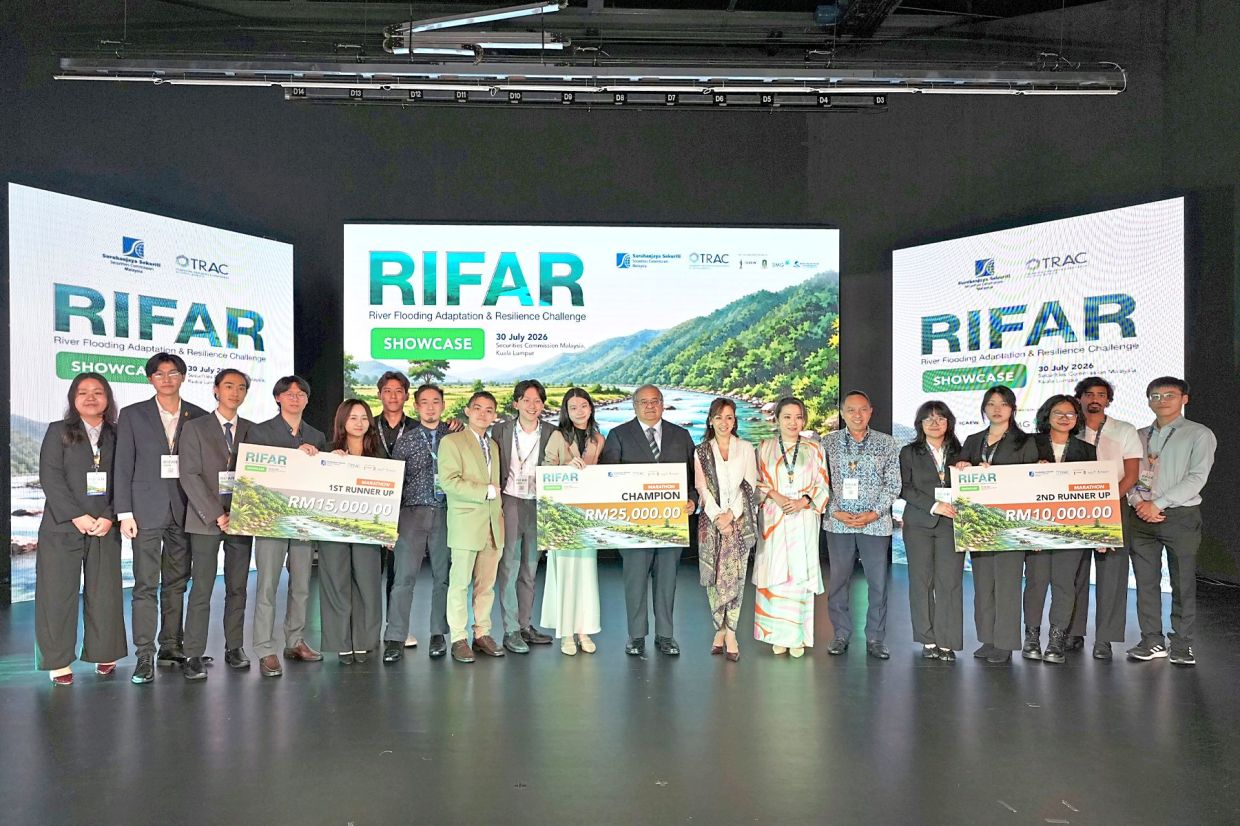
Speaking as the guest of honour at the Securities Commission Malaysia’s (SC) River Flooding Adaptation and Resilience (Rifar) University Challenge showcase on July 30, 2026 – an event attended by 250 representatives from government, financial institutions, academia and student groups – Tengku Zatashah’s observations framed a wider national reality: ground-
level clean-ups alone cannot solve a crisis of this scale.
Scaling capital for climate resilience
Malaysia’s adaptation financing needs by 2050 are estimated at close to RM3.5 trillion at the very minimum, according to projections in the World Bank’s Malaysia Country Climate and Development Report. This is in addition to a projected RM1.3 trillion required for the energy transition under the National Energy Transition Roadmap (NETR).
Addressing the audience, SC chairman Datuk Mohammad Faiz Azmi made it clear that public coffers alone cannot carry this burden.
“For policymakers and regulators such as the SC, who look after the capital markets, our role is to help facilitate the funding of the various initiatives we need to both reduce emissions and at the same time build resilience,” he said.
He noted that public funds alone cannot bridge a gap of this magnitude, making capital market intervention essential. Under the SC’s Capital Market Masterplan 2026–2030 (CMP), sustainability stands as a central pillar to facilitate private capital deployment for resilient projects.
However, SC engagements reveal that early-stage climate solutions remain difficult to finance due to marginal bankability and limited commercial viability, creating a core bottleneck in developing mature, investment-ready project pipelines.
“No single capital pool can meet these needs alone. Adaptation financing will likely require a blended finance approach. This is because the viability of projects depend on public sector involvement and patient capital or credit enhancements, to de-risk projects before private capital can follow,” he explained.
To address the challenges of deal structuring, he added that regulatory efforts will focus on unlocking new pools of concessional and philanthropic capital to effectively crowd in private sector financing.
Mobilising young minds
To operationalise these principles and nurture bankable solutions, the SC leverages market-led challenges to bridge university minds directly with corporate industry and regulatory framework designers.
Building directly on last year’s Coastal Flooding Adaptation and Resilience (Cofar) Challenge – which tackled coastal erosion – the SC moved inland this year through Rifar to focus on severe flood exposures in the Klang River Basin, specifically Taman Sri Muda.
Conducted in partnership with ICAEW Malaysia, Lembaga Urus Air Selangor (LUAS), Landasan Lumayan Sdn Bhd (LLSB) and the Jeffrey Sachs Centre on Sustainable Development, Rifar engaged around 400 students across 46 local and international universities competing for RM57,000 in cash prizes across two tracks.
The Marathon Track tasked students with constructing tangible, financially viable flood mitigation solutions, with transition co-benefits for Taman Sri Muda, following expert webinars and site assessments.
The Marathon Track top honours went to champion Team BDR (Universiti Malaya and Monash University Malaysia), with first runner-up awarded to Team Anak Sungai (Sunway University, Monash University Malaysia, National University of Singapore, and University of Hong Kong), and second runner-up going to Monash University Malaysia’s Team Blues Bond.
The Sprint Track challenged participants to generate public awareness around river health through digital media, evaluating 21 creative video submissions.
The champion title went to Team Ban Banjir, representing Sunway College, the University of Nottingham Malaysia and Monash University Malaysia.
Emphasising that “ideas matter, but implementation matters more”, Mohammad Faiz commended the participants. His sentiments echoed Tengku Zatashah’s final call to action encouraging youth to step forward, leverage their platforms and engage directly with ground-level environmental realities to drive meaningful change.