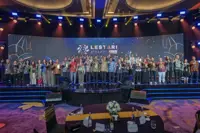
Organised by KG Media, the Lestari Awards recognise sustainability initiatives by businesses in Indonesia, from large enterprises to SMEs. Now in their third year, the awards span 14 categories covering environmental, social and broader sustainability efforts.
Here, members of the judging panel reflect on this year’s entries and the evolving approaches to sustainability across Indonesia.
Mainstreaming sustainability: Indonesia’s new direction for green innovation

Indonesia’s sustainability movement has moved beyond being merely a buzzword or a discourse on paper. The Lestari Award 2026 shows how corporations and communities are beginning to integrate sustainability into their operations. Lestari Award judge, Indonesian Society of Sustainability Professionals (IS2P) chairman, director and Sustainahaus principal consultant Satrio Dwi Prakoso (pic) shared his reflections on the new direction of green innovation in Indonesia.
From charity to core strategy
In assessing 43 submissions in the Large Enterprise category for environmental issues, Satrio observed a crucial paradigm shift. Sustainability is no longer viewed as a Corporate Social Responsibility (CSR) obligation, but as an integral part of long-term business strategy.
Themes such as the circular economy, sustainable ecosystems and waste management are increasingly intertwined with economic and social value.
“Sustainability is starting to become part of business strategy, rather than just CSR activities. This can be seen in the many innovations that are directly linked to companies’ operational processes as well as community empowerment,” said Satrio.
He also highlighted how some of the most transformative solutions often emerge from simple problems encountered in everyday life. Programmes such as PepsiCo Sustainable Agriculture and Nathabumi demonstrate the integration of the circular economy directly into core business processes, rather than simply addressing waste at the end of the production chain.
“The best innovations often emerge from simple problems encountered every day. The solutions are not always complicated, but their impact can be significant,” he stressed.
Major challenges
Although more participants present measurable impact indicators, challenges remain. Satrio said the biggest challenge facing innovators is no longer a lack of ideas, but access to business models and supporting ecosystems needed to scale.
“The biggest challenge is no longer finding ideas. What is needed is more access to funding, investors and markets so that these innovations can expand and remain viable in the long term,” he explained.
Without appropriate funding, investor networks and market access, promising innovations risk remaining at the pilot-project stage. Long-term resilience depends on combining environmental impact with financially sustainable business models. The diversity of participants also signals that sustainability is no longer exclusive to a handful of entities, but is becoming a mainstream movement across industries and communities.
“From large corporations to community-based initiatives, all show that Indonesia’s sustainability movement is becoming more mature and increasingly part of the mainstream,” Satrio concluded.
Harmonising technology and humanity for true sustainability

Amid rapid modernisation and the onslaught of technology, sustainability can become trapped in cold, technical solutions. Yet the Lestari Award 2026 offers a different perspective. For judge and Angin Dampak Jaya senior advisory lead Ratna Hartien (pic), the true face of sustainability lies in an innovation’s ability to embrace the human dimension and nurture the social ecosystem around it.
Balancing two pillars
Reviewing the entries, particularly in the Small Enterprise category, Ratna identified a compelling common thread. The strongest participants did not rely on technology or community management alone. Their success came from balancing both. Technology serves as an enabler while people remain at the heart of the change it drives.
“No participant won simply because they managed their technology well or focused on people alone. Both elements need to be present and kept in balance,” Ratna said.
Multiplying grassroots
This year’s entries showed significant progress in areas such as the circular economy, waste management and sustainable agriculture. More importantly, participants were not focused solely on environmental improvements. They were also developing solutions that create genuine economic opportunities for local communities. Their approaches are becoming more holistic and people-centred.
“Many solutions seek to address more than one challenge at a time, creating environmental benefits while opening up economic opportunities for communities. People are at the centre of these solutions rather than the focus being solely on technology,” she said.
Ratna also noted a significant improvement in the quality of innovation compared with the award’s early years. Participants are becoming better at translating environmental concerns into practical solutions supported by sound business models and long-term potential.
“The quality of innovation this year is very promising. More participants not only care about environmental issues but can also translate that concern into mature solutions. I am confident that we can shine at the regional level,” she said.
Optimism of young innovators
The enthusiasm and courage of young innovators are central to Ratna’s optimism about Indonesia’s green future. Sustainability is no longer merely a theory discussed in classrooms. It is about having the courage to experiment and collaborate on the ground.
“What gives me the greatest optimism is seeing more young innovators understand that sustainability is not simply an environmental issue. It is also about creating solutions that are economically viable, beneficial to communities and capable of continued growth,” she concluded.
Defining credible impact in sustainability innovation

Corporate enthusiasm for adopting the sustainability agenda is commendable. However, amid widespread green campaigns, it is essential to distinguish genuine innovation from routine operational practices.
For Angga P. Putra (pic), Lestari Award judge and acting climate and WWF Indonesia market transformation programme director, the event provides a crucial space for reflection to test whether submitted ideas deliver impactful novelty.
Assessing the entries, Angga noted that most proposals were dominated by community collaboration programmes. While well intentioned and positive, he highlighted common field limitations, particularly regarding a programme’s economic sustainability once handed over to residents.
“Innovations managed alongside communities are often limited to production, failing to build a business plan. Ideally, innovation is developed alongside a business plan, an area where community capability remains insufficient,” Angga observed.
Defining meaningful impact
A critical finding during judging was the tendency of participants to prematurely claim massive impact, even when programmes had run for only a few months. Angga stressed the importance of methodological honesty and a clear distinction between early results and long-term impact.
“Innovation does not always have to be tied immediately to impact, as impact requires running for a sustained period. Proving impact for projects under a year old is quite difficult,” he asserted.
Looking ahead, Angga urged companies not to treat sustainability programmes as mere regulatory compliance. A deeper shared understanding of innovation’s true essence is needed, alongside integrating ESG issues with concrete business value.
“Generally, participants are working towards innovation, yet lack a clear understanding of what innovation actually is. Since most entrants are corporate entities, ESG issues should ideally form an attractive component linked directly to innovation,” he stated.
These critical observations are intended not to discourage progress, but to mature Indonesia’s green ecosystem with greater integrity. Clear timeline indicators and valid verification tools will ensure every sustainability step remains truly accountable.
“Moving forward, strong timeline indicators are necessary when measuring impact. If measuring implementation and immediate results, a timeframe of under one year is appropriate,” Angga concluded.