THE nation’s favourite chocolate malt drink brand is proving that sustainability does not have to be an abstract concept for children.
It can be a bench they sit on, a basketball hoop they shoot into or a ping-pong table they play on at recess.
Milo Malaysia officially launched the second edition of its Milo Energy For Good programme, expanding the initiative from 200 schools in 2025 to more than 300 schools across 13 states this year.
The launch, which also coincided with the 2025 Benefit Award Presentation Ceremony, was held at SJK (C) La Salle in Kuala Lumpur on Aug 12.
Milo Energy For Good is a component of the CAREton project, a used beverage carton (UBC) recycling partnership between Tetra Pak and Milo that began in 2012.
As of last year, the project has collected 515 million UBCs in collaboration with local municipal councils, educational institutions and retailers, and has repurposed the recovered material into polyethene-aluminium (polyAl) roofing sheets, panel boards, school sports equipment and classroom furniture.
Since the project’s inception, 133 buildings have been built with polyAl roofing sheets nationwide.
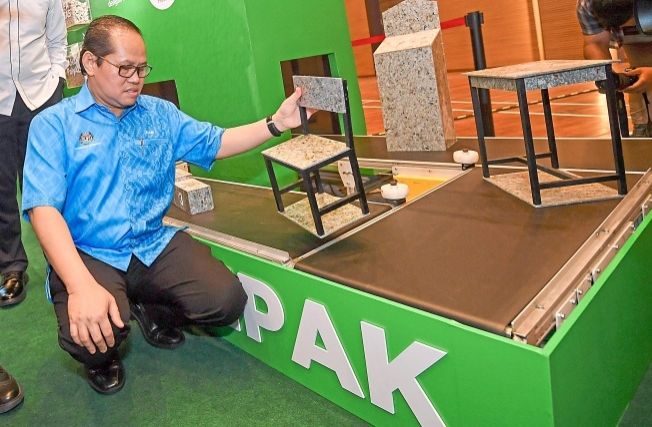
What sets the campaign apart, however, is that it has been recognised nationally not simply as a functioning recycling programme, but as a pioneering example of the circular economy – closing the loop by turning UBCs from schools directly back into classroom and school resources.
While the broader CAREton project drove macro-level impact, Milo seeks to foster a closer connection with students.
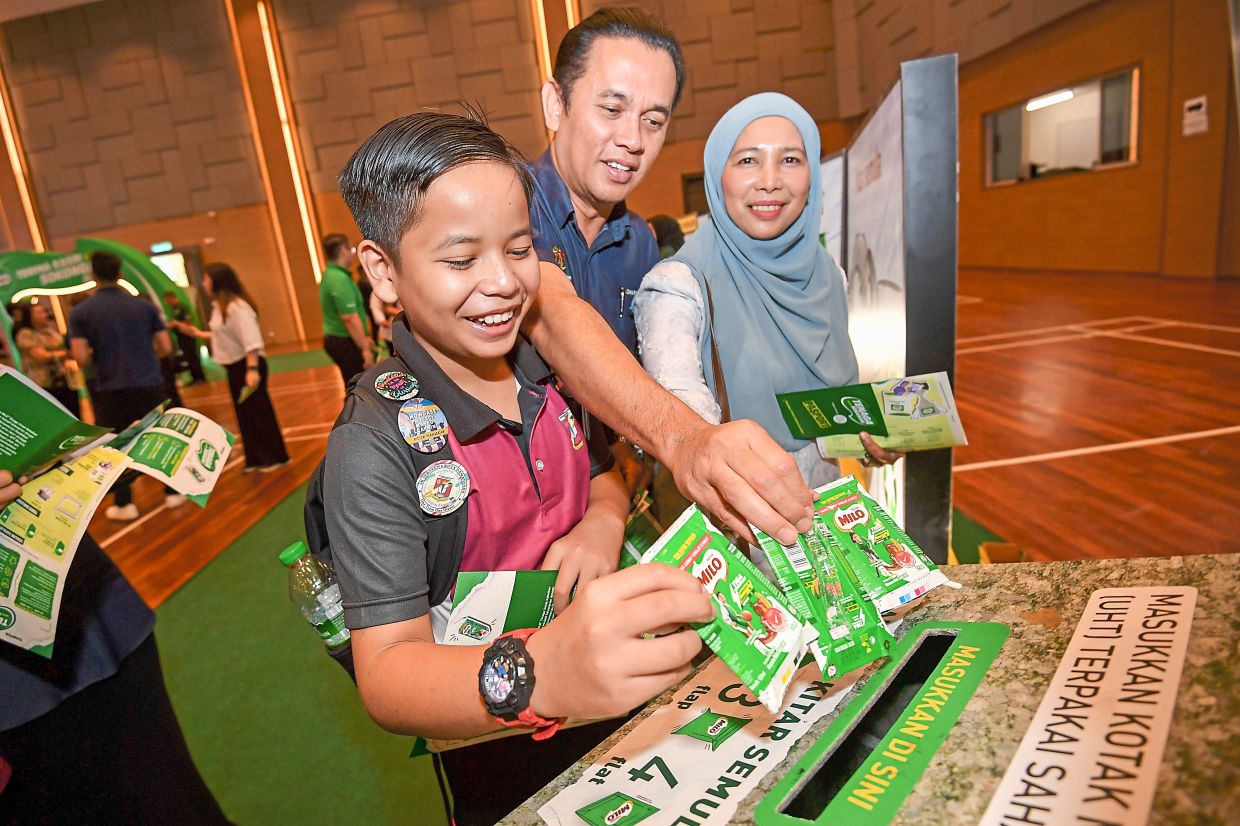
The Milo Energy For Good makes the impact of recycling tangible. It ensures students directly experience the circular economy and the fruits of their efforts right inside their own schools, utilising the products their recycled UBCs helped create.
Last year’s inaugural Milo Energy For Good programme collected approximately 300,000 pieces or 4,237kg of UBCs, with redemptions including basketball, track and field, ping-pong and classroom sets.
Turning ‘used’ into useful
The mechanics of the programme are simple. Students collect UBCs and earn points based on weight – one point per kilogramme of general UBCs and three points per kilogramme of Milo UBCs specifically.
Before dropping off their UBCs, students are taught to prepare them using a simple four-step method: insert the straw after drinking, flip the sides up, flap the bottom and flatten it.
Those points can be redeemed for sports equipment and classroom sets manufactured from recycled polyAl boards.
Among this year’s polyAl items are:
> Track and field set (150 points):
10 hurdle barriers, a winner’s podium, training and disc cones, and batons.
> Ping-pong set (200 points):
One multifunctional ping-pong table, four bats and three ping-pong balls.
> Netball set (300 points):
One netball post and ball trolley, and six netballs.
> Classroom set (200 points):
10 sets of tables and chairs.
This year, Milo distributed 1,000 sets of eco-friendly tables and chairs to acknowledge and give back to schools nationwide that showed strong participation in last year’s edition.
State education departments from Kuala Lumpur, Selangor, Putrajaya, Penang, Kedah, Pahang, Terengganu and Kelantan received their allocations to distribute among schools during the event, as part of the 2025 Benefit Award Presentation Ceremony.
Additionally, a friendly competitive element keeps the programme’s momentum going as schools vie for the highest average points at both state and national levels.
The winners at both state and national levels will each receive a trophy, certificate of recognition and an RM1,000 cash prize.
State-level collections run for three months till Oct 15, after which state champions advance to the national round from Oct 19 to 26, where they must submit videos showcasing their recycling journey, creativity and learning outcomes.
All participating schools also receive points for the Physical Activity, Sports and Co-Curriculum Assessment.
Sustainability: An extension of Milo’s DNA
For Milo, sustainability is not a recent pivot, but a continuation of a legacy.
Speaking at the launch, Nestle Malaysia, Singapore and Brunei chief executive officer Juan Aranols framed the programme not as a new direction for the brand, but as an evolution of CAREton, and more broadly, as part of nearly 80 years spent championing active, community-driven lifestyles among Malaysians.
“We believe sustainability should be practical, accessible and rewarding. Through this initiative, we are helping students see that every recycled beverage carton can contribute to something meaningful for their schools and communities.
“By encouraging students, teachers and families to make recycling part of their daily routines, we hope to inspire habits that last well beyond the classroom,” he said.
Aranols added that the programme’s growth reflects the recycling habits it has helped build, and the bonds it has fostered among teachers, students, parents and communities working towards a shared goal.
“It is about empowering young Malaysians to take action, work together and recognise that small efforts, when multiplied across communities, can create a meaningful impact for the environment,” he said.
Also present at the ceremony were Education Ministry director-general Datuk Dr Mohd Azam Ahmad, who officiated at the event, and co-curricular and arts management sector deputy director Mohd Kamal Hashim, alongside Tetra Pak Malaysia sales director Yew Teong Koh and Milo Malaysia business executive officer Ng Su Yen.
Closing the loop
Milo Energy For Good speaks to a broader Scope 3 emissions agenda.
Post-consumer packaging falls outside of the company’s direct operational control. Yet, it still counts toward its extended environmental footprint.
By building an infrastructure that recovers this packaging and converts it into usable goods, the brand is addressing a downstream emissions category that is often one of the hardest for consumer brands to influence, while simultaneously giving schools tangible, durable assets in return.
The programme’s growth trajectory suggests that the model is scaling sustainably rather than as a one-off activation.
Recycling and sport have long been part of Milo’s brand identity in Malaysia, and Milo Energy For Good gives students a tangible reason to connect the two.
As this year’s collection gets underway, the real measure of success is when more schools and students come to see UBCs not as rubbish, but as a building block for their classrooms and playing fields.