
News of El Nino has loomed large since 2026 began, with forecasts suggesting that it could intensify into a “super” El Nino that may push global temperatures to new highs.
What is El Nino? Spanish for “the Little Boy”, it refers to the climate phenomenon resulting from unusually warm ocean surface temperatures in the central and eastern Pacific Ocean.
La Nina, in contrast, is characterised by unusually cool ocean surface temperatures in the same region.
Malaysians have been warned that the El Nino is expected to peak between November and January, bringing higher temperatures, prolonged dry spells and reduced rainfall. These conditions could trigger water shortages, fires, haze and lower agricultural productivity.
The Malaysian Meteorological Department has forecast that temperatures in the country could climb to 40°C early next year. According to weather data, the highest temperature ever recorded in Malaysia was 40.1°C in Chuping, Perlis, during a strong El Nino in April 1998.
With extreme heat, buildings that are not designed to cope with higher temperatures can become uncomfortably hot. The instinct may be to stay indoors and turn up the air conditioning, but this raises an important question: how can buildings be designed or retrofitted to remain cool, energy-efficient and resilient in a warming climate?
While there are various strategies to reduce indoor temperatures, experts say there is no single solution. While measures such as improving ventilation, using reflective materials and incorporating greenery can help reduce indoor temperatures, their effectiveness depends on how they work together.
A holistic approach that addresses these interconnected factors is essential to create buildings that are climate-resilient and energy-efficient.
5 fundamental strategies for energy-efficient building design
According to Prof Dr Lim Chin Haw, research clutter lead for net-zero buildings and cities from Taylor’s University’s Faculty of Innovation and Technology, passive building design relies on five fundamental strategies: orientation, shading, daylighting, insulation and landscaping.
1. Orientation
Positioning a building in relation to the sun’s paths
2. Shading
Use of hoods to protect windows or other openings from the sun
3. Daylighting
While natural light reduces artificial lighting needs, it can bring in heat. Advanced technologies resolve this trade-off with:
Spectrally selective glass: Blocks infrared radiation and allows a narrow band of daylight to come into the building.
Low-emissivity (Low-E) glass: Features a special coating to prevent the glass from emitting heat.
4. Insulation
Roof insulation is among the most important energy-efficiency measures. In Malaysia, energy efficiency is regulated under By-Law 38A of the Uniform Building By-Laws (UBBL), which incorporates Malaysian Standard MS 1525:
- Overall Thermal Transfer Value (OTTV): Measures heat gain through building envelope.
- Roof Thermal Transfer Value (RTTV): Measures heat gain transferred specifically through roof assemblies.
- U-value vs R-value: U-value measures how much heat transfers through a building material, while R-value measures its thermal resistance.
- Regulatory threshold: Under the UBBL, roof assemblies must achieve a U-value below 0.4 W/m²K.
5. Landscaping
Urban greenery helps mitigate urban heat island effect and reduce ambient temperatures, as demonstrated by initiatives like Singapore’s Skyrise Greenery scheme.

Ventilation strategies for buildings
While preventing heat is essential, it is equally important to move hot air out for thermal comfort in hot, humid climates.
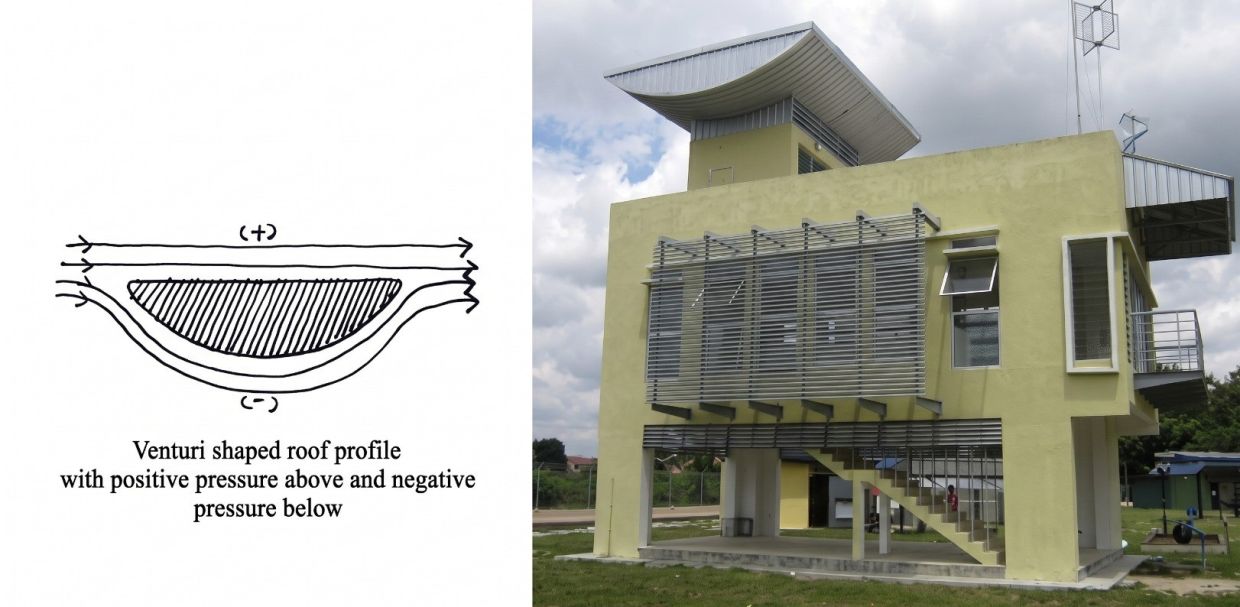
In a 2012 paper co-authored with researchers from Universiti Kebangsaan Malaysia’s (UKM) Solar Energy Research Institute, Prof Lim evaluated a wind-induced natural ventilation tower on a two-storey building.
- Challenge: Modern buildings are not equipped with passive architectural features for natural ventilation, except through windows and doors.
- Wind-induced natural ventilation: The tower uses an inverted airfoil roof geometry design to leverage the Venturi effect. As wind passes over the roof, it generates a negative pressure to draw air from below, pulling the air through the building and out through the tower.
- Performance:
- Baseline (by simulation): 7 ACH (air changes per hour, the number of times the entire volume of air in a given space is replaced completely in 60 minutes)
- With ventilation tower (empirical data): Daily average increased to between 45 ACH and 75 ACH
- Conclusion: The Venturi shaped roof wind induced natural ventilation tower can produce sufficient low pressure required to induce fresh air from outdoor into indoor spaces, demonstrating great potential for application in buildings under hot and humid climate.
For landed homes, Prof Lim recommended incorporating a central courtyard for intermediate terraced homes to enhance natural daylighting and ventilation.
Climate-resilient school upgrade in Malaysia
Besides residential homes, schools are another type of building that warrants thermal retrofits as temperature rises.
The National Green Schools Programme (Program Sekolah Hijau Kebangsaan), aims to transform existing schools into healthier, more climate-resilient and ultimately zero-carbon learning environments.
The Malaysia Green Building Council (malaysiaGBC) studied 10 schools in Kuala Lumpur, utilising building surveys, energy audits, indoor environmental quality assessments and computer simulations to evaluate the effectiveness of different retrofit strategies, according to malaysiaGBC chief executive officer Mitch Gelber.
Key priorities include:
- Improving thermal comfort
- Enhancing natural ventilation and air movement
- Reducing solar heat gain and glare
- Maintaining good daylight
- Optimising energy performance
Among the challenges identified were:
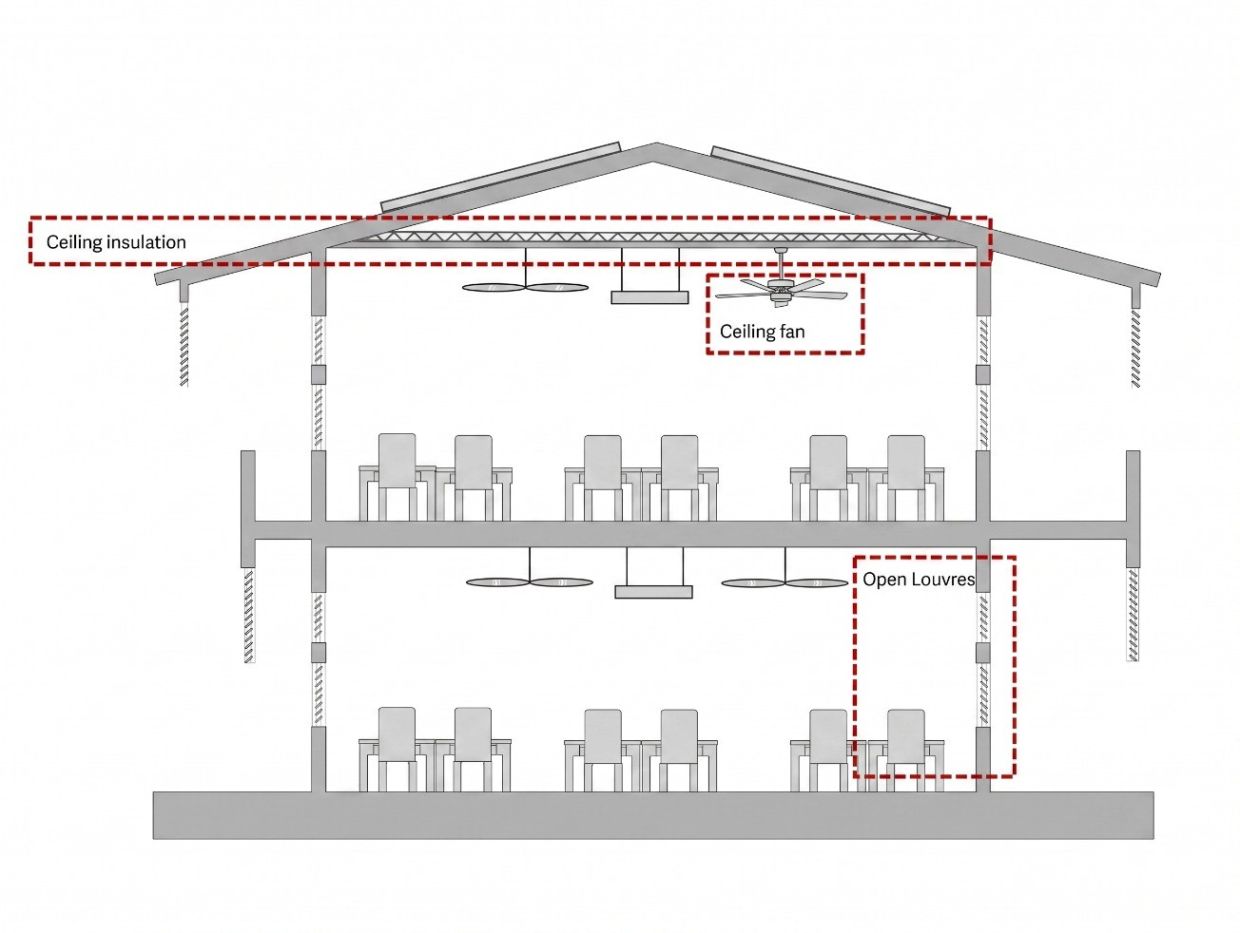
- Low thermal comfort: Under typical naturally ventilated classroom conditions with the existing ceiling fans, classrooms may be thermally comfortable for only around 47% of occupied hours.
- Low air quality: In air-conditioned classrooms, closing windows without providing adequate fresh air ventilation can lead to periodic spikes in carbon dioxide concentrations exceeding recommended levels.
- Lighting trade-offs: Using curtains reduces direct sunlight and heat gain, but results in a reliance on artificial lighting that is less than ideal for teaching and learning.
MalaysiaGBC has identified a range of practical interventions, which include:
- Improving air movement through higher-performance ceiling fans
- Reducing heat gain through roofs and facades
- Introducing external shading
- Optimising natural ventilation
- Improving daylighting and lighting
“By reducing heat gain and improving air movement, classrooms can remain comfortable for longer while consuming significantly less energy.
“This is a more sustainable and climate-resilient approach because it improves the building’s underlying performance, rather than simply relying on additional mechanical cooling,” Gelbert said.
Next steps of the programme include:
Implement pilot retrofit projects
Validate their performance under real operating conditions
Use the lessons learned to refine a scalable national framework for upgrading schools across Malaysia
The National Green Schools Programme is a national initiative supported by the Natural Resources and Environmental Sustainability Ministry, the Education Ministry and the Kuala Lumpur Education Department.
Phase 1 was delivered with technical expertise from IEN Consultants Sdn Bhd and funding from the Danish Trade Council under the Ministry of Foreign Affairs of Denmark and the United Nations Development Programme – GEF Small Grants Programme.
Climate-resilient communities and urban heat management
Similar urban heat mitigation efforts are unfolding across communities, where multi-sector partnerships see residents and experts working together to build climate-resilient communities.
In Melaka, a climate resilience initiative led by Majlis Bandaraya Melaka Bersejarah (MBMB), the Z Zurich Foundation, Zurich Malaysia and Resilient Cities Network, is tackling indoor heat for residents of Rumah Pangsa Pantai Peringgit.
Challenge: Through heat sensors installed in over 40 homes, researchers from Nanyang Technological University’s Asian School of the Environment found that indoor temperatures remained as high as 29°C even after outdoor air had cooled.
Cooling strategies: To reduce indoor heat, the initiative applied Dulux heat-reflective paint on the exterior walls and introduced urban greening.
Heat emergency response training: In collaboration with Monash University and St John Ambulance of Malaysia, the project trained an initial cohort of 36 participants, including volunteer responders, paramedics and paramedic trainers, with the knowledge and skills to stay cool, recognise heat-related illnesses and respond to cases of heat exhaustion or heatstroke.
Heat-reflective paint coatings
Heat-reflective exterior paint coatings is a practical and scalable passive cooling solution to mitigate urban heat at the building envelope level – walls, roof, windows and doors separating a building’s interior from the exterior environment.
According to AkzoNobel Malaysia commercial head Craig Tham, conventional exterior paints – particularly darker colours – generally absorb and retain more solar heat, causing wall surfaces to become hotter.
The KeepCool Technology in Dulux Weathershield products uses specially selected pigments and formulation technology to reflect more solar radiation away from the painted surface, he added.
Performance: Laboratory and product tests have shown that KeepCool Technology can reduce exterior wall surface temperatures by up to 5°C under certain conditions.
Benefits: Lowering wall surface temperatures help reduce heat transfer into buildings and support improved indoor comfort.
“Their effectiveness is often strongest when combined with complementary measures such as ventilation, shading, insulation, greenery and thoughtful building design.
“By lowering wall surface temperatures, reflective coatings can help reduce heat transfer into buildings and support improved indoor comfort,” he said, adding that actual outcomes may vary depending on building and environmental conditions.