Aviation is widely regarded as a hard-to-abate sector, but to what extent?
“When we talk about these decarbonisation measures that we spent hundreds of millions on, we are talking about single-digit emission reduction,” said AirAsia chief sustainability officer Yap Mun Ching.
For airlines, decarbonisation efforts do not necessarily stem purely from sustainability commitments. More often, the main motive is to save costs, with emission reduction as a secondary benefit.
Fuel efficiency is a case in point. Lower fuel consumption brings down operating costs while cutting emissions, creating a strong incentive for airlines to pursue the decarbonisation path.
To decarbonise, an airline has four pathways overall: fleet renewal, operational efficiency, carbon offsetting and the use of sustainable aviation fuels (SAF).
AirAsia, for instance, has implemented about 20 flight operational measures, which, collectively, reduce fuel consumption by 2.5% to 2.7%.
“If we take all these in totality, it’s US$250mil of savings in terms of fuel,” Yap said.
Fleet replacement
As planes age, maintenance costs go up and asset values depreciate, making fleet renewal a sound business decision.
AirAsia is undergoing progressive fleet replacement, with an aim of replacing its entire fleet with newer aircraft by 2035.
It has an existing order of about 360 Airbus planes, Yap said.
She explained that newer aircrafts are more fuel-efficient, and in some cases, offer longer range and increase passenger capacity.
Fleet modernisation is also Malaysia Aviation Group’s (MAG) most impactful long-term lever.
It is progressively retiring older Boeing 737-800 NG (narrow body) and the A330-200/A330-300 (wide body), and replacing them with next-generation aircraft featuring advanced aerodynamics, lightweight composite materials and new-generation engines.
Under its Long-Term Business Plan 3.0, MAG plans to induct 55 Boeing 737-8 and 737-10 aircraft, as well as 40 Airbus A330neo aircraft by 2032.
These aircraft deliver 14% to 25% improvements in fuel efficiency per seat. The newer fleets also produce lower nitrogen oxide emissions, reduce noise footprint and improve maintenance efficiency.
DCT and RAP
MAG is focused on improving fuel efficiency and operational performance through a range of targeted initiatives, such as optimising flight routes through Direct Track (DCT).
It enables aircraft to operate more efficient, real-time optimised routes through enhanced air traffic coordination and performance-based navigation.
This translates into shorter flight distance and reduced airborne time, lower fuel burn per sector, immediate carbon emissions avoidance and improved on-time performance.
Even marginal route optimisation can yield significant emission savings across the network, it added.
MAG, through its ground handling arm AeroDarat Services (ADS), is also accelerating the electrification of ground operations.
ADS accounts for approximately 78.9% of MAG’s ground fuel consumption. In 2023, it introduced Asia’s first electric aircraft pushback tractor, followed by Remote-Controlled Aircraft Pushback (RAP) in 2024 using battery-powered Mototok units, replacing conventional diesel tow tractors.
ADS observed a reduction of up to 10 tonnes of CO2 annually per unit, besides reducing noise and diesel exhaust emissions.
Combo units
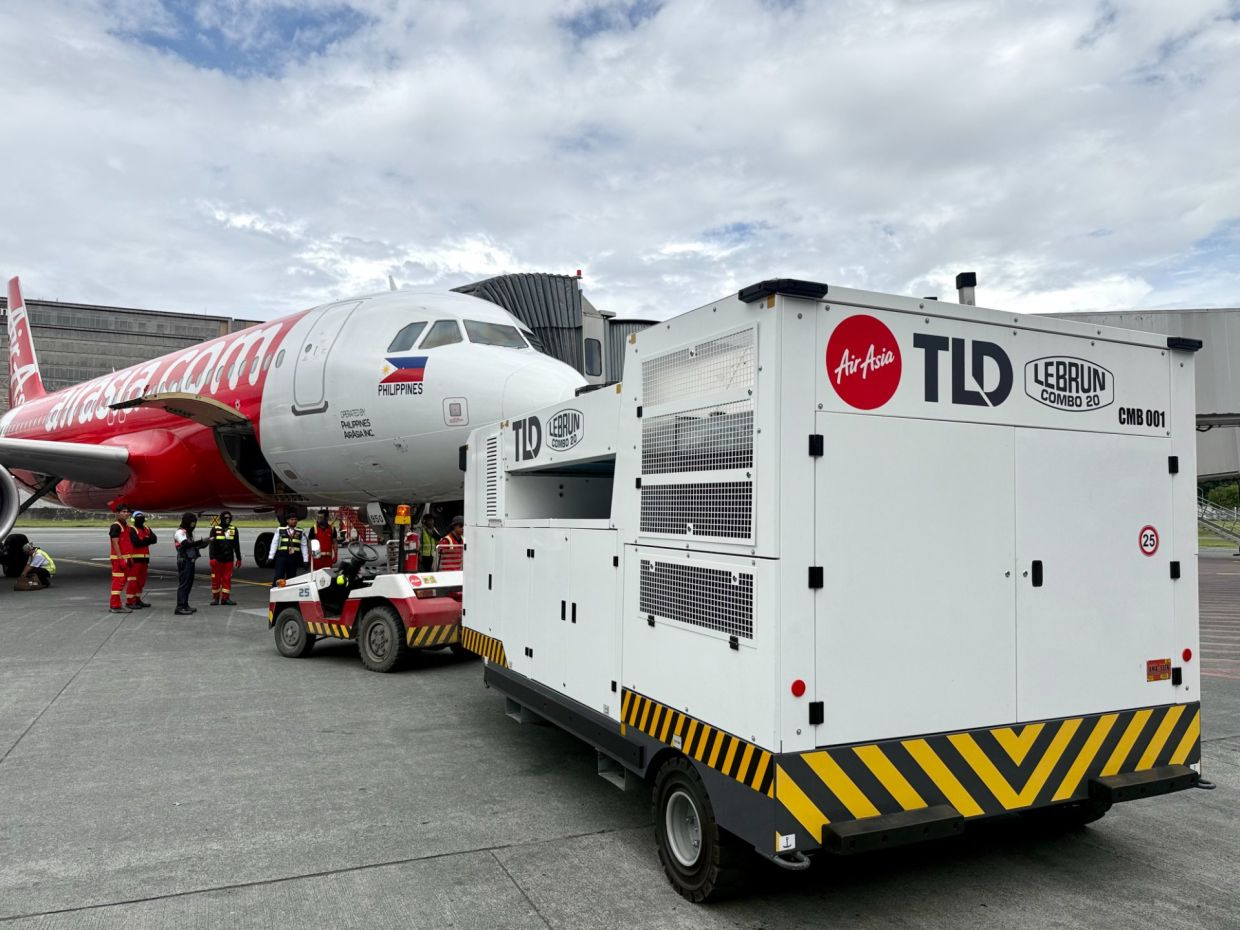
AirAsia uses diesel-powdered combo units to provide for electrical and air-cooling needs of an aircraft while it is stationary on ground before a flight.
Without a combo unit, an aircraft relies on the use of its auxiliary power unit (APU) to perform the same functions, but this is costly and carbon-inefficient because APUs are powered by aviation turbine fuel.
Combo units could lead to 90% reduction in emission from ground operations.
Yap added that while electric combo units are available, airports currently lack charging facilities. Ideally, these units would be recharged using renewable energy.
Aerowash
Aircraft are taken out of service when an exterior clean-up is necessary, which is why they are washed infrequently.
The process is also labour intensive.
However, accumulated dirt increases aerodynamic drag, reducing fuel efficiency, Yap explained.
Enter Aerowash, a dry-wash technology that cleans jets more quickly and with fewer workers.
Previous data from the Scandinavian high-tech company showed that a wide-body plane can save 1% to 2% of emissions, Yap shared. While this appears modest, the impact is significant in terms of cost saving.