
ONE of the biggest grouses among those opposed to data centres (DCs) relates to energy consumption. Their concern is that meeting the voracious electricity demand of these facilities will require the country to build more power plants and expand its power infrastructure.
If the additional costs are not fully borne by DC operators, some could eventually be passed on to all electricity consumers, including ordinary households and existing businesses.
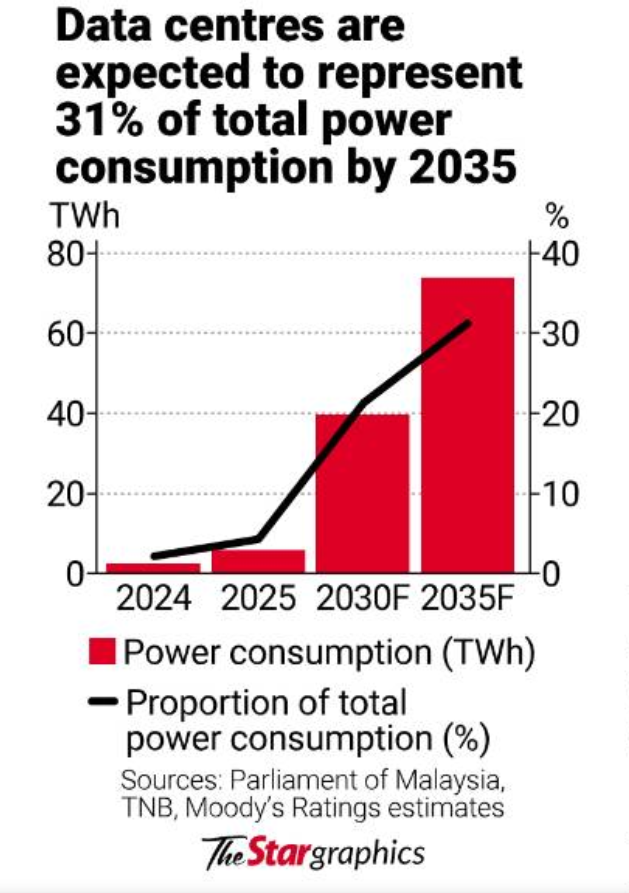
The scale of the potential demand is significant. The government’s projections show that DCs could account for 31% of total electricity consumption in Peninsular Malaysia by 2035, up from just 4% in 2025.
So, when Investment, Trade and Industry Minister Datuk Seri Johari Abdul Ghani told the media this week that ordinary citizens and legacy businesses would neither directly nor indirectly subsidise DC infrastructure costs, it must have come as a relief.
But how will this be ensured? One of the measures introduced in 2025 was the Ultra High Voltage (UHV) tariff for large electricity users such as DCs.
Based on analyst estimates, DCs could pay an effective average rate of around 60 sen per kWh under the UHV tariff, roughly one-third higher than the current average base tariff of 45.40 sen per kWh.
Industry veteran Nirinder Singh Johl tells StarBiz 7 that the introduction of voltage-based tariffs in July last year is in line with global practices.
This is because electricity charges are based on the voltage level at which customers connect to the grid, allowing tariffs to better reflect the cost of supplying different categories of users. He adds that this should also facilitate more targeted cost recovery from the sector.
Johari also highlighted the government’s efforts to address what it calls “phantom demand”, where DC developers reserve large blocks of electricity capacity without fully utilising them.
Reserving capacity carries a cost for the power system, as Tenaga Nasional Bhd (TNB) may need to plan and invest in grid infrastructure and ensure sufficient generation capacity to meet the requested demand, even if a developer eventually uses less electricity than it has reserved.
To discourage such practices, the government has raised the connected load charge from RM8.50 to RM89.64 per kW, the minister said.
But could there be more to the story, or more specifically, to the calculation of electricity tariffs for all?
Economist Anthony Dass says the government’s assurance that other consumers will not bear the burden of rising electricity demand from DCs depend on how the additional infrastructure costs arising from this demand are allocated.
Under Malaysia’s electricity pricing system, he says TNB can recover approved and efficient costs through regulated electricity tariffs, while power producers are paid for electricity supplied under their respective agreements.
“But even if DCs pay for their own connections, some wider infrastructure costs could still be shared with households and existing businesses. The government must, therefore, ensure that these costs are clearly identified and recovered from DC operators,” Dass tells StarBiz 7.
First, a look at how the costs of supplying electricity are factored into tariffs.
In Peninsular Malaysia, electricity tariffs are regulated by the Energy Commission (EC) under the Incentive-Based Regulation (IBR) framework.
The EC assesses the costs of supplying electricity and determines the tariffs, subject to the approval of the Energy Transition and Water Transformation Minister.
These costs comprise electricity generation and delivery to homes and businesses through the electricity network.
The former covers payments to power producers for the electricity they generate, including the fuel used to run their power plants.
The latter covers the upkeep and expansion of the network, including transmission lines, substations and distribution infrastructure.
Under the current Regulatory Period 4 (RP4), which runs until December 2027, about 70% of the average base tariff of 45.40 sen kWh goes towards generation costs, while the remaining 30% covers network and retail costs.
So rising demand from DCs could require further investment in both power generation and electricity infrastructure.
Under the IBR framework, TNB is allowed to recover the cost of these investments through tariffs, together with an approved return on its assets.
Generation costs also include fuel expenses incurred by power producers to run their plants.
Changes in fuel prices and other generation-related costs are reflected through the Automatic Fuel Adjustment (AFA) mechanism, which adjusts electricity charges monthly.
Depending on whether these costs rise or fall, consumers may face an additional charge or receive a rebate.
The gas element
Natural gas is a key part of this equation, as it is one of the main fuels used to generate electricity in Peninsular Malaysia, with much of the additional generation capacity expected to come from gas-fired power plants.
But a crucial question is whether there will be sufficient gas to fuel these new plants and, if so, at what price.
Moody’s Ratings, in a recent report, notes that meeting the government’s projected DC-related electricity demand of around 73 TWh by 2035 could require an additional 14GW to 17GW of power generation capacity.
Peninsular Malaysia’s installed capacity stood at 28GW in 2025.
The rating agency estimates that this would entail generation investments of around RM80bil to RM95bil over the next decade, to be undertaken by TNB and independent power producers (IPPs).
The estimate assumes that the additional electricity demand will be met predominantly through firm capacity, essentially gas-fired power plants, as opposed to intermittent capacity such as solar.
However, the investment requirement could be lower if renewable energy (RE) and battery storage play a bigger role in meeting the demand.
To meet this anticipated demand, the EC has been calling for new gas-fired power plants to be built.
“The issue of gas supply is becoming more pressing as Malaysia prepares to add new gas-fired generation capacity. While the power purchase agreement (PPA) extensions will keep existing plants running for several more years, the new plants will require additional fuel supplies over the longer term.
“Where will the gas to fuel these plants come from, and how much will power producers have to pay for it?,” an industry player asks.
This is crucial, as the answers will determine the overall cost of electricity generation, which in turn feeds into the calculation of electricity tariffs.
However, the country’s domestic gas resources are facing supply constraints, increasing the need to source additional supplies, including liquefied natural gas (LNG).
An important development is the expiry of the Gas Framework Agreement (GFA) between Petroliam Nasional Bhd (PETRONAS) and the power sector at the end of 2027.
The agreement governs the supply of domestic gas to power plants under a tiered pricing arrangement.
The arrangements for gas supply and pricing beyond that date are still under review, with the EC having sought industry feedback on the future market framework.
However, one industry player says the expiry of the GFA does not necessarily mean power plants will immediately have to pay full market prices for all their gas requirements from 2028.
“The eventual impact on generation costs would depend on the post-2027 supply and pricing arrangements, as well as the availability of domestic gas.
“Declining domestic gas production could increase the power sector’s reliance on imported LNG, which is exposed to international price movements and foreign-exchange fluctuations,” the industry player says.
Off-grid solution
Coming back to the DC story, it is noteworthy that the government has imposed a requirement on recently-approved DCs to have their own on-site energy production.
This means that these DCs have to find off-grid solutions to meet their needs.
This is clearly a step in the right direction, as it would decouple the capital expenditure (capex) on energy generation from the calculation of electricity tariffs in the country.
However, some sources tell StarBiz 7 that a few of the 27 DCs recently made subject to this requirement have obtained waivers from the government.
This is reportedly on the grounds that they had already invested substantial sums in their projects and that it would be unfair to require them to build their own power plants at this stage.
These players are instead being allowed to enter into energy supply agreements with TNB, the sources say.
It is also understood that those required to comply strictly with the “captive energy” requirement have made limited progress, given the huge capex involved and the scarcity of gas turbines.
An industry expert has raised a critical counterpoint to the government’s official stance. While policymakers say DCs are “ring-fenced” so everyday Malaysians don’t subsidise them, basic market dynamics and constraints on gas supply mean that DCs could still push up energy prices for everyone.
It is noteworthy that DCs are also looking to meet some of their energy needs through solar power, supported by battery storage. However, solar alone is insufficient to power DCs around the clock.
As one industry expert estimates, a 1GW DC development occupying 250 acres could require between 20,000 and 25,000 acres of solar installations to support a 24-hour power supply.
Such a large area of land is not readily available to DC developers entering Malaysia today.
Indirect cost spillovers
But would tariffs rise even without DCs?
“Yes, largely because of gas supply. Malaysia’s peninsular gas reserves are declining. Even without DCs, Malaysia has a fixed pool of cheap domestic piped gas,” the expert says.
However, DCs create massive incremental demand.
“Because the cheap domestic gas allocation is already spoken for, generating extra electricity for DCs forces power plants to buy more expensive imported LNG at international market rates. When scarce supply meets surging demand, baseline market prices rise across the board,” the expert explains.
He also argues that while the government’s UHV tariff successfully prevents DCs from receiving direct retail discounts, indirect cost spillovers remain unavoidable.
This is because surging demand from DCs forces Malaysia to rely more heavily on costly imported LNG and invest in significant grid expansion. This tightens supply and pushes up baseline energy costs for the entire country, he says.
Bank Muamalat Malaysia Bhd chief economist Mohd Afzanizam Abdul Rashid tells StarBiz 7 that at the end of the day, the question of higher tariffs will depend on gas prices and the strength or weakness of the ringgit.
“Whether all this will still translate into higher electricity tariffs really depends on the prices of key commodities such as coal and natural gas, as well as the currency, as these factors will be reflected in the AFA on a monthly basis,” he says.
So, will the public and private sectors end up footing part of the bill for the rising energy demand from DCs?
The conclusion seems to be that despite government assurances that DCs will bear their own energy costs, their surging demand for electricity and the increasingly expensive imported gas needed to meet it could ultimately push up tariffs for ordinary Malaysians and businesses.
Already a subscriber? Log in
Get 20% OFF The Star Digital Access
Cancel anytime. Ad-free. Unlimited access with perks.