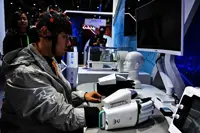
TIANJIN: On sorting lines in smart factories, at precision workstations in automobile manufacturing plants and even at home tending to household chores, a batch of robots equipped with multidimensional tactile sensors can dexterously grasp, operate and adaptively perform tasks, accomplishing movements that were once only possible for humans.
These robots, capable of sensing pressure, texture and posture, possess “tactile fingertips”, enabling artificial intelligence (AI) to transition from virtual algorithms to the real world.
This is the industrial transformation brought about by embodied intelligence, and the core “sensory organs” enabling it all originate from Tianjin.
“Robots are important carriers of AI, facilitating its transition from the virtual world to reality,” said Yin Jihui, secretary of the Hexi district Party committee.
As a national advanced manufacturing research and development (R&D) base, Tianjin is focusing on core technology research and industrial implementation of embodied intelligence robots, cultivating globally competitive industry leaders.
Paxini Technology (Tianjin) Co is one such representative example.
“The key to these logistics robots lies in our independently developed multidimensional tactile sensors,” Lin Tong, director of Paxini’ s data collection centre, said.
Currently, 80% of humanoid robots worldwide utilise Paxini’s sensors.
Tactile sensors, known as the cornerstone of the intelligent cognition and information interaction industry, have also been listed by China as one of the key critical chokepoint technologies alongside lithography machines and chips.
“Five or six years ago, similar tactile sensor products cost as much as 100,000 yuan each, severely restricting the development of the entire robot industry,” Nie Xiangru, co-founder of Paxini, recalled.
The high import costs made tactile perception a luxury, making it difficult to be commercialised on a large scale.
The Paxini team spent four to five years in R&D, successfully creating the world’s first 6D hall array multidimensional tactile sensor, transforming core technology from a heavy reliance on imports to 100% domestic self-sufficiency.
Today, Paxini’s basic tactile sensor models are priced at just 199 yuan, just 0.2% of the price of equivalent products in the overseas market.
This has made tactile perception accessible from laboratories to various industries, turning a luxury into a basic hardware accessible to everyone.
The key to reducing costs lies in optimisations in chips, structure and algorithms with each product generation, Nie said.
“The advancement of software algorithms enables us to reduce our reliance on hardware.
“When prices become cheaper, the order volume increases which means the costs can be further reduced. Naturally, the prices spiral downward.” — China Daily/ANN