
KUALA LUMPUR: Khazanah Nasional Bhd is intensifying efforts to strengthen Malaysia's industrial capabilities, talent pipeline and strategic infrastructure as global supply chains continue to shift amid geopolitical tensions and trade fragmentation.
In The Khazanah Report 2025, managing director Datuk Amirul Feisal Wan Zahir said Malaysia's next phase of development would depend not only on attracting investments but also on ensuring they translate into stronger domestic capabilities, deeper industrial linkages and higher-value economic activities.
"The next phase of development, however, will depend not on attracting more investment alone, but on whether those investments strengthen firms, deepen industrial linkages and build higher-value capabilities.
“Otherwise, the economy risks remaining active without becoming meaningfully stronger," he said.
The sovereign wealth fund highlighted investments aimed at strengthening Malaysia's semiconductor ecosystem, including US-based edge artificial intelligence company Syntiant, which has recently expanded manufacturing operations in Penang, and local fabless integrated circuit design company SkyeChip Bhd.
Amirul Feisal said initiatives such as Dana Impak's Jelawang Capital and the Malaysia Growth Innovation Programme (MGIP) are designed to help Malaysian companies, suppliers and talent scale alongside global investments entering the country.
He noted that Malaysia could no longer rely solely on remaining an attractive destination for foreign capital.
“We cannot rely solely on remaining an attractive destination for capital. Investment activity must translate into stronger domestic capability, deeper industrial linkages and more enduring economic value,” Amirul Feisal said.
Despite a challenging global environment marked by geopolitical tensions, technological disruption, currency volatility and trade fragmentation, Khazanah reported a resilient financial performance in 2025.
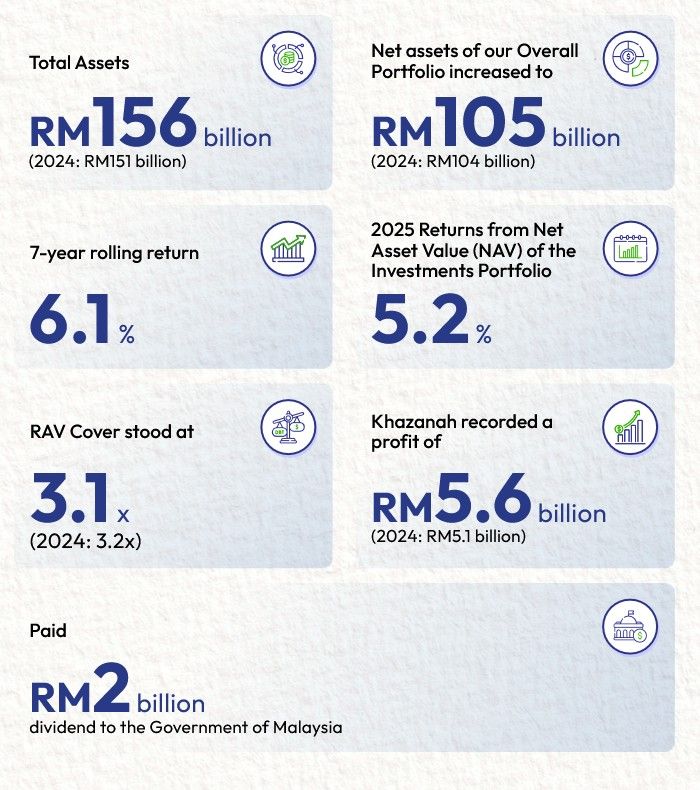
The fund recorded a 5.2% return for the year and a seven-year rolling annualised return of 6.1%, reflecting the portfolio’s ability to generate returns across market cycles and in line with our mandate and risk appetite.
Its total assets increased to RM156bil, while net assets stood at RM105bil. Profit from operations came in at RM5.6bil.
Supported by strong performance in global and domestic public markets, Khazanah also paid a RM2bil dividend to the government during the year, bringing cumulative dividends paid since 2004 to RM21.1bil. Cumulative shareholder returns since 2004 stood at RM93.1bil.
“In 2025, Khazanah delivered resilient financial and strategic performance amid heightened global volatility, underpinned by disciplined portfolio management and continued execution of our Advancing Malaysia strategy,” Amirul Feisal said.
Khazanah also continued to support Malaysia's energy and digital infrastructure development through companies such as Tenaga Nasional Bhd , Telekom Malaysia and UEM Lestra, while the privatisation of Malaysia Airports Holdings Bhd (MAHB) marked a significant milestone in the stewardship of strategic national infrastructure.
The sovereign wealth fund also advanced its Warisan KL initiative, which involves the conservation and activation of eight heritage buildings around Kuala Lumpur.
Seri Negara at Bukit Carcosa reopened to the public in December 2025, followed by Bangunan Sultan Abdul Samad in February 2026 and Pejabat Pos Besar Lama in May 2026.
On talent development, the K-Youth programme trained 9,934 youths in 2025, bringing the cumulative total to more than 34,000 participants since inception. The programme focuses on preparing talent for sectors including semiconductors, aviation, technical and vocational education and training (TVET), as well as digital and technology industries.
Meanwhile, Khazanah introduced its Securing the Future framework in 2025 to further embed sustainability, resilience and transition-readiness considerations across its investment decisions and portfolio companies.
"We remain steadfast in ensuring that our efforts continue to raise both the ceiling and the floor towards national competitiveness and resilience," Amirul Feisal said.