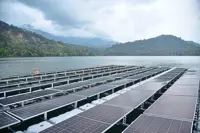
PETALING JAYA: Malaysia’s National Carbon Market Policy (NCMP), launched on April 21 establishing the framework for voluntary and future compliance carbon markets, is seen as supporting solar energy adoption, energy efficiency retrofits and waste infrastructure investment, says Hong Leong Investment Bank (HLIB) Research.
It noted that solar technology would likely be one of the first solutions adopted by corporates seeking to meet voluntary environmental, social and governance and decarbonisation targets “as solar technology is already mature, scalable and commercially viable”.
The research house has maintained an “overweight” recommendation on renewable energy (RE) stocks.
It has a “buy” call on Solarvest Holdings Bhd with a target price of RM3.43, seeing the group as a key beneficiary, given that the company has a 30% to 40% market share in large scale solar projects and a robust order book pipeline.
“We understand the recent strength in RE names has been driven by several supportive factors, including more stable solar module prices (11 US cents to 12 US cents per watt), rising national focus on energy security, and the continued rollout of new RE capacity schemes,” it added.
It believes RE companies’ long-term earnings visibility remains robust and expects the NCMP to serve as a catalyst for a gradual rise in corporate demand for carbon reduction solutions and offset instruments.
“This should benefit RE players that are able to supply green electricity bundled with RE certificates,” it said.
HLIB Research said that besides supporting carbon credit trading, the NCMP lays the groundwork for broader carbon pricing instruments, most notably a national carbon tax.
“In this sense, the policy is not only about developing a carbon market, but also about preparing Malaysia’s business landscape for a future where carbon emissions carry a direct financial cost,” the research house said.
A carbon tax was initially expected to be introduced in 2026, targeting high-emission sectors, such as iron, steel and energy, but the rollout may be delayed as industries face higher energy and operating costs amid ongoing geopolitical tensions in the Middle East and broader global economic uncertainty.