
THE government’s base medical and health insurance/takaful (MHIT) plan, covering hospitalisation, surgery, medicines and select critical illnesses, has faced criticism from health experts who argue that the priority should be strengthening the public healthcare sector, as around 80% of Malaysians lack medical insurance.
Late last month, Bank Negara Malaysia (BNM) and the Finance and Health Ministries released a White Paper outlining the base MHIT plan. This is an insurance and takaful product that increases access to private healthcare at a more affordable cost, including lower premiums for those who accept higher co-payments and seek greater coverage limits.
This plan, offered alongside other MHIT products by insurance and takaful operators (ITOs), will undergo a pilot implementation phase in the second half of this year before its market launch in early 2027.
It comes with a standardised package of benefits as well as more predictable premiums, an area of concern for many MHIT holders facing rising premiums.
The take-up is entirely voluntary, and Employees Provident Fund members can use their Account 2 savings to pay for the premium.
A senior medical professional with public sector experience tells StarBiz 7 that whether a country chooses to emphasise the public or private provision of healthcare services will depend on what it wants and where it is heading in terms of comprehensive healthcare provision for its populace.
The base MHIT plan is a key component of the RESET strategy announced last March to transform private health insurance offerings in the market.
Its main aim is to enable people to get medical coverage at an affordable premium and to transition private healthcare services to the diagnostic-related group (DRG) payment system from the current fee-for-service payment system to better manage escalating costs.
He describes the current main problem as virtually impossible to monitor and enforce, warning that while the plan may provide temporary relief, the government will soon realise the coverage is insufficient, leading to abuse of medical cards and patients being left vulnerable, especially in emergencies.
“In fact, many of these insurance policy holders are dropping out because their coverage has been wiped out by private hospitals. The ITOs have taken the easy way out by raising premiums to ridiculous amounts.
“Even with their health maintenance organisations and managed care organisations, the ITOs cannot monitor these private hospitals,” he says.
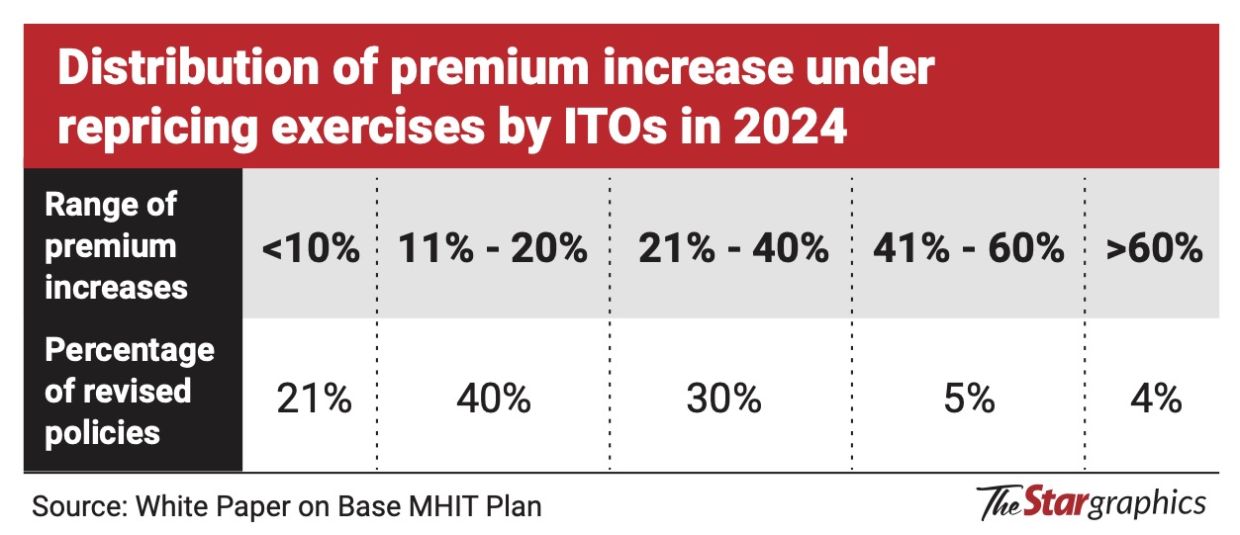
According to the White Paper, between January 2024 and June 2025, around 340,000 MHIT policies representing 5.2% of policies that saw their premiums raised, were surrendered.
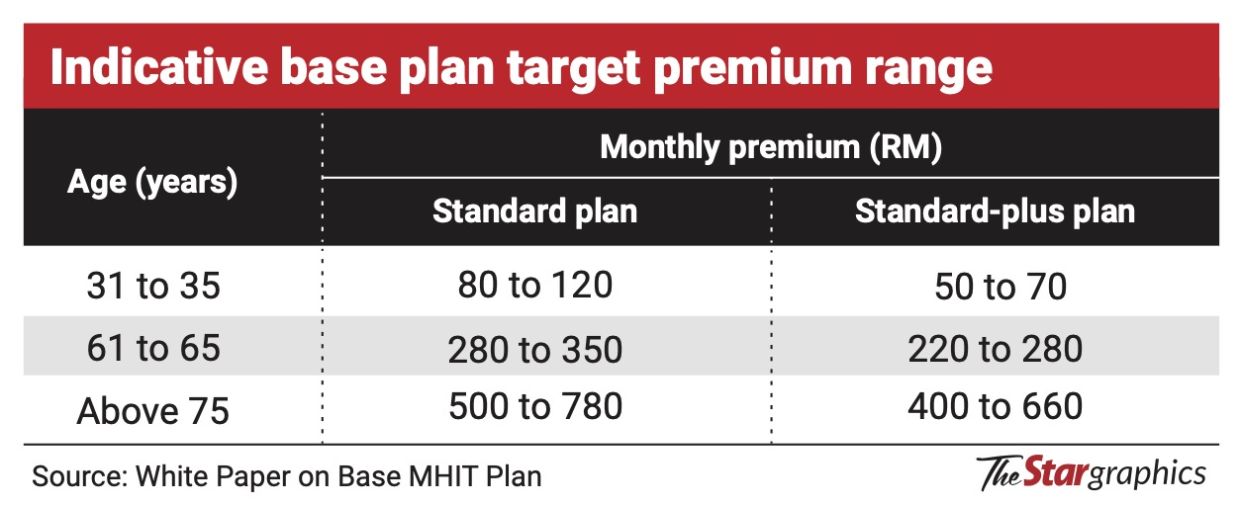
There are worries that the already burdened public healthcare system will face a deluge of people who now have no other alternative if they fall seriously ill or meet with an accident. The base plan aims to address this by making premiums more affordable.
He attributes the inclusion of pre-existing conditions to the government’s concern over the high number of people surrendering their insurance or takaful medical coverage due to rising premiums.
The White Paper says a standardised underwriting approach to managing risks associated with prior medical conditions will be offered while BNM is considering a no look-back provision to ensure that ITOs will not deny claims on grounds of prior medical conditions.
Perhaps, this provision can convince many, including those who have given up their policies, to take it up. The worry is whether the annual coverage limit of RM100,000 for those below 60 is enough, as BNM claims it can cover 99% of conditions, even with multiple admissions. The annual limit rises to RM150,000 for those above 60, with a corresponding rise in premiums.
Dr Chan Chee Khoon, a health policy analyst and co-founder of the Citizens’ Health Initiative, says the base plan, a risk-rated voluntary health insurance, is an “unsatisfactory band aid which detracts from the chronic under-funding and under-staffing of the public healthcare sector”. He questions whether the government is sacrificing equitable healthcare for citizens in the interest of its investments in for-profit healthcare.
Chan points out that the government is a “conflicted institution” as its investments in the private healthcare sector will be affected by the introduction of the DRG payment system, because profit margins will be reduced. Healthcare advocates also point to private hospitals being beholden to their shareholders, to the detriment of patients.
“Leading health economists in academia, the World Health Organisation and international development agencies advise against not just for-profit healthcare paid for by for-profit insurance (which is inequitable and wastefully inefficient) but also against social health insurance (SHI),” he adds.
The introduction of the base MHIT plan effectively does away with the need for a national health insurance scheme, a form of SHI, funded by employees, employers and the government as announced in late 2023. BNM says the base plan is not a social insurance scheme but a national initiative in which participation is voluntary.
Foundation of public health
It is arguable whether the introduction of a base MHIT plan is an effective move, as there are worries that rising premiums may be hard to stem.
The government tacitly acknowledges it, speaking of the RESET strategy as a commitment to a “whole-of-nation” response required to deal with the multi-faceted issues involved to deliver better health outcomes for all Malaysians.
With rising cost-of-living concerns, people may have no choice but to go without medical coverage, even when offered a more affordable option.
On top of that, BNM says highly complex and costly treatments that exceed the base plan’s policy limits will continue to be managed within the public healthcare system. This is because the plan is complementary to, and not a replacement of, the public healthcare system.
Prof Sharifa Ezat Wan Puteh, a public health expert at Universiti Kebangsaan Malaysia, says public healthcare will continue to provide essential services, especially for those who are uninsured or who have used up their coverage amount.
“Those in the lowest income bands, patients infected with communicable diseases and on welfare will still need public healthcare. This will continue to be subsidised by the government,” she says.
Sharifa notes that close monitoring is needed to assess how the premiums of at-risk groups, such as the elderly and those with non-communicable diseases (NCDs), are impacted, as their inability to afford medical insurance or takaful coverage – even with lower premiums from the base MHIT plan – could result in reliance on the public healthcare system.
She adds that reducing medical inflation through the base plan will take time and depends on whether people are persuaded to adopt it.
“Will this flatten the cost curve? I think it will but that would be in the long run, say another five to 10 years from now,” Sharifa says.
In the meantime, she advocates for primary care and general practitioners to play a role in promoting better health and wellness.
“Staying healthy for as long as possible is beneficial,” she adds.
This is why the public healthcare sector could do with more funding, especially as the country ages, bringing with it a rise in NCDs.
As a point of reference, under Budget 2025, the RM45.3bil allocation to the Health Ministry, despite being 9.8% higher than Budget 2024, amounted to 2.4% of gross domestic product (GDP).
As Chan of Citizens’ Health Initiative points out, the average expenditure by governments of upper middle-income countries is 3.1% of GDP.
“Malaysia is on the verge of joining the ranks of high-income countries, whose governments on average spend 8.3% of GDP,” he says.
The Citizens’ Health Initiative favours a progressive taxation regime to bolster public finances that can be used to expand and reinforce the Health Ministry’s capacity for delivering public-sector healthcare services.
The group of public health advocates the setting up of a National Health Fund with credible stakeholder representation, accountability and transparency.
An alternative, according to the former public sector medical professional, is to allow private healthcare management companies run government healthcare, as this has been done effectively in the United Kingdom and Singapore.
“If we are moving towards funding healthcare through insurance, then clearly massive monitoring and intensive surveillance is needed as private hospitals are answerable to their shareholders and financiers,” he says.
“In the Malaysian context of the private-versus-public healthcare discourse, private healthcare providers can never match the resources of the public healthcare system, especially the blood banks, the complex surgeries, ability to deal with complicated cases and the depth of human resources,” he says.
Already a subscriber? Log in
Get 20% OFF The Star Digital Access
Cancel anytime. Ad-free. Unlimited access with perks.