AFTER sluggish progress, the Asean Power Grid (APG) is gaining traction.
Envisioned in the late 1990s as a way to interconnect South-East Asia’s power systems, the project is now being reinvigorated by fresh political commitment and long-awaited financial support.
At the opening of the 43rd Asean Ministers on Energy Meeting (AMEM) in Kuala Lumpur, Prime Minister Datuk Seri Anwar Ibrahim called the APG “the crown jewel” of the bloc’s energy vision.
Malaysia is the Asean chair for 2025.
The slow progress of the APG has largely been attributed to political risk and fragmented regional commitment.
However, at the forum, the Asian Development Bank (ADB) and the World Bank launched a new financing initiative to support the APG.
The ADB has pledged over US$10bil in loans, grants and blended finance over the next 10 years.
Meanwhile, the World Bank is providing an initial contribution of US$2.5bil in project support, including technical assistance and preparation funding.
This includes a US$12.7mil seed grant to the Asean Centre for Energy (ACE) to prepare bankable projects and define the next phase of support to advance the APG agenda.
Jakarta-based ACE is the central coordinator for Asean’s cross-border energy efforts.
Complementing this financial push, an enhanced memorandum of understanding was also signed by all 10 Asean member states at the forum, aimed at harmonising regulatory frameworks and technical standards.
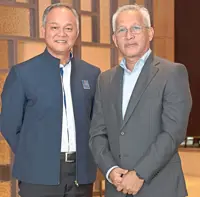
“That’s a strong combination, maybe even the most promising we’ve seen so far,” ACE executive director Datuk Abdul Razib Dawood tells Starbiz 7.
What is giving the old vision a new lease on life?
Energy security has become a key driver, says Razib citing the example of Spain, which experienced a massive blackout earlier this year. He points out one of the key recommendations post the blackout investigation was to build more power links and strengthen the existing ones with neighbouring countries.
“Spain’s blackout was a wake-up call, forcing the country to rethink its energy dependencies.
“Similarly, Asean now sees the APG not as a nice-to-have, but a must-have,” adds Razib, who was previously the chief executive office of Malaysia’s Energy Commission.
Despite recent pledges from the ADB and World Bank, financing remains a significant hurdle.
Razib notes that ACE’s feasibility studies alone, aimed to harmonise regulatory frameworks across member states, will cost over US$90mil with the full build-out of the grid exceeding US$250bil.
“The figures underscore the sheer scale of the APG project. National utilities can’t carry this burden alone,” he says, emphasising the need for greater support and innovative financing mechanisms such as public-private partnerships, blended finance, and green bonds to mobilise the necessary capital.
One key technical challenge is in the deployment of costly high-voltage submarine cable lines necessary for cross-border power connections. Additionally, with growing demand for submarine cables and a small pool of suppliers, there are supply chain constraints, resulting in long lead times from manufacturers.
Asean is now the fifth-largest economic bloc in the world and poised to move a rung up in the near future. Currently, the region’s power mix is dominated by fossil fuels.
The region is projected to see a 2.6-fold increase in energy demand by 2050, fuelled by rapid urbanisation and industrialisation.
To address this surge sustainably, the new regional energy plan, the APAEC 2026-2030, which was endorsed during the 43rd AMEM, targets a 30% share of renewables in the primary energy mix and a 45% share in installed power capacity by the end of the period.
Adding to this pressure is the rapid growth of energy-intensive data centres, particularly in Malaysia, Singapore and Indonesia.
With many global tech firms committing to net-zero targets, these data centres are demanding clean, reliable energy sources to mitigate carbon emissions.
Reliable clean energy is also essential for Asean to participate meaningfully in the global AI-driven economy.
To support this, Razib says ACE is developing a regional Renewable Energy Certificate (REC) framework, which is essential for enabling cross-border renewable energy trade.
“Asean countries are facing a triple balancing act: ensuring reliable power supply, keeping costs affordable and simultaneously accelerating the shift to renewables in order to meet both national targets and global climate commitments.”
One notable development since 2019 is the successful green energy transactions through the Laos-Thailand-Malaysia initiatives.
This initiative served as a ‘pathfinder pilot project’ for multilateral power trade with Singapore subsequently joining the arrangement.
Razib notes that regional grid ambitions are no longer confined to discussions but are now being embedded in national policies.
He points to the Sumatra-Malaysia line which is now part of the RUPTL of PLN in Indonesia. The Laos-Vietnam line is also part of the new PDB 8 in Vietnam.
Another example is the Vietnam-Malaysia-Singapore undersea cable project, estimated to cost around RM21bil. The project aims to transmit 2,000 megawatt (MW) of wind-generated power from southern Vietnam through Malaysia to Singapore.
According to Razib, the project is particularly significant because it reflects the region’s growing readiness to tackle the complex technical and regulatory challenges of subsea connectivity.
“This project is not just an isolated success, it’s a signal of what’s possible when vision, investment and regional cooperation converge,” he says, adding that developing the terms of reference for a subsea cable development framework is one of ACE’s priorities this year.
As the APG shifts to more complex subsea cable projects, experts caution it faces “diminishing returns.”
Early land-based links were cheaper and hence delivered quick wins. Without long-term power purchase agreements and strong government backing, newer projects may struggle to secure investments, they say.
Elsewhere in Malaysia, Tenaga Nasional Bhd
(TNB) is seeking international partners to form a consortium to develop a major interconnection linking Sarawak and Peninsular Malaysia.
This project will be a vital part of the APG aiming to export power to neighbouring countries, including Singapore.
It aims to transmit up to 2,000 MW of hydro energy from Sampadi near Kuching to Sedili in Johor through a 700km submarine cable.
TNB had also signed a joint development agreement with Singapore state-owned SP Group and Singapore Energy Interconnections (the firm focused on cross-border electricity imports into the island state) to conduct a full feasibility study for a second electricity interconnection between Peninsular Malaysia and Singapore. Operations are targeted to begin by 2030.
Meanwhile, the existing Malaysia–Thailand interconnection is also being upgraded to raise its current capacity of 300 MW to at least one gigawatt (GW).
Sharing key milestones at the forum, Deputy Prime Minister Datuk Seri Fadillah Yusof – who also serves as the Energy Transition and Water Transformation Minister – said that out of the 18 planned APG interconnections, nine have been completed.
The current cross-border transmission capacity in the region is 10.22GW, including grid-to grid and generation to grid, with a target addition of 25GW by 2040
Fadillah highlighted the completion of eight Asean priority economic deliverables, which include frameworks on petroleum security, renewable energy, energy efficiency and conservation, and a new long-term roadmap for regional energy cooperation.
The minister also said Thailand had committed to signing the Laos-Thailand-Malaysia-Singapore power integration project agreement by November this year.
Looking ahead, Razib says ACE will be working closely with the Philippines, which will assume the Asean Chair in 2026.
Other regions have shown what’s possible. The Nordic electricity grid (linking Norway, Denmark, Sweden, and Finland) was conceptualised around the same time as the APG and now stands as a model of how cross-border cooperation can successfully connect the currents.
“Our journey to build the APG has been long and challenging. Yet nothing is insurmountable with strong Asean unity and spirit,” Razib concludes.
Already a subscriber? Log in
Get 20% OFF The Star Digital Access
Cancel anytime. Ad-free. Unlimited access with perks.