
THE ringgit’s fierce charge from the bottom rung to the top of the world currency chart has silenced the naysayers for now.
At the height of the ringgit’s weakness, many predicted it would be a matter of time before one US dollar equalled RM5.
Today, the ringgit has appreciated about 11% against the greenback to RM4.16 at the time of writing, and there is even a prediction by BMI, a unit of the Fitch group, that it could hit RM3.55 by the end of next year.
The ringgit has also gone up against other key world currencies.
The local unit has appreciated more than 7% against its closest neighbour and top trading partner Singapore’s currency. It has also appreciated about 13% against the Japanese yen, a favourite of Malaysian tourists.
That said, volatility is the name of the game in any market. Predictions, however sound they seem, remain just that. Every seasoned investor knows there is no escape from external shocks and global geopolitical tensions.
The US presidential election on Nov 5 could also impact the dynamics of the US dollar-ringgit by quite a bit.
It is important to first look at the fundamental factors which have catapulted the ringgit to where it is today.
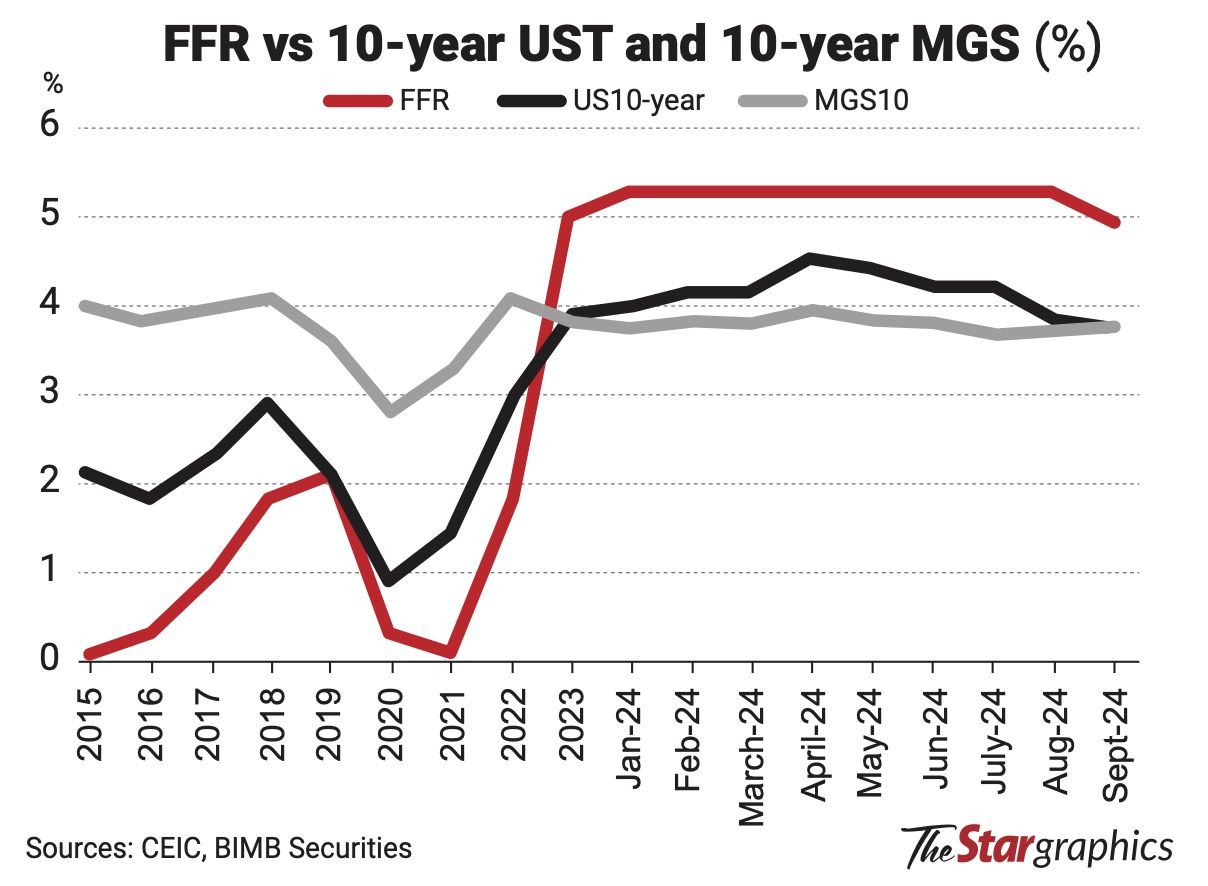
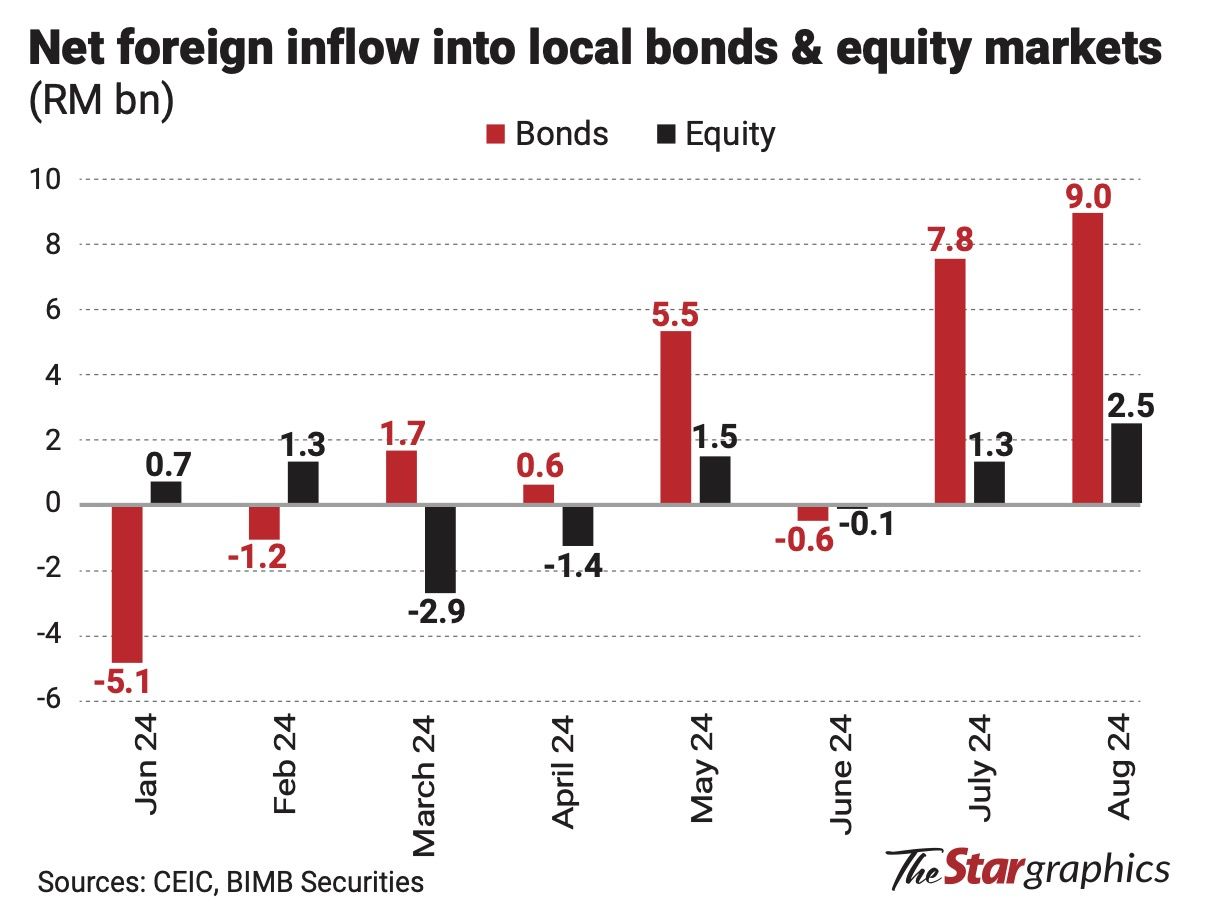
A melange of factors – like a larger-than-expected US Federal Reserve (Fed) rate cut, which weakens the greenback, repatriation of funds by government-linked companies, higher foreign fund buying of local stocks and bonds, more tourist arrivals and reform policies that are finally bearing fruit – has played a huge role in propping up the local unit.
The country has also attracted data centre and artificial intelligence investments from big tech names like Microsoft, ByteDance, Google, AWS and Oracle, boosting sentiment among potential investors and lending further optimism to the ringgit.
The economy appears to be on a steady path, with 5.9% growth in the latest quarter – the strongest since the fourth quarter of 2022.
Bank Negara’s international reserves are also at their highest in a decade with US$117.6bil, most of which is made up of foreign currencies. Foreign currency reserves are important and can be used to stabilise the local note should it face pressure.
With all the seemingly feel good factors in place, the question on everyone’s minds now is, how high can the ringgit go?
One-way bet: reality or myth?
Many predictions and targets have been made since the ringgit hit a fresh multi-year high of RM4.12 last week.
Sunway University economics professor and economics adviser to the prime minister Dr Yeah Kim Leng reckons the ringgit is poised to strengthen further.
“The ringgit saw a spectacular rise over the last two months and it is poised to strengthen further against the greenback given more interest rate cuts telegraphed by the Fed,” he tells StarBiz 7.
And given Malaysia’s strong economic fundamentals as reflected by its sturdy growth, low and stable inflation, rising domestic and foreign investments as well as exports and foreign reserves, the ringgit’s upside against the US dollar is akin to a one-way bet, Yeah adds.
Maybank head of forex research Saktiandi Supaat says the bank has revised its prediction for the ringgit to end this year at RM4.00, with some risk of overshooting below that level, from its previous target of RM4.25.
“We continue to hold to our view of a gradual downward trend into 2025. Our Behavioural Equilibrium Exchange Rate or BEER model finds the ringgit only slightly overvalued given current external factors.
“Overvaluation episodes can continue for a period of time if the environment is conducive and fundamentals remain aligned as seen back in 2010-2011 when the ringgit was overvalued and was in a period of overvaluation not affected by ‘election’ effects,” he says.
Saktiandi notes that since July 1, the ringgit has appreciated around 12% versus the greenback and is currently at RM4.16, a 64 sen adjustment from the high of RM4.80 on Feb 20.
“Our view that the ringgit’s effective exchange rate was undervalued by around 8% at the start of this year seems to be appropriate.”
OCBC forex strategist Christopher Wong reckons at this point, the ringgit’s strength is “more a case of unwinding the weakness” seen in the past two to three years.
“And this comes amid brightened economic prospects, relative political stability and an improving external environment helped by more Fed cuts and hopes of a China recovery,” he says.
“The ringgit continued to outperform regional and major currencies in September, gaining 5.2% versus the US dollar.
“The main triggers this round were the Fed cutting its rate more than expected, inflows into domestic bonds and equities as well as Chinese stimulus.”
Wong notes that the scale of support measures from China this time round is large as opposed to the previous piecemeal approach, suggesting that Chinese policymakers are determined to make a genuine effort to do whatever it takes to tackle woes at home.
These include unleashing liquidity, lowering debt servicing burdens, supporting the poor, rebooting domestic equity sentiments and rebuilding real estate confidence.
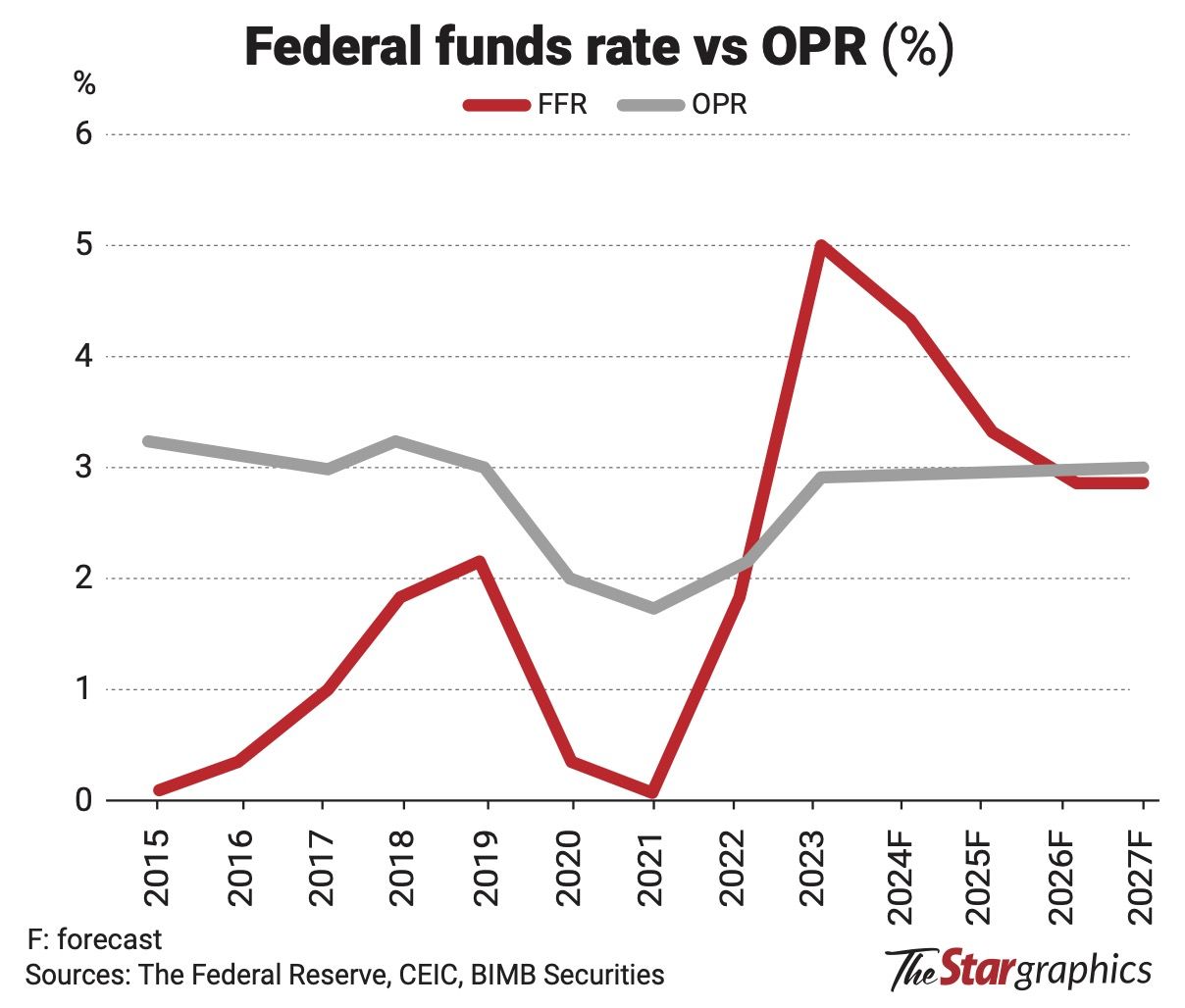
“Markets are still hopeful of more support measures and these positive factors impact Asian forex, including the ringgit.”Wong says OCBC’s fair value model now projects the ringgit going into RM3.90 next year, supported by a combination of domestic and exogenous drivers, including yield differential dynamics whereby the Fed front-loads rate cuts while Bank Negara likely maintains a “hold” on rates.
Adding to that are Malaysia’s solid economic fundamentals such as robust economic growth, current account surplus, fiscal improvement, exports which are riding on a global tech and semiconductor up-cycle, and sustained foreign direct investment inflows.Further conversion of foreign currency deposits into ringgit may also be another factor supportive of the ringgit, he notes.
BIMB Research also expects the ringgit to appreciate further amid hints of another 50 basis points Fed cut in the fourth quarter of this year.
However, it reckons that the ringgit’s rise has been “too fast and ahead of fundamentals”.
Reducing Malaysia’s export value?
“Despite the clarity given by the Fed on its funds rate trajectory, we opine that the appreciation of the ringgit was too fast, driven by hot money via bonds and equity markets.
“The rapid inflows could suffer a pullback especially if there are changes in the macro numbers of the US economy.
“The rapid appreciation of the ringgit may also reduce Malaysia’s exports value and thus pressure net exports contribution to gross domestic product in the fourth quarter of this year and 2025,” says BIMB Securities.
While it is somewhat theoretically true that with a stronger ringgit, Malaysian exporters will make less profit as most of their sales are denominated in US dollars, their input costs should also go down.
Sunway University’s Yeah says only exporters of goods and services that yield less than 10% profit margin will face reduced profitability.“And this only if they are unable to raise prices in US dollars or reduce cost through raising efficiency and productivity as well as through product or service quality innovations where they can charge higher prices,” he adds.
He notes that Malaysian manufacturers, exporters and service providers need to prepare for the ringgit going below RM4 per US dollar in 2025.
A gradual pace is desirable to allow time for affected parties to adjust which typically will involve moving higher up the efficiency, productivity and value trajectories.
Yeah also argues that a firmer local note will in fact, result in lower imported inflation while enabling the government and private sector to lower the cost of servicing US currency-denominated borrowings.
According to the central bank’s estimates, imports on average account for 26% of private consumption, and for every 5% depreciation of the ringgit against the US dollar, inflation will rise by 0.2 percentage point.
Hence, given the current rise in the ringgit against the dollar, the consumer price index inflation is estimated to decline by around 0.3 percentage point.
“The pass-through to lower consumer prices, however, will vary according to the type of goods and services, size of old stocks, intensity of competition, sensitivity of demand to price changes and pricing behaviour.
“Food imports and other fast-moving goods, especially those with just-in-time inventories, will likely see quicker easing of prices,” Yeah says.
Maybank group chief economist Suhaimi Ilias points out that while a stronger ringgit can make Malaysian exports more expensive, and thus less positive for exporters, imported goods will be cheaper and positive for importers in Malaysia.
“To sustain export growth without affecting demand for Malaysian exports before buyers find other alternatives, it would be useful to look at the trade weighted index of the ringgit which still looks in line with trading partners.”
Focus on productivity
Suhaimi says Malaysia should not be dependent on undervalued currencies plus subsidies and cheap labour to drive and define the country’s export competitiveness.
“Amid the ringgit’s recovery, subsidy rationalisation and the government intention to increase workers’ income and labour share of GDP, our competitiveness should be underpinned by factors like productivity, efficiency and innovation as envisioned under the Madani Economy framework and New Industrial Master Plan 2030.”
Yeah also points out that a more representative measure of international competitiveness is the trade-weighted and inflation-adjusted real effective exchange rate which appreciated 5.9% in the first eight months of this year.
The August index remains at 1.25% below the 2020 level, indicating that the ringgit’s recent appreciation is a recovery from its decline since then.
“In short, the ringgit appreciation against the US dollar and its trading partners can be attributed to the country’s improving economic fundamentals.”
Meanwhile, Malaysians travelling, studying or making acquisitions or investments abroad will have higher purchasing power.
But some economists recently sounded the alarm bells on this, saying that the more Malaysians travel, and exchange ringgit for foreign currencies, the higher the outflow of the ringgit. This could hurt the local note’s strength.
Most seem to agree though, that there will be minimal Bank Negara intervention in the ringgit’s current trajectory.
Yeah says the central bank intervenes only to curb excessive exchange rate volatility or misalignment while allowing the market to determine the appropriate level in line with prevailing domestic and global growth and financial conditions and expectations.
This prudent stance is expected to continue.
Maybank’s Suhaimi says there is no indication of Bank Negara being “unhappy” with the ringgit’s movement, unlike back in February-March when the central bank openly said the ringgit was undervalued and undertook interventions as well as specific measures to encourage corporates to repatriate and convert their foreign currency earnings from exports and investments abroad.
OCBC’s Wong notes that at this point, there is little need for intervention. “Bank Negara has also given its ‘blessing’ to the ringgit as it sees ‘enduring support’ for it,” he says.
Already a subscriber? Log in
Get 20% OFF The Star Digital Access
Cancel anytime. Ad-free. Unlimited access with perks.