
KUALA LUMPUR: The on-going US-China trade war, if it intensifies further, could reduce Malaysia's exports by up to 2.7 percentage points under a worst-case scenario, impact export-oriented industries and reduce GDP growth.
Bank Negara Malaysia said on Friday the trade protectionism measures implemented since the beginning of this year are expected to weigh down on gross exports by 0.6 percentage point to one percentage point.
“This mainly reflects the lower final demand from China, the US and the EU, which account for 38.4% of Malaysia’s final export demand,” it said.
However, if trade tensions intensify further, the downside risk to export growth will be more severe.
“In the event that both downside risks materialise, the total impact to Malaysia’s exports growth could be a reduction of as much as 1.8 percentage points to 2.7 percentage points,” it cautioned.
Bank Negara said as a small open economy, Malaysia will inevitably be affected by the escalating global trade tensions. The impact of trade tensions to the economy can be assessd via the trade, income and investment channels.
With total trade amounting to 131% of GDP, Malaysia would be primarily affected via the trade channel.
Malaysia’s exports are expected to be affected directly via lower demand from affected countries and indirectly via slower production in the global value chain.
“Weaker trade activity would also incur some spillovers on Malaysia’s domestic economy. In particular, this is expected to weigh on private sector spending mainly through the income and investment channels,” it said.
Bank Negara said for workers, especially those in the export-oriented industries, the moderation in export growth was expected to adversely affect employment and income, in turn, lowering household spending.
Lower export orders and proceeds would also negatively affect on the companies' profi tability.
It also said this would impact the companies' need and ability to invest in capacity expansion, reducing private investment activity for the year.
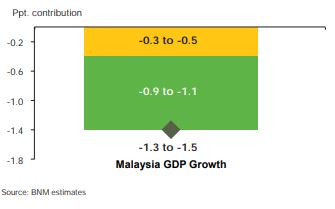
“Taken altogether, in its current form, trade tensions are expected to weigh down Malaysia’s GDP in 2019 by 0.3 percentage point to 0.5 percentage point.
“However, the overall impact on growth could be as large as a reduction of 1.3 – 1.5 ppt should both downside risks materialise.
“It is also important to note that rising trade hostilities could increase volatility in the global and domestic fi nancial markets, thereby posing additional headwinds to growth,” it said.
However, there could be potential gains for Malaysia from trade substitution opportunities.
Several regional countries stand to benefi t from potential trade diversion from PR China.
These include Malaysia, Thailand, Indonesia and Vietnam. Collectively, the potential diversion of US’ imports away from China to other countries is estimated to amount up to US$140bil.
“While there is potential for higher exports for individual countries, this would not fully off set the impact of lower global growth on trade activities,” it said.
Already a subscriber? Log in
Get 20% OFF The Star Digital Access
Cancel anytime. Ad-free. Unlimited access with perks.