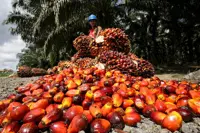
KUALA LUMPUR: Malaysian palm oil futures reversed earlier losses to chart a second straight session of gains at the close of trade on Monday, as the market's outlook of falling output supported prices.
The benchmark palm oil contract for September delivery on the Bursa Malaysia Derivatives Exchange was up 0.3 percent at 2,290 ringgit ($570.22) per tonne on Monday evening, in a second session of gains after four consecutive days of losses.
Palm was down at the midday break on weak export demand and losses in U.S. soyoil, and is down nearly 7 percent so far this month.
Trading volumes stood at 59,556 lots of 25 tonnes each at the close of trade. <1fcpo-tot>
"There's a market expectation for production to see declines ... But for the market upside to sustain it requires demand to pick up," said a Kuala Lumpur-based trader. "Current low prices should be attractive to consumers."
Palm oil output in Malaysia, the world's second largest producer, fell 2.1 percent on-month in May to 1.53 million tonnes for a second straight month.
Production typically slows during the Muslim fasting month of Ramadan and the festival of Eid which marks its end, which took place from mid-May to mid-June this year.
Slow demand for the tropical oil from key buyers such as India and China have weighed on the market in recent weeks, said a trader earlier on Monday.
"Exports have been bad since the export tax was reinstated, and Indonesian prices are more competitive than ours," he said, referring to Malaysia's tax on crude palm oil exports.
Malaysia resumed export taxes on crude palm oil in May, after suspending it for four months at the start of the year to increase demand and boost prices. It announced a 5 percent rate for the month of July.
Exports of palm oil and related products from the world's second largest producer declined 12.5 percent from June 1-25, reported inspection company AmSpec Agri Malaysia on Monday, versus the corresponding period in May.
In other related oils, the Chicago July soybean oil contract was last down 0.1 percent, while the September soybean oil on China's Dalian Commodity Exchange rose 0.3 percent.
The Dalian September palm oil contract was up 0.6 percent.
Palm oil prices track the performance of other edible oils, as they compete for a share in the global vegetable oils market. ($1 = 4.0160 ringgit) ($1 = 68.1525 Indian rupees) ($1 = 6.5387 Chinese yuan) - Reuters
Already a subscriber? Log in
Get 20% OFF The Star Digital Access
Cancel anytime. Ad-free. Unlimited access with perks.