
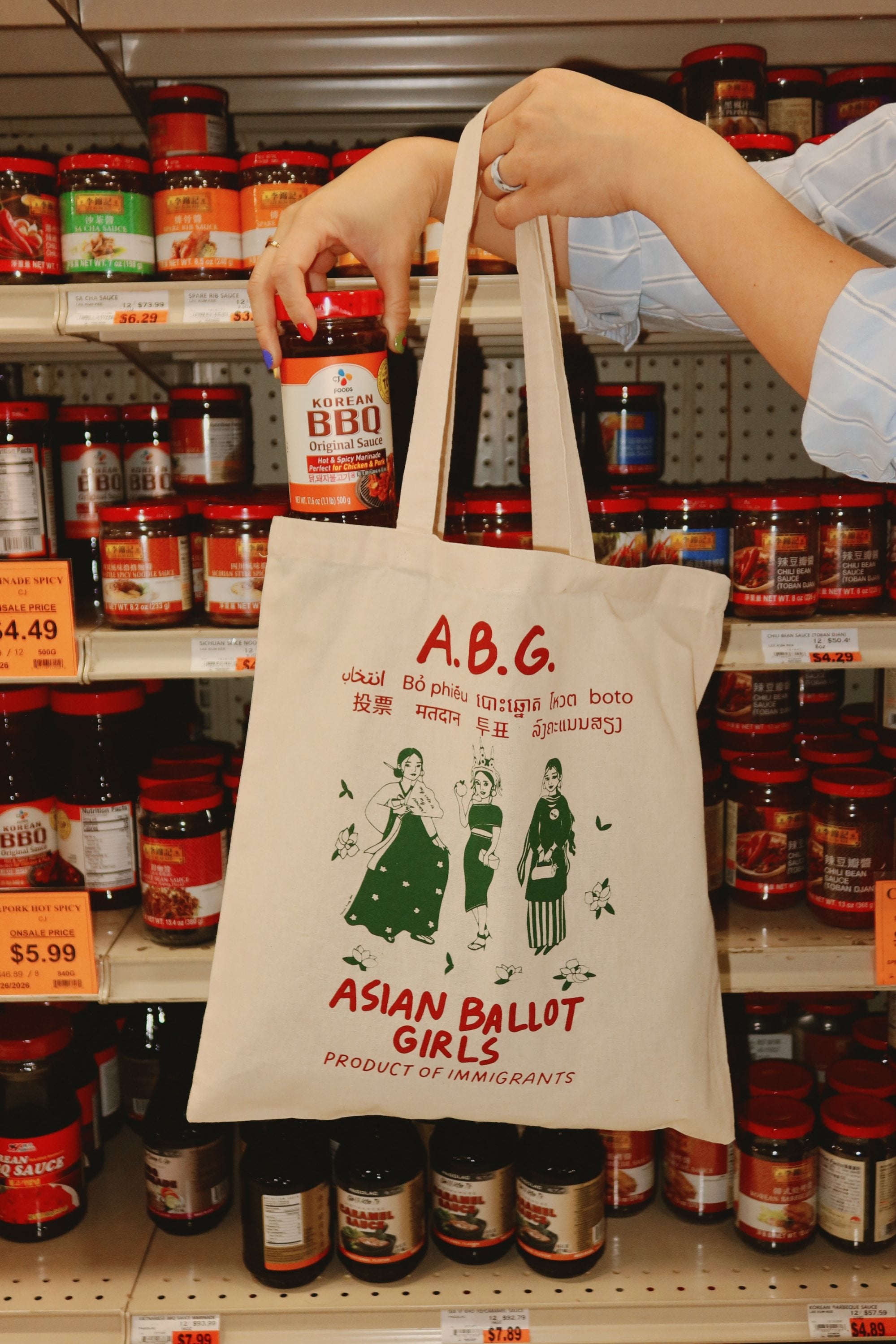
On tote bags distributed by Asian-owned businesses in the US state of Georgia, three Asian-American women appeared in a design inspired by the Three Ladies rice brand. The bags were part of a campaign that put a voting twist on the online “Asian baby girl” meme.
“We had an ‘Asian Ballot Girls’ campaign,” said Chany Chea, programme director of the Asian-American Advocacy Fund. “We had merch which went viral.”
As Democrats won races in Republican strongholds across the southern United States in last week’s midterm elections, Asian-American organisers in Georgia, Texas and North Carolina drew on years of local outreach efforts.
In Georgia, that meant working with artists and shop owners. In Texas, it was to build a multilingual guide to the ballot. In North Carolina, it meant helping young people get involved before they were old enough to vote.

Beyond the governor’s race, in which Democrat Keisha Lance Bottoms defeated her Republican opponent, Chea pointed to state Senate district 48 as another sign of Asian-American political growth in Georgia.
Few expected the district, which covers parts of Forsyth, Fulton and Gwinnett counties, to be competitive, but Chea’s group saw an opportunity and made 72,000 voter contact attempts there this year. Democrat Laura Murvartian went on to defeat Republican incumbent Shawn Still by 53 per cent to 47 per cent.
Georgia has around 300,000 eligible Asian-American voters, concentrated in some battleground areas, Chea said.
“We’ve spent years intentionally developing trusted leaders across our diverse [Asian-American and Pacific islander] communities here in Georgia,” Chea said. “This year we really leaned into those relationships.”
The group distributed door literature in seven Asian languages: Hindi, Chinese, Korean, Urdu, Vietnamese, Bangla and Tagalog. It also ran in-language digital and ethnic media ads, while its canvassing and phone-banking teams collectively represented nine languages.
Among other high-profile victories, Democrats James Talarico and Gina Hinojosa won a Texas Senate seat and the governorship, respectively. Roy Cooper flipped a North Carolina Senate seat, and Annie Andrews defeated Senator Darline Graham in South Carolina.
Graham was appointed to the seat in July following the unexpected death of her brother, Lindsey Graham. She also had the backing of US President Donald Trump.

Polling data supports the trend. A survey of 10,141 voters conducted by BSP Research and the African-American Research Collaborative from October 20 through to Election Day found that Asian-American respondents – 2,130 of those polled – backed Democratic candidates over Republicans by 64 per cent to 33 per cent nationwide.
Taeku Lee, a Harvard professor of government who worked on the poll, said the results were similar among Asian-American voters in the South, who favoured Democrats by 62 per cent to 35 per cent. He did not specify how many Asian-American respondents were from the South.
Texas: a hard-fought battle
Talarico’s win was among the most high-profile Senate victories for the Democrats. It shattered a Republican stronghold in Texas, where no Democratic candidate has won a Senate race since 1988, and the party had been locked out of statewide office entirely since 1994.
Texas has about 19 million voters, including some 1.2 million eligible Asian-American voters, Stephanie Cho, executive director of the Asian-American Texas Action Fund, said. Many live in the Houston and Dallas areas, with smaller communities in Austin and San Antonio.
The Asians for Talarico group knocked on 70,000 doors, made 300,000 calls and sent 300,000 MMS messages, according to Asian Texans for Justice Action Fund. “Nearly seven out of every 10 Asian voters canvassed said yes to Talarico,” it wrote in a media release.
Alice Yi, co-founder of Asian Texans for Justice, began registering Asian voters in Texas more than a decade ago. In 2012, about 17 per cent of the Asian population was registered to vote in the state, but by 2024, that figure had climbed to over 68 per cent, according to Yi.
“This is not just this year,” she said. “This is over a decade of advocacy, and community in coalition building, and education.”
New York Times data show that Asian-American voters in the Texas Senate race backed Talarico over Republican Ken Paxton by 69 per cent to 30 per cent. The estimates draw on the Times/Siena poll, precinct-level election results and voter file data, among other sources.
In addition to door knocks, calls and MMS messages, Asian Texans for Justice also leaned into digital and YouTube advertising, as well as Google search, leading up to the election.
“I also found so many first-time young Asian voters, which is very rewarding,” Yi said.
Asian Texans for Justice also offered a “Ballot Builder” online tool on its website. It allowed voters to see who was running, learn what each race is about, and save their picks, all in their preferred language.
“That is a big help for the people who don’t understand the English language,” she added.
The Chinese community in Texas was split around 50/50 between Democrats and Republicans in 2016, Yi said, but this year it is expected to “swing about 65 per cent” with the economy the key issue for voters.
“Our Asian community really did have a swing vote, and had the margin of victory,” she said. “Almost 30 years involved in Texas politics, I feel like finally, my job is well done.”
Cho stressed the importance of year-round engagement, including cultural events rather than activities focused solely on work.
She said the anti-trans, anti-China and anti-Muslim rhetoric in many of the campaign ads running across the South had ultimately backfired.
“The extreme racism and the extreme anti-trans rhetoric really backfired,” she said. “It soured people because it was too extreme. What I was hearing a lot is that most people don’t want to hear that.”
North Carolina: playing the long game
Shruti Parikh, director of education and political engagement at North Carolina Asian-American Together in Action, credited the results to “playing the long game” by engaging young people.
This meant engaging this demographic before they were eligible to vote, training young leaders, registering first-time voters and helping people see democracy as a habit rather than something to participate in only every two to four years.
Asian-Americans are the state’s fastest-growing electorate, with about 150,000 registered voters, she said.
“We had wins from the top of the ticket down to the state and local races,” she said. “That was very exciting for us.”
Asian-American turnout more than doubled in 2022, she said, while early voting among younger Asian-American voters this year was 145 per cent higher than in 2022.
She cited a recent survey of 744 Asian-American voters statewide, in which 68 per cent said North Carolina officials listened to their needs “not much” or “not at all”. The group responded by expanding its in-language educational materials.
The organisation reached 100,000 voters during early voting and ran a multilingual hotline that received more than 150 calls over the 17 days of early voting and on election day.
“This kind of infrastructure matters, and it doesn’t come overnight,” Parikh said. “These community organisations were there before the campaign ads started, and we’re there after election day as well.” -- SOUTH CHINA MORNING POST