BEIJING: China warned the US it would retaliate if Washington proceeds with curbs on remote access to advanced chips, while urging the Trump administration to resolve differences through dialogue.
The Ministry of Commerce in Beijing on Tuesday (Nov 17) expressed "strong dissatisfaction and firm opposition” after the US unveiled sweeping new restrictions on China’s access to high-end AI chips. Those curbs came days before President Xi Jinping is set to host his American counterpart for their third summit of the year.
"China hopes the US will work with us in the same direction and return to the right track of resolving differences through consultation and cooperation,” the ministry said in a statement.
"If the US persists, China will take countermeasures to firmly safeguard its sovereignty, security and development interests.”
The measures run counter to understandings reached by the two countries’ leaders and threaten the stability of global semiconductor supply chains, the ministry added. A fragile trade truce that brought down sky-high tariffs between the two superpowers last year is currently set to expire in January.
Rules released Monday by the US Commerce Department seek to prevent Chinese companies from renting Nvidia semiconductors outside the US and obtaining processors through Singapore and several other countries. They risk putting technology restrictions back at the center of US-China tensions just as the leaders prepare to shore up their delicate detente.
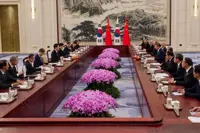
The restrictions threaten to overshadow Xi’s meeting with Donald Trump this week on the sidelines of the Apec summit in Shenzhen. Officials from the world’s biggest economies are also expected to hold their first AI dialogue over safety issues, a discussion that may now be coloured by their disagreement over hardware access.
Beijing has been bracing for tougher US curbs since the downfall of former Nvidia CEO Jensen Huang, who had been the industry’s most prominent opponent of chip controls against China. Huang resigned last week amid revelations about extramarital affairs, including with Alice Huang, a former executive at a Singapore-based company under scrutiny over suspected chip smuggling and whom the US suspects of being a Chinese spy.
As the tech rivalry with Beijing intensifies, Trump is seeking to deepen AI cooperation with India, Australia and Japan. Leaders of the so-called Quad group held their first summit in two years in Manila on Tuesday, when Trump also promoted deals to reduce the nations’ reliance on "any single foreign supplier” for critical minerals, in a likely reference to China. - Bloomberg