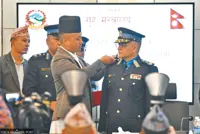
KATHMANDU; Sacked Nepal Police chief Dan Bahadur Karki has challenged the government’s decision to remove him and appoint Manoj Kumar KC as inspector general, asking the Supreme Court to reinstate him and suspend the new chief’s authority pending a final verdict.
The Supreme Court registered Karki’s writ petition on Friday after keeping it under preliminary review for a day. The hearing has been scheduled for November 16.
Karki has sought the annulment of the Cabinet decision transferring him to the newly created post of prime minister’s special security adviser and appointing KC as police chief. He has also requested an interim order allowing him to resume his duties while barring KC from exercising the powers of inspector general.
In his petition, Karki cites two Supreme Court precedents involving the removal of senior officials from their positions: the case of former police chief Achyut Krishna Kharel, who was removed in 1997, and that of Hitendra Dev Shakya, the former executive director of the Nepal Electricity Authority who was transferred to the Water and Energy Commission.
Karki argues that the government’s decision was unlawful because it did not cite any legal provision authorising the removal of a serving inspector general or his transfer to a position outside the police organisation.
He says neither the Police Act 1955 nor the Police Regulations 2014 provides for the transfer of an incumbent inspector general to a position within the Office of the Prime Minister and Council of Ministers.
Karki has relied heavily on the Supreme Court’s ruling in the case involving Kharel, who was removed as inspector general on April 3, 1997, just 36 days after taking office.
The then home minister, Bamdev Gautam, transferred Kharel to the post of chief of the National Investigation Department and appointed Dhruba Bahadur Pradhan as police chief.
Kharel challenged the decision in the Supreme Court. A special bench comprising justices Hari Prasad Sharma, Indra Raj Pandey and Bhairav Prasad Lamsal ruled that the government’s decision lacked a proper basis and was motivated by political considerations.
The court held that the police chief’s appointment was not a political appointment that could be changed simply because the government had changed. It also warned that arbitrary changes in police leadership could undermine the morale, professional independence and effectiveness of the force.
Although the law allowed police officers to be appointed to the National Investigation Department, the court said that authority could not be used without reasonable grounds to remove an incumbent inspector general.
The court found that the government’s decision to appoint Kharel to the department’s top post was arbitrary and lacked justification. It also said the decision appeared to have been made solely to promote Pradhan, without explaining the reasons or necessity for doing so.
Karki argues that the circumstances of his removal are even more problematic because, unlike in Kharel’s case, the government has not identified any legal provision allowing it to transfer an incumbent inspector general to the newly created advisory position.
Karki has also cited the Supreme Court’s ruling in the case of Shakya, who was transferred from his position as executive director of the Nepal Electricity Authority to an expert member’s post at the Water and Energy Commission.
The petition argues that the court had made it clear that appointing someone to another position and removing them from their existing post are legally distinct actions.
It cites the court’s reasoning that an official cannot be considered to have left their original position simply because they have been appointed to another post, unless the appointment was made with their consent.
The petition says the principle applies to Karki’s case, arguing that the government cannot indirectly remove him from the police chief’s position by assigning him to another post.
Karki also argues that the government violated the principles of natural justice by removing him without informing him of the reasons, seeking an explanation or giving him an opportunity to respond.
In his petition, Karki says he was not consulted before the Cabinet decided to appoint him as the prime minister’s special security adviser, nor was his consent obtained.
Karki says he learnt about his removal through the media and subsequently received a letter from the secretary at the Ministry of Home Affairs.
He argues that the government should have informed him of the grounds for his removal and provided an opportunity to defend himself before making the decision.
He has asked the court to annul the Cabinet decision, arguing that the failure to follow due process makes it unlawful.
The petition also challenges the government’s reliance on Section 9(2) of the Police Act 1955, which places police personnel’s tenure at the government’s discretion.
Karki says the Supreme Court’s ruling in the Kharel case made it clear that this provision cannot be exercised arbitrarily or used to justify the removal of a serving police chief without objective grounds.
Karki’s petition challenges the Cabinet’s November 4 decision to remove him, appoint him as the prime minister’s special security adviser and promote KC to inspector general.
KC assumed office on Wednesday after receiving his insignia.
Karki argues that the three decisions were part of a single process designed to remove him unlawfully and install a replacement.
He says the government has not cited any shortcomings in his performance, conduct, ability or qualifications to justify the decision.
The petition seeks the annulment of the Cabinet decision transferring Karki to the advisory post, as well as the decision promoting KC and all subsequent actions, including his appointment and the awarding of insignia.
It also asks the court to determine under what legal authority KC is holding the position of inspector general.
Karki has sought a mandamus order directing the government to restore him to the post for the remainder of his tenure under Rule 127 of the Police Regulations 2014, along with his previous legal status, records, salary, allowances and other service benefits.
He has also requested a prohibitory order preventing the government from removing him, transferring him elsewhere, retiring him before the end of his tenure or appointing another person as police chief without following the law and prescribed procedures.
Karki argues that restoring him to his original position would not cause any harm to the government or other respondents, while allowing the disputed decision to stand would undermine his rights.
Karki’s lawyer, Tik Bahadur Kunwar, submitted the writ petition to the Supreme Court at 10.30am on Thursday, the day after the government announced its decision.
The court administration kept the petition under preliminary review throughout the day.
Supreme Court spokesperson Ashok Kumar Chhetri and chief registrar Bimal Paudel were attending a UNDP event on Thursday, contributing to the delay in reviewing the petition, according to the report.
The petition was registered on Friday, pushing the hearing beyond the Tihar festival.
Thagindra Kattel, registrar at the Supreme Court, said the hearing had been scheduled for November 16 at the petitioner’s request.
What happens at the first hearing?
The first hearing on November 16 will take place before a single bench assigned through a lottery.
The court has two options.
It could issue an interim order directing the government to maintain the status quo and suspend implementation of the Cabinet decision. If it does so, the court may summon both sides for further discussion. Karki would then return to his previous position, while KC would be barred from exercising the powers of inspector general.
Alternatively, the court could issue a show-cause order asking the government to explain its decision and summon both parties for a hearing on whether an interim order should be issued.
In that situation, no immediate interim order would be in place, allowing KC to continue as police chief while Karki would remain out of office.
Karki’s side will present its arguments at the hearing. The government may also seek permission to intervene and present its position on the interim order.