




Amid continuously escalating tensions, Chinese Foreign Minister Wang Yi on Tuesday accused a handful of Philippine politicians of “egregious, irrational and intolerable” conduct, urging Manila to rein in their anti-China rhetoric, state media reported.
Wang made the remarks during a phone conversation with Philippine Foreign Minister Theresa Lazaro, as China-Philippines relations were currently facing what he described as “malicious interference”, according to Xinhua.
“Some Philippine politicians have repeatedly attacked and smeared China out of their political bias and self-interest, crossing China’s red lines,” Wang said.
He accused them of “politicising normal economic, trade and people-to-people exchanges and infringing upon the legitimate rights and interests of Chinese personnel and institutions in the Philippines”.
“Such egregious actions are utterly irrational and intolerable,” he added. “They also have damaged the Philippines’ international image.”
Wang demanded that the Philippine government impress on relevant individuals the need for restraint and ensure that it speaks with “a rational and consistent voice” on China policy.
Following the phone call, Lazaro said on her X account that they had “a frank and constructive discussion”.
“Both sides emphasised the need for continued diplomatic dialogue and the proper management of differences anchored on mutual respect,” she wrote.
The two sides reached a basic consensus on improving and developing bilateral relations, agreeing that healthy and stable China-Philippines relations serve both countries’ interests and meet regional expectations, and pledged to maintain diplomatic dialogue.
They also agreed to work to remove internal and external disruptions and responsibly manage differences to maintain stability while seeking to expand areas of common interest, according to the Chinese readout.
The phone call occurred amid a series of public spats between senior Philippine officials and Chinese diplomats over issues ranging from long-standing South China Sea disputes to broader regional security concerns.
The latest row erupted over China’s participation in the 13th Asean Defence Ministers’ Meeting-Plus (ADMM-Plus), held in Cebu on October 28 and 29. Chinese Defence Minister Dong Jun did not attend; Beijing instead sent its defence attache to Manila.
China accused Philippine Defence Secretary Gilberto Teodoro Jnr of abusing the country’s Asean chairmanship and placing obstacles to China’s participation “out of personal self-interest”, saying he had deliberately delayed inviting Dong, leaving him too little time to prepare.
Teodoro, who Beijing sanctioned in June for “making erroneous remarks that undermined China’s interests”, rejected the accusations, insisting that China had been invited and given an opportunity to present its views.
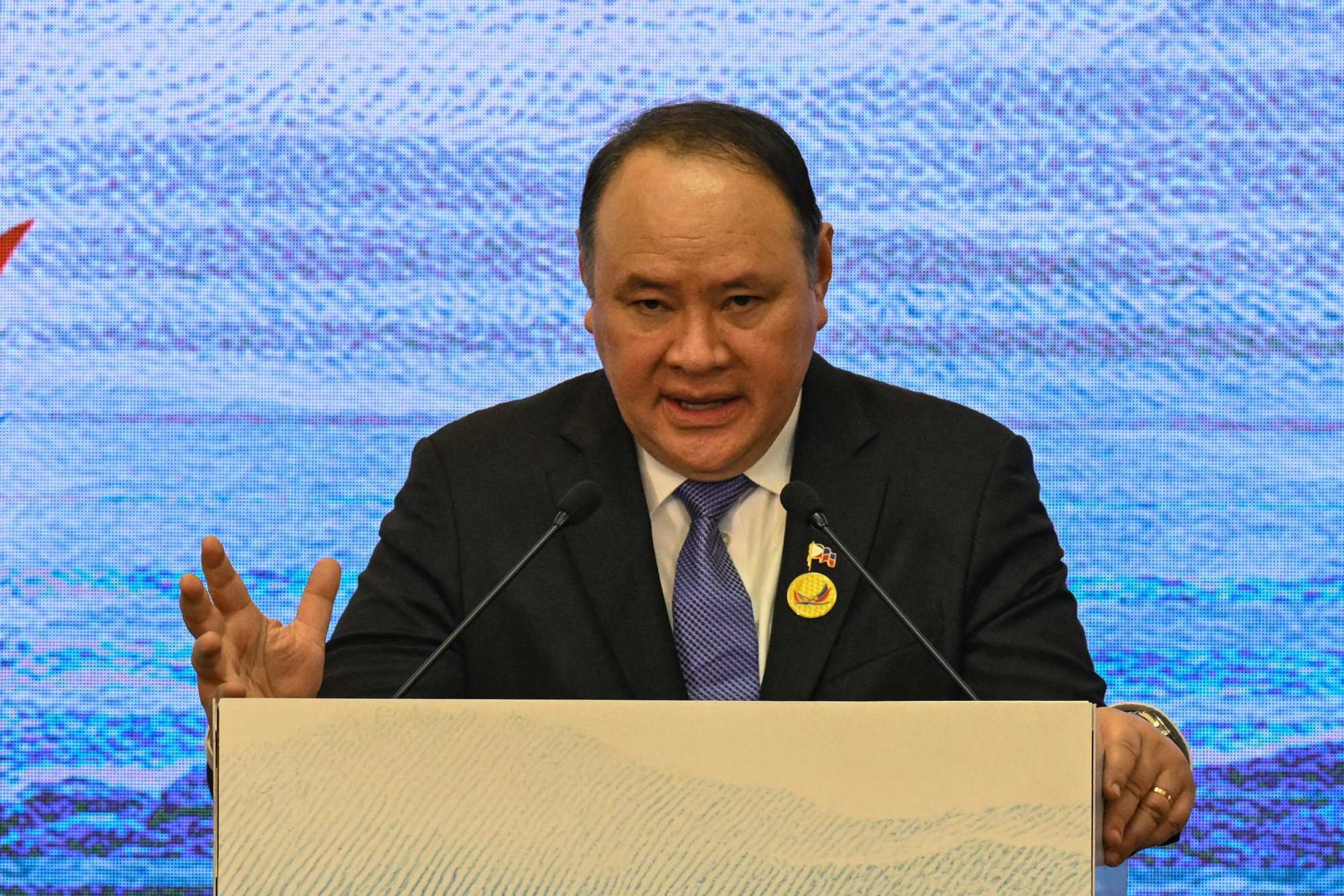
Teodoro said on Sunday he was open to running for the 2028 presidential election. As one of the most prominent China hawks in the Philippines, he has repeatedly criticised Beijing over the South China Sea and advocated closer defence ties with the United States.
Earlier in October, Chinese Ambassador to the Philippines Jing Quan said that China “may easily win” if it chose to use force, while stressing that Beijing would not resort to force and “loves peace”.
He made the remarks in response to Teodoro’s description of China as a regional “troublemaker”.
During Tuesday’s call, Wang reiterated China’s “unwavering resolve” to safeguard its sovereignty and territorial integrity and achieve national reunification, calling on the Philippines to implement its one-China policy in practice and exercise prudence in maritime-related matters.
This underscored Beijing’s growing concerns over stepped-up military cooperation among the Philippines, the United States and Japan in the South China Sea, as well as waters and islands in the northern Philippines close to Taiwan.
Beijing sees Taiwan as part of China to be reunited by force if necessary. Most countries, including the Philippines, the US and Japan, acknowledge or recognise a “one-China” policy and do not recognise Taiwan as an independent state, but Washington is opposed to any attempt to take the self-governed island by force and is committed to supplying it with weapons.
The Philippines also announced plans in May to begin negotiations with Japan on delimiting their maritime boundaries in the waters east of Taiwan.
The China Coast Guard subsequently launched regular patrols to strengthen its presence and bolster its sovereignty and maritime-rights claims. -- SOUTH CHINA MORNING POST


