
Lithium deposits formed by ancient volcanic activity may lie beneath parts of China’s battery manufacturing heartland, particularly along the southeastern coast, according to a new study.
In an interview with the South China Morning Post, geologist Duan Zheng said that “potential targets for clay-type lithium deposits in southeastern China overlap with lithium battery industrial clusters in East and South China”.
“Local supplies could significantly reduce transport costs and supply-chain risks,” added Duan, who is from the Chinese Academy of Geological Sciences’ Institute of Geology and one of the authors of the study.
The paper was published in September by the peer-reviewed Chinese journal East China Geology. It assessed the potential for volcanic clay-type lithium deposits in southeastern coastal China through geological comparisons with major finds in the US and Europe.
“Lithium is a critical strategic mineral, generally classified into three types: hard-rock, brine and clay,” the team wrote in the study, a collaboration with researchers from the Nanjing Centre of the China Geological Survey.
“Volcanic clay-type lithium deposits discovered in acidic volcanic regions in recent years represent an important new resource,” the paper said.
As of May 20, China had about 17,000 lithium-battery-related companies. Of these, 40 per cent were in southern China and 31.6 per cent in eastern China, together accounting for 71.6 per cent of the national total, according to several reports.
China relies mainly on imported lithium raw materials, including hard-rock lithium from Australia and resources from South America. Developing competitive domestic sources near manufacturing centres could reduce dependence on overseas producers.
“Such resources could increase the flexibility of domestic supply and strengthen China’s bargaining power, although these benefits would depend on successful exploration and commercial production,” Duan said.
According to the paper, late Mesozoic acidic volcanic rocks “are widely distributed in southeastern China, extending about 1,200km (746 miles) along the coast and roughly 500km inland, with a total area of around 150,000 sq km”.
Long-term geological surveys have identified four cycles of volcanic activity and 105 calderas in the region, which is known as the volcanic belt of southeastern China.
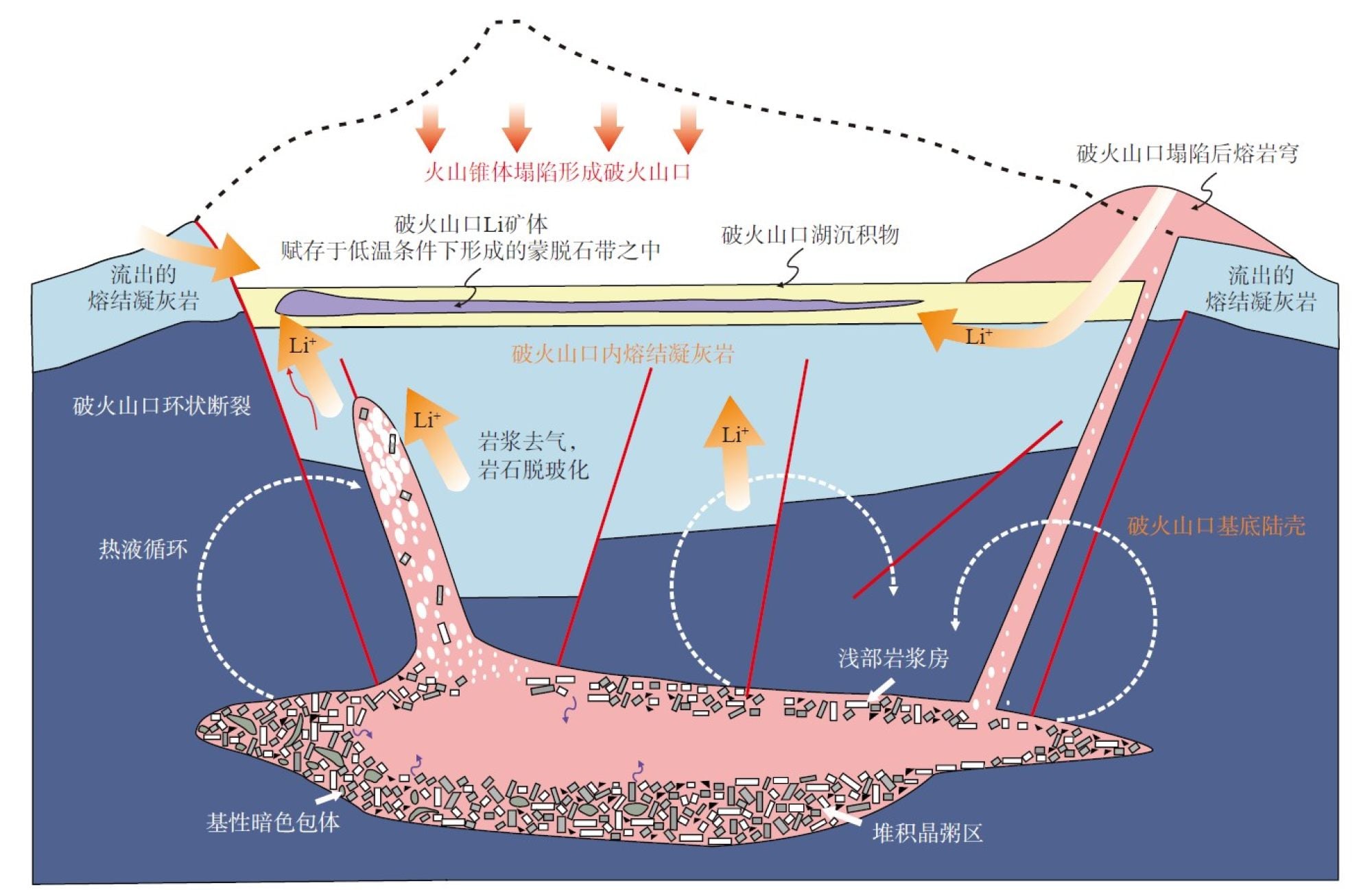
Calderas are large depressions that form when the ground collapses following volcanic activity. They can contain thick layers of volcanic sediments that have been altered into clay-rich deposits, creating conditions favourable for lithium accumulation.
The researchers nominated the Shirenbei Basin in Heping county, Guangdong province, as the first priority for further investigation, with clay-type lithium mineralisation identified in clay-rich layers within its volcanic rocks.
The Shouchang Basin in Zhejiang province’s Jiande city ranked second. Areas around Jinyun and Lucheng, also in Zhejiang, were considered promising, according to the researchers, because of the presence of clay minerals such as smectite and illite.
“The first step is to identify the reserves of volcanic clay-type resources in the Shirenbei Basin of Guangdong province and the Shouchang Basin of western Zhejiang province,” Duan said.
“The next step is to conduct an investigation and evaluation of the illite and montmorillonite clay layer resources in the thick continental volcanic rock area of eastern Zhejiang.”
Drilling should focus on locations where the upper sections of ring-shaped caldera faults intersected with sediments deposited in ancient caldera lakes, he added.
“The upper parts of ring-shaped caldera faults are the most favourable sites for lithium enrichment,” Duan said. “Drilling should prioritise areas where these faults intersect with caldera-lake sediments.”
The geological process begins with volcanic eruptions that produce lithium-bearing rocks and debris.
“These deposits contain lithium mainly in clay minerals formed through the weathering and alteration of volcanic debris,” the researchers wrote. “They are also modified by hydrothermal activity during the reactivation of calderas.”
Calderas create a closed hydrological system, they explained. “Rhyolitic ignimbrite and rhyolites formed during later volcanic activity continually release lithium under the influence of rainfall, allowing it to accumulate within the caldera.”
Magmatic gases and hot, mineral-rich hydrothermal fluids can also supply additional lithium or redistribute the element through surrounding rocks. Over geological time, these processes can concentrate lithium in clay minerals, particularly smectite and illite.
“The formation of major volcanic clay-type lithium deposits around the world is closely linked to acidic volcanic rocks and magmatic-hydrothermal systems,” the team wrote. “The enclosed hydrological environment created by calderas plays an important role in concentrating lithium.”
To assess the region’s potential, the researchers compared its geology with several major overseas deposits, including the McDermitt deposit – the world’s largest known volcanic clay-type lithium deposit.
Total predicted resources of the McDermitt deposit, located within a caldera spanning Oregon and Nevada in the western United States, could reach 120 million tonnes, according to the study.
The researchers also cited the Jadar deposit in western Serbia, which has identified lithium ore resources of 85.4 million tonnes at a cut-off grade of at least 1.76 per cent lithium oxide.
The study noted that estimates of US lithium resources rose from 35,000 tonnes in 2019 to 630,000 tonnes in 2020, 1 million tonnes in 2023 and 1.8 million tonnes in 2024 – a more than 50-fold increase over five years.
These figures illustrate how resource estimates can change with advances in geological knowledge and exploration. They should not, however, be confused with proven economically recoverable reserves.
China’s southeastern coastal deposits remain far less well understood. Measured lithium concentrations in the region range from several hundred parts per million to about 1,000 ppm, below the roughly 2,000 to 3,000 ppm reported for parts of McDermitt.
According to the paper, some layers in Heping contain lithium oxide concentrations of 0.1 to 0.2 per cent and are relatively thick, making them promising targets for further investigation.
The findings do not establish that southeastern China contains large deposits that can be mined commercially.
“At this stage, the findings remain exploration clues and an assessment of potential,” Duan said. “We cannot yet conclude that the deposits can be mined economically.”
Further drilling is needed to determine the size, continuity and grade of potential deposits, while processing presents another major challenge. Extraction costs and technological maturity remain significant uncertainties.
The region’s high population density and environmental restrictions could pose further obstacles to mining projects. Research into its volcanic clay-type lithium resources also remains at an early stage.
“Systematic, dedicated exploration for volcanic clay-type lithium deposits is largely absent in this region,” Duan said. -- SOUTH CHINA MORNING POST