VIENTIANE: White wind turbines rise above Dak Cheung’s forested mountains, while families in nearby villages are discovering new opportunities to improve their lives.
The journey to Dak Cheung district in Xekong province winds through lush forests and rolling hills stretching towards the Vietnamese border. Clouds drift across the valleys, and the cool mountain air offers a refreshing escape from the heat of the lowlands.
Standing between 1,100 and 1,700 metres above sea level, the Dak Cheung Plateau is a landscape of green mountains, red earth and traditional villages, home to diverse ethnic communities whose lives have long been closely connected to the surrounding forests.
Behind this natural beauty, however, lies a history of difficult living conditions. For generations, families have relied on upland rice farming and forest products, working long hours on mountain slopes while facing poor roads, limited markets and few opportunities to earn a regular income.
Today, the landscape is changing. Giant wind turbines stand along the ridges, generating renewable electricity for neighbouring Vietnam. Yet for the people living beneath them, some of the most meaningful changes are taking place much closer to home.
At the centre of this transformation is the 600-megawatt Monsoon Wind Power Project, the first wind farm in Laos and the largest onshore wind project in South-east Asia.
The US$950 million project, which began commercial operations on August 22, 2025, comprises 133 turbines across Dak Cheung district in Xekong province and Sanxay district in Attapeu province. It exports electricity to Vietnam under a 25-year power purchase agreement.
While the project marks a major step in Laos’ renewable energy development, its influence is also reaching households through employment, agriculture, infrastructure and education.
For one local villager, the change has come through an unexpected occupation: making interlocking bricks.
Before joining activities linked to Monsoon Wind, Chansamone Saypanya, a Dak Laeng villager, grew rice, tended gardens and took occasional jobs clearing grass or preparing farmland to support his family.
His income was uncertain, depending largely on the availability of casual work. After the company approached villagers about employment opportunities, he began making interlocking bricks for construction activities.
He now earns more than 200,000 kip (US$9) a day, compared with the 150,000 to 200,000 kip he sometimes received from casual labour.
“It’s better,” he said, comparing his new work with his previous livelihood.
Although the increase may appear modest, having another source of cash income offers an important opportunity in a community where many families have traditionally depended on subsistence farming.
The villager also welcomed the project’s support for coffee cultivation, saying newly distributed seedlings and agricultural training could help families improve their livelihoods.
“If the project had not come, many people would not have made progress,” he said.
However, he acknowledged that the newly distributed coffee seedlings had not yet produced a harvest, meaning their potential contribution to family incomes remains uncertain.
That hope is shared by Souphan Soulivan, a 23-year-old woman from a local ethnic community who is participating in Monsoon Wind’s coffee-growing programme.
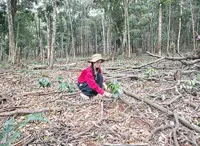
Her family of nine is among the households affected by road improvements associated with the wind farm. They have chosen to grow coffee on shaded land near the turbines, hoping to turn it into a productive plantation.
The young woman said her family had received 6,000 coffee seedlings from the project and believed the area’s natural shade provided suitable conditions for cultivation.
For her, the goal is simple: “To earn more income for the family.”
She also hopes the plantation will help protect the environment by reducing the need to clear land for cultivation.
“We do not burn the forest,” Souphan said, explaining her family’s approach to growing coffee under existing tree cover.
The coffee plants are expected to begin producing cherries in approximately two years. Until then, the family must continue caring for them without knowing how much income the harvests will eventually bring.
Meanwhile, she is gaining practical skills through training in preparing natural compost, caring for coffee plants, selecting ripe cherries and improving processing methods.
She has also participated in school meal activities, coffee seedling programmes and basic healthcare training, gaining experience that could benefit both her family and the wider community.
Monsoon Wind Social Manager Chakrit Duangjai said coffee cultivation offers an alternative to traditional upland rice farming, which requires considerable labour and often produces limited harvests.
“Can coffee change that? We think so,” he said during a presentation on the project’s community development activities.
According to Chakrit, the project has distributed more than one million coffee seedlings, with cultivation activities covering approximately 460 hectares across 404 plots.
The company is encouraging farmers to improve quality and processing techniques so they can get a better price for their crop rather than simply increasing yields.
Chakrit recalled meeting villagers who had grown coffee for years but had never tasted a drink made from their own beans. Some knew only the taste of instant coffee bought from local shops.
Many farmers previously sold freshly harvested coffee cherries to traders, often mixing ripe and unripe fruit and accepting low prices because they lacked the equipment and knowledge needed to process their crops.
The project has since introduced training in harvesting, roasting and processing, enabling farmers to produce higher-quality coffee and potentially secure better returns.
Beyond coffee farming, improved access to water is also changing daily life.
Chakrit described a community of 37 households where villagers helped install a pipeline carrying water from a source approximately five kilometres away, using materials provided by Monsoon Wind.
The improved supply has enabled families to expand vegetable growing and coffee processing, while reducing the time women spend carrying water to their gardens.
Some households have purchased coffee-milling machines, allowing them to process their harvests instead of immediately selling fresh cherries to traders.
“Now they have the choice to process it themselves,” Chakrit said.
Locally grown vegetables are also supplied to markets and the Monsoon Wind kitchen, with some produce used in school meal programmes.
Road improvements have brought further benefits. Routes developed for the wind turbines now also connect villages to agricultural areas and markets, making it easier to transport produce and obtain essential goods, particularly in the rainy season.
For remote communities, better roads can also improve access to schools, healthcare facilities and other services.
Education and healthcare are another focus of the company’s activities. Monsoon Wind has supported medical check-ups, village health volunteers, school improvements and scholarships for 10 students to pursue university studies in Ubon Ratchathani, Thailand.
Chakrit said these opportunities demonstrate the potential of young people from remote communities.
“If they have opportunities, they can improve and develop themselves,” he said.
The wind farm has also created jobs for Lao workers. According to the developer, construction generated at least 1,600 jobs, more than 1,000 of which were filled by Lao nationals.
Beyond employment and agriculture, the company is exploring Dak Cheung’s potential for community-based tourism. Its cool climate, forested mountains, waterfalls and distinctive ethnic traditions could attract visitors seeking experiences beyond Laos’ established destinations.
Chakrit said young villagers have been encouraged to interview elders, document traditional customs, prepare village maps and create videos about their communities, helping preserve local heritage while exploring future tourism opportunities.
The company’s community development commitment extends beyond the construction period.
Monsoon Wind has pledged US$1.1 million annually for community development during its operations, supporting education, healthcare, agriculture and infrastructure. Its website says the programme covers 31 villages.
If maintained over 25 years, the commitment would total US$27.5 million, representing a potentially important source of long-term support for rural communities.
“We take community development very, very seriously,” Chakrit said.
The developer reports that no households were resettled during construction. However, Chakrit said 769 households had been identified as affected by project activities, requiring compensation or livelihood restoration support.
Ensuring these households receive fair treatment and that livelihood programmes produce lasting benefits will be important measures of the project’s success.
For the local brick-maker, the immediate change is an opportunity to earn more from his daily work. For the young coffee farmer, the future rests in thousands of seedlings that have yet to bear fruit.
Their experiences reflect the hopes of families seeking greater financial security while maintaining their connection to the land and traditions of Dak Cheung.
As the white turbines turn above the district’s green mountains, they represent a new chapter in Laos’ clean energy development.
But beneath them, another story is unfolding, one measured not in megawatts, but in better harvests, new skills, improved living conditions and opportunities for the next generation.
For Dak Cheung, the greatest achievement may ultimately be not only the electricity exported to Vietnam, but the new livelihoods taking root in the villages below. - Vientiane Times/ANN