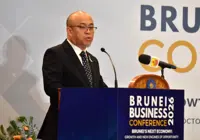
BANDAR SERI BEGAWAN (Borneo Bulletin/ANN): Brunei Darussalam must accelerate economic diversification by developing new industries, strengthening local businesses and ensuring investments generate skilled jobs and higher exports, said Coordinating Minister for Economic Policies and Minister of Economy, Trade and Industry Dato Seri Setia Dr Abdul Manaf Metussin.
Delivering the keynote address at the Brunei Business Conference 2026 on Monday, he said the country needed to adapt to global uncertainties, shifting trade patterns, technological advances and the transition towards sustainability to remain competitive.
Between 2015 and 2025, Brunei’s economy grew by an average of about 0.7 per cent annually, while the non-oil and gas sector expanded by 2.7 per cent a year.
The sector’s share of gross domestic product increased from 46 per cent to 54 per cent, while its share of total exports rose from seven per cent to 60 per cent over the same period.
While the figures reflected progress in diversification, he said further efforts were needed to improve productivity, innovation and the competitiveness of local businesses and workers.
Speaking under the theme “Brunei’s Next Economy: Growth and New Engines of Opportunity”, he identified downstream oil and gas, agri-food and fisheries, tourism, telecommunications, digital and creative media, transport and logistics, and advanced manufacturing as priority sectors.n
These industries could support higher-value production, create skilled employment and expand exports, while building on Brunei’s existing strengths and access to regional markets.
As of August 2026, the Brunei Economic Development Board’s tracked investment portfolio comprised 27 operating foreign and domestic projects, representing about USD6 billion in investment and employing more than 2,000 local workers.
Developing new industries
The minister cited Hengyi’s planned USD5 billion Phase 2 expansion, targeted to begin operations in 2029, as an opportunity to attract complementary downstream manufacturers and increase local participation in industrial supply chains.
In agri-food, a joint feasibility study is under way for the proposed Brunei-Singapore Agri-Tech Food Zone, which could attract investment, create opportunities for local businesses and strengthen food security.
He also called for greater emphasis on food safety, product quality and sustainability, including regenerative agriculture and Brunei Pesticide Free certification, to help local products access higher-value markets.
Investors, he said, should explore opportunities throughout the agri-food value chain, from primary production and processing to packaging, logistics and market access.
The green and blue economies were also identified as potential growth areas. Brunei’s target of obtaining at least 30 per cent of its total installed power generation capacity from renewable energy by 2035 could create opportunities in solar energy and supporting infrastructure.
Sustainable manufacturing, waste management, aquaculture and seafood processing could further support cleaner production, food security and responsible use of natural resources.
Strengthening regional connectivity
The minister highlighted the Brunei Darussalam-Indonesia-Malaysia-Philippines East ASEAN Growth Area (BIMP-EAGA) and wider regional partnerships as avenues for expanding services, logistics and distribution.
He pointed to improvements at Muara Port Company Sdn Bhd, where port turnaround time fell from 30.8 minutes to 11.6 minutes in 2025.
An ongoing expansion is expected to increase container terminal capacity from 220,000 to 500,000 twenty-foot equivalent units by 2027, strengthening the port’s role in regional trade.
Given Brunei’s relatively small domestic market, he urged local businesses, particularly micro, small and medium-sized enterprises, to pursue regional partnerships and participate in wider value chains.
Businesses should also position themselves to benefit from procurement opportunities created by major investments, while improving productivity, meeting industry standards and adopting modern technologies.
Technology and local talent
The minister said global interest in data centres and artificial intelligence (AI) presented opportunities, but investments needed to be assessed carefully given their electricity and water requirements.
He said such projects should contribute to the wider economy by supporting industrial development, improving productivity and building local capabilities, rather than being pursued solely for the investment value.
Examples included UNN’s partnership with Vobile Inc. to establish an AI-capable data centre to support innovation in the creative and multimedia industry, and Envolve’s AI-powered Food Innovation Initiative, which aims to improve productivity in the food sector and contribute to food security.
Preparing Bruneians for jobs in emerging industries was another priority. Manpower requirements submitted by investors indicate that projects under implementation are expected to generate more than 2,900 jobs once operational.
He called for closer cooperation between employers and education and training institutions to align skills development with industry needs, supported by stronger coordination across ministries.
The minister said progress should be measured by tangible outcomes, including projects becoming operational, more contracts awarded to local suppliers, skilled employment for Bruneians and increased exports.
He urged conference participants to turn discussions into concrete investment opportunities and partnerships, stressing that cooperation between the Government and private sector would be crucial to building a more diversified, resilient and competitive economy in support of Wawasan Brunei 2035. – Lyna Mohammad - Borneo Bulletin/Asia News Network