




Chinese researchers have developed a “lifelike” shape-changing hydrogel they say could provide a platform for next-generation developments, such as flexible tissue engineering scaffolds, brain-computer interfaces and humanlike robots.
Inspired by living organisms, the team created a light-triggered system called STERS, which uses liquid metal particles to generate slow, self-sustaining chemical reactions that allow a hydrogel to change its structure over time.
Capable of growing and changing alongside living tissues, this adaptive system could inspire next-generation biomedical materials and devices. It could also have broad implications in fields such as regenerative medicine and soft robotics, according to the researchers.
“This novel approach enables programmable, lifelike morphological evolution in hydrogels, spanning microscopic to macroscopic scales, minutes to weeks, and single to multiple transformation cycles,” the team said in a paper published in the peer-reviewed journal Matter on September 4.
Living organisms rely on physical structural changes – such as colour changes and directional growth – to adapt, grow and evolve. Scientists are actively developing smart synthetic materials and devices inspired by these dynamics.
Du Xuemin, study author and a professor at the Chinese Academy of Sciences’ Shenzhen Institutes of Advanced Technology, said he had long been engaged in research on smart materials and had previously drawn inspiration from species such as sensitive plants, whose leaves fold inward when touched, and the chameleon.
Du said in an interview that the field of smart materials had advanced rapidly, with shape reconfiguration accelerating from slow speeds to the millisecond range.
Materials in development include shape memory alloys, which can bounce back and forth between set shapes when triggered by external stimuli such as temperature changes.
“However, after conducting extensive research in this area, I returned to the perspective of living organisms,” Du said.
“I realised that while organisms undergo rapid shape changes, they also undergo slow long-term evolutionary transformations,” he said, pointing to wound repair and embryonic development as examples.
Tissue engineering often uses scaffolds loaded with active substances to promote healing, but Du noted that existing materials either transformed too rapidly or lacked shape-morphing abilities.
“So I wondered if we could mimic these slower morphological transformation processes in nature to construct slow, shape-morphing materials,” he said.
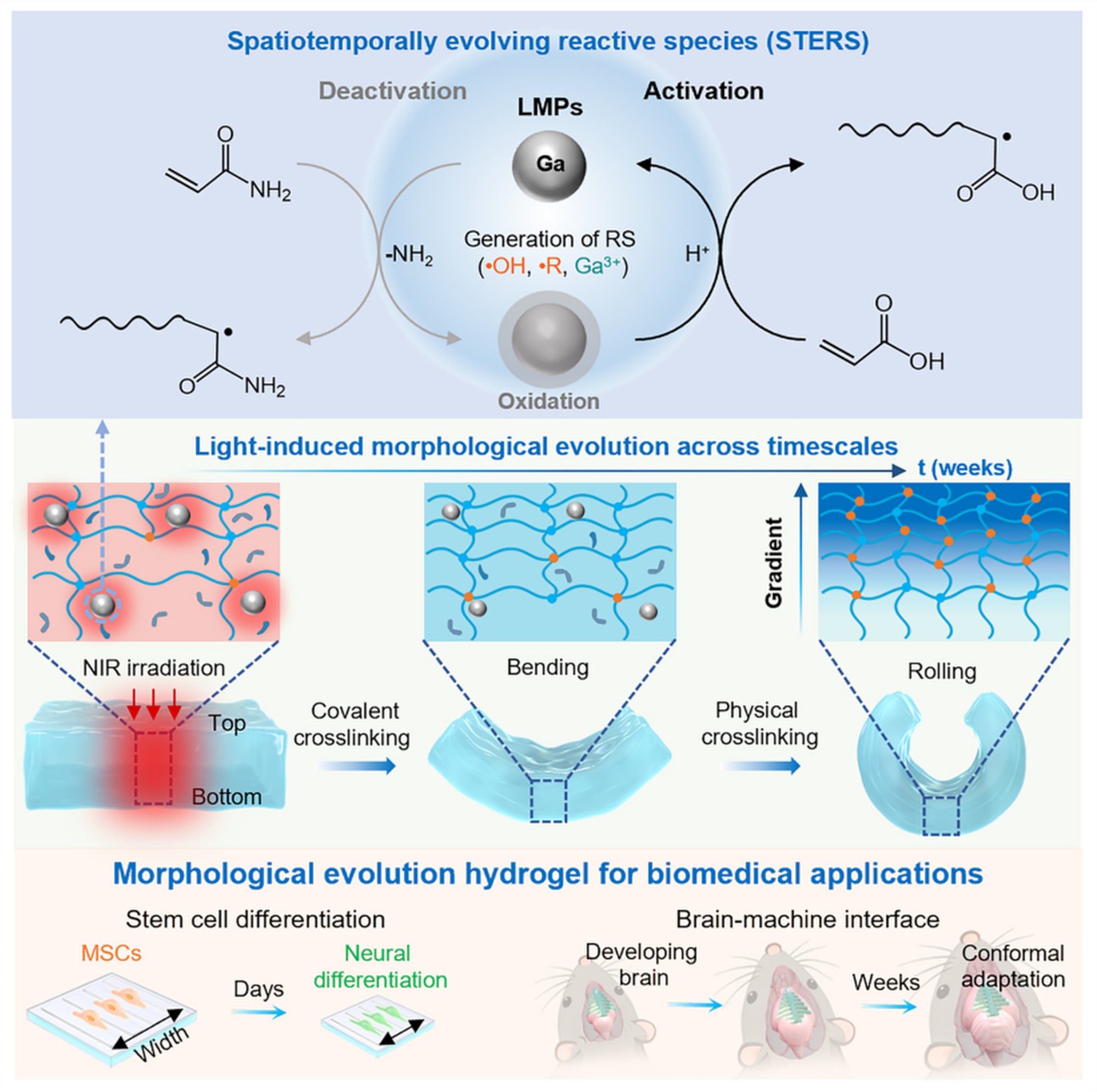
To achieve this, the team developed a liquid metal-based system inspired by active chemical species being released in cells to drive morphological changes.
The STERS or “spatiotemporally evolving reactive species” system integrates gallium-based liquid particles that produce reactive species and vinyl monomers that help drive that production and the polymerisation of the hydrogel, thus creating building blocks for the gel to change shape.
The system is activated by near-infrared light, and a single exposure can sustain the STERS system for up to four weeks.
The researchers said this worked because the liquid metals generate reactive species through cycles of surface oxidation when exposed to environmental elements, followed by the removal of the oxide layer to re-expose the metal and allow the reaction to repeat.
To test their system, they used the hydrogels to guide stem-cell differentiation into bone and neural-like cells.
“Furthermore, we modified the surface of a brain-machine interface electrode with this material to monitor how electrical signals evolve during rat embryo development,” Du said.
“This allows precise detection of changes in brain waves, offering a new technique for studying brain activity during embryonic development and advancing brain science.”
The material’s transformation rate and magnitude can be tailored to match embryonic brain changes, as development patterns are already well understood in existing literature.
Du said the use of liquid metals, which can pose biological safety risks to tissue, was another safety consideration.
To mitigate this, the team packaged the materials using a sandwich structure to safely and effectively encapsulate the material and avoid leaks to surrounding tissue, he said.
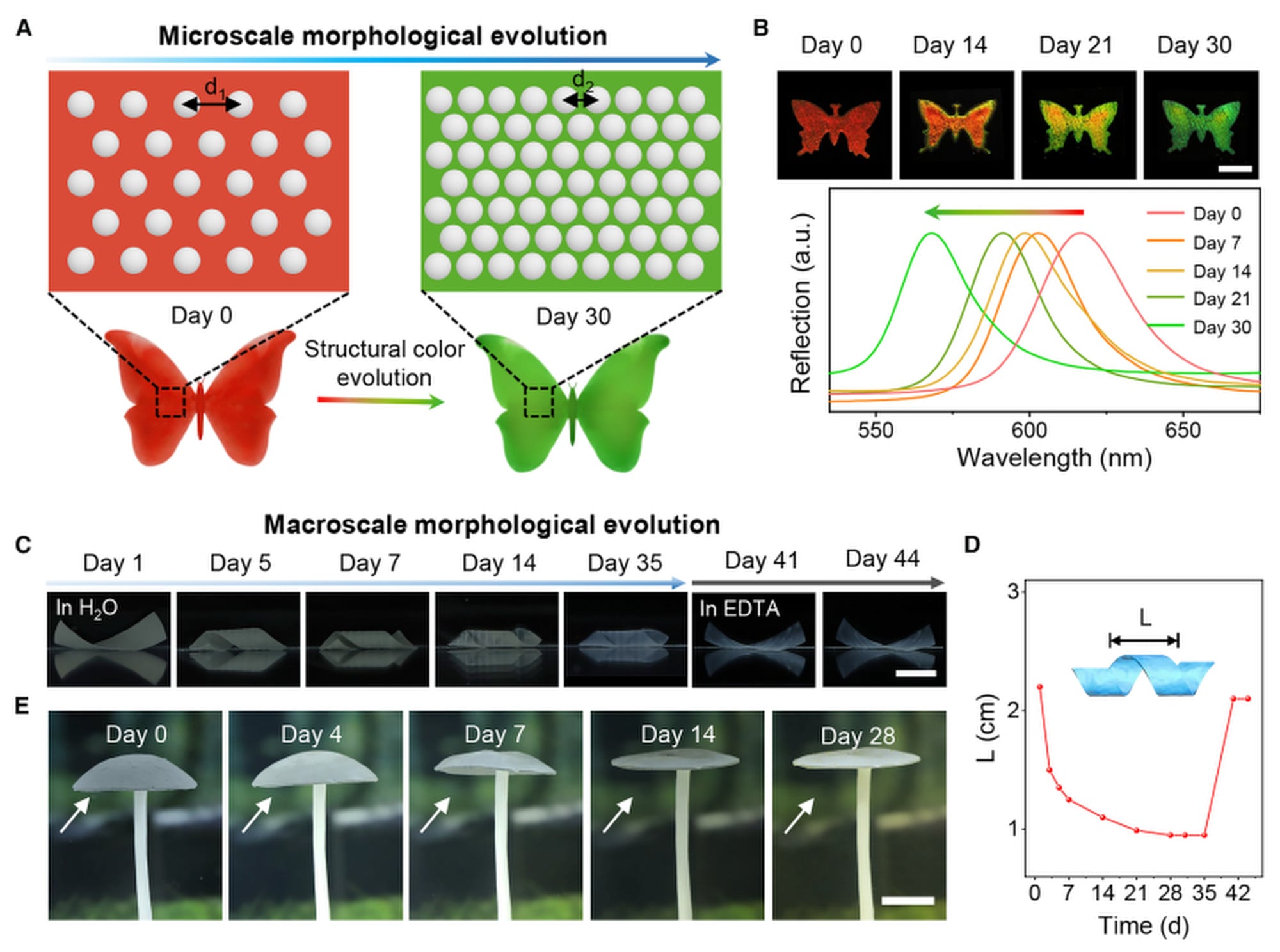
Du said he believed there were opportunities for the STERS system in other fields such as robotics. For robots to become more humanlike, he said, their sensing capabilities, skin and other physical characteristics must also align with humans.
The system also holds promise for sensing applications. The team created a hydrogel that gradually changes colour over the span of a month, serving as a long-term visual indicator.
However, Du noted that several hurdles remained for long-term clinical applications, including precisely matching the material’s transformation timeline to specific tissues, exploring even slower shape morphing and achieving on-demand control of the transformation process using external stimuli.
For now, he said, the system could be used as a sensor or for laboratory demonstrations in tissue engineering and brain-machine interfaces. -- SOUTH CHINA MOPRNING POST


