VIENTIANE: Laos has called for stronger international cooperation to heal the lingering wounds of war, stressing that addressing the threat posed by cluster munitions and unexploded ordnance (UXO) requires shared humanitarian responsibility.
Lao Prime Minister Sonexay Siphandone emphasised on Monday (Sept 14) that healing the wounds of war requires shared humanitarian responsibility rather than individual state efforts. He made the remarks while speaking at the opening of the third Review Conference of the Convention on Cluster Munitions in Lao capital Vientiane, which Laos is hosting from Monday to Friday.
In his opening remarks, Sonexay said Laos has made UXO clearance a national priority by integrating its international commitments into the National Socio-Economic Development Plan and Sustainable Development Goal 18, "Lives Safe from UXO." He said the conference should help turn political commitments into practical results by accelerating clearance, safely returning contaminated land to communities, strengthening assistance for victims and reducing casualties.
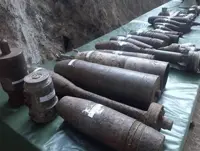
The scale of Laos' continuing challenge was highlighted on Sunday, when more than 270 delegates visited a UXO clearance site in Phikyai village, about 17 km from Luang Prabang city centre in northern Laos' Luang Prabang province. The field visit gave participants first-hand insight into the country's decades-long effort to remove the deadly remnants of war.
Luang Prabang remains one of the provinces significantly affected by UXO contamination. Since 2016, technical surveys in the Phikyai area have covered 423 hectares, identifying 347.2 hectares as confirmed hazardous areas.
Clearance operations have so far released 119.73 hectares, including 117.3 hectares of agricultural land. The work has resulted in the discovery and destruction of 3,461 explosive items.
For residents, clearing contaminated land is closely tied to livelihoods and development. Most villagers depend on agriculture, and the release of safe land allows communities to expand rice cultivation, crop and fruit production and livestock raising, while also creating opportunities for commercial activities and tourism.
Between 1964 and 1973, more than two million tons of ordnance, including around 270 million cluster submunitions, were dropped on Laos, with roughly 30 per cent failing to detonate and leaving an estimated 80 million unexploded submunitions behind.
Since its establishment in 1996, UXO Lao has deactivated more than 2.08 million items of ordnance.
By hosting the conference, Laos is bringing its long experience in dealing with the legacy of war to the international stage while urging countries and partners to turn shared commitments into concrete action. - Xinhua