COTABATO, Philippines: On a basketball court in the Philippines' Marawi, ballots piled high on pallets awaited transport to towns across a Muslim-majority region that has traded decades of separatist violence for a chance at self-determination.
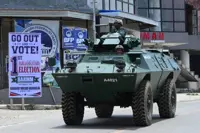
Not far from there, campaign posters clung to the sides of bombed-out buildings, a stark reminder of bloody battles between jihadist fighters and government forces nearly a decade ago.
Following an on-off peace process that began in the late 1990s, the Bangsamoro Autonomous Region in Muslim Mindanao (BARMM) heads to its first polls on Monday (Sept 14), trading appointed parliamentarians for elected ones.
In a region long marred by political violence and blood feuds between powerful families, a peaceful election would be considered a success, party leaders said last week.
"Everyone agrees that more than winning, we need to preserve the relative peace we've achieved... That's paramount for everyone," said candidate Naguib Sinarimbo, a key strategist for the newly formed Bangsomoro Federalist Party (BFP).
Former rebels and dynastic clans are expected to dominate the polls, while minority Christians and Indigenous groups vie for representation.
The group that had fought for regional autonomy in the predominantly Catholic country, the Moro Islamic Liberation Front (MILF), is now split between two competing parties.
An estimated 14,000 men from the MILF remain under arms.
Thousands of them have followed military commander Abdulraof Macacua to his BFP party since President Ferdinand Marcos chose him as interim chief minister.
Senior MILF leadership opposed that appointment, with thousands more fighters remaining loyal to longtime chairman Murad Ebrahim and his United Bangsamoro Justice Party.
Checkpoints have proliferated in recent weeks and more than 20,000 security personnel have been assembled to secure polling stations, but the lead-up to Monday's vote has not been without incident.
Last month, a Macacua motorcade was ambushed and peppered with bullets.
On the day after AFP arrived in regional capital Cotabato, a convoy of about 200 armed MILF fighters was turned away from the city for violating the terms of the region's peace agreement, said election official Ray Sumalipao.
'Brother against brother'
At a base for the MILF's military wing outside Cotabato, a young fighter admitted he was fearful of a clash "brother against brother".
In his office inside the compound, 78-year-old Murad shook his head at the idea, saying there would be "no conflict".
"The spirit of brotherhood is stronger than political differences," he said, adding he maintained open lines of communication with his one-time allies, who remain MILF members despite being stripped of rank.
The group's former chief negotiator, Mohagher Iqbal, said in a separate interview: "If we lose fair and square, we don't have a problem with that."
To Murad, residents accepting the outcome would hinge on how the polls are conducted, citing alleged voter intimidation by the Philippine military.
"Sometimes during elections, the military conducts operations. Although they don't directly block people from going to vote... people get scared," he said.
Sinarimbo, of the rival faction, warned against the "dangerous idea that some groups are the only ones entitled to rule the government because they were the ones who fought for it".
"There are risks involved," he said of the vote. "But I think the level we've achieved is sufficient enough to hold the parties to continue with the (peace) agreement."
"There's no turning back."
Learning to vote
In Lanao del Sur province, home to Marawi, Vice Governor Mohammad Khalid Adiong said that "the most critical element" was returning the region's combatants to civilian life.
"Decommissioning was the central purpose of the peace talks," he said.
The Adiong family has joined with other regional political dynasties in forming the BARMM Grand Coalition, positioning itself as an alternative to the now-divided MILF.
Many voters, meanwhile, are contending with an unfamiliar process.
"Who knows how to vote?" candidate Emelita Cordero had asked a group of would-be constituents in one of the BARMM's Christian communities.
"No one was raising their hand," said Cordero, 57, whose small BEST party is fielding a slate that is nearly half women.
She said those education sessions were injecting voters with a sense of enthusiasm.
Sumalipao, the regional head of election commission Comelec, told AFP he expected a turnout of "not less than 80 per cent".
In a Cotabato wet market, 70-year-old vendor Luzminda Juanilla said she was simply happy to be choosing her own leaders.
"It was exhausting before... There was so much killing," she said.
"It took a long time, but it's here now." - AFP