
Chinese President Xi Jinping and Russian President Vladimir Putin both vowed to strengthen the role of the Shanghai Cooperation Organisation (SCO) during their meeting on Monday, as the two countries seek to deepen strategic coordination amid mounting tensions with Washington and its allies.
The two leaders met on the sidelines of the SCO summit in Bishkek, Kyrgyzstan.
Xi said the SCO has a mission to safeguard regional stability and promote regional development amid growing uncertainty and unpredictability in a fast-changing international situation, according to a readout from the Chinese side.
“China is willing to work with all parties, including Russia, to discuss the future development of the organisation, help it achieve steady and long-term growth, and strengthen the force that leads the reform of global governance and advances an equal and orderly world multipolarity,” he said.
Putin said Russia and China should enhance solidarity and cooperation within the organisation and play a guiding role, the readout said.
The encounter, on the sidelines of the SCO’s 25th anniversary, was their second face-to-face meeting this year following Putin’s trip to China in May, just days after Donald Trump’s visit.
Xi arrived in Bishkek on Sunday and held talks with Kyrgyz President Sadyr Japarov, according to state news agency Xinhua.
Putin praises relations between Moscow and Beijing
When talking on bilateral matters during Monday’s meeting, Putin praised how the relations between Moscow and Beijing have become a model for state-to-state relations, saying Russia is willing to strengthen cooperation with China in fields including trade, energy, industry, transport, science and technology, according to the Chinese readout.
Xi said the relevant departments from both sides are actively implementing the initiatives he and Putin discussed during Putin’s state visit to China in May, and have already achieved substantial results.
“We believe that under our strategic guidance and the joint efforts of both sides, the foundation of China-Russia relations will become more solid, the pace of development more steadfast, and the prospects even brighter,” said Xi.
During Putin’s May visit, the two leaders extended the 2001 Treaty of Good-Neighbourliness and Friendly Cooperation, signed multiple cooperation documents and issued joint statements on comprehensive strategic co-ordination and a multipolar world.
Trade between the two countries has rebounded this year following a dip in 2025. Figures for the first half of the year rose by around 25 per cent year on year, while the total for the first seven months of the year approached US$159 billion, according to official Chinese data.
Energy is expected to feature prominently in the latest talks, including the stalled Power of Siberia 2 gas pipeline.
Moscow has portrayed the project – which would carry as much as 50 billion cubic metres (1,765 billion cubic feet) of Russian gas annually to China through Mongolia – as central to its eastward economic pivot after losing many of its European markets.
But the two sides have not reached agreement on pricing, financing, supply commitments and construction timelines.
Kremlin spokesman Dmitry Peskov said in May that an “understanding” had been reached on the route and construction method, but no final commercial contract had been signed.
Xi, Putin discuss international and regional issues
Xi and Putin also discussed international and regional issues of common interest, according to the readout, without elaborating.
Beijing has not condemned the invasion of Ukraine and called for negotiations to end the war while insisting it was not a party to the conflict. It has also rejected accusations from the West that it is supporting Russia’s defence-industrial base.
Taking part in the talks on the Russian side were Foreign Minister Sergey Lavrov and Deputy Prime Minister Alexey Overchuk, alongside officers from the Presidential Office.
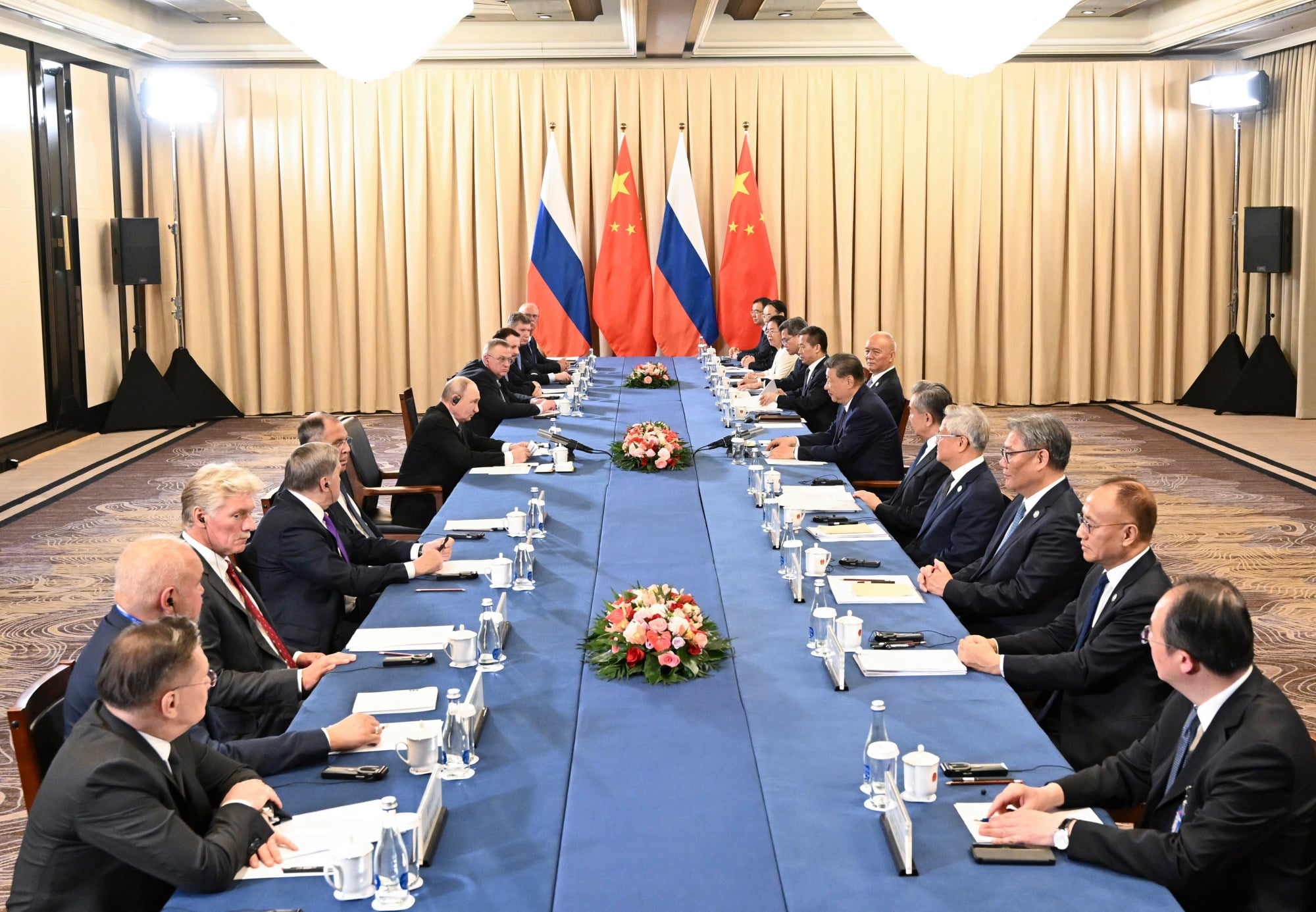
Notably, Economic Development Minister Maxim Reshetnikov and Energy Minister Sergei Tsivilev, CEO of the Russian Direct Investment Fund (RDIF) and the Rosatom State Corporation – the state nuclear energy and nuclear goods company – also attended the meeting, according to the Kremlin, which indicated potential cooperation areas.
Xi and Putin have met in person more than 40 times since 2013, branding their relationship a “no limits” partnership in February 2022.
While both have presented it as a strategic counterweight to Western pressure, they have stopped short of declaring it a formal alliance, and analysts have said the Ukraine war has left Russia increasingly reliant on China for trade, technology and diplomatic support.
Both countries have also tried to promote the SCO as a platform for a more multipolar international system.
China and Russia founded the 10-member security and economic forum in 2001, along with Kazakhstan, Kyrgyzstan, Tajikistan and Uzbekistan. India, Pakistan, Iran and Belarus have since become members.
Chinese state media has framed the summit as an opportunity to expand the organisation’s role beyond traditional security cooperation into trade, connectivity, digital development and global governance.
Former Kyrgyz prime minister Djoomart Otorbaev wrote in state-run China Daily on Monday that the group’s expanded membership had broadened its focus from security to economic development across Eurasia.
However, it remains a loose grouping, with members divided over issues such as the wars in Iran and Ukraine, relations with Russia and the extent to which it should challenge Western influence.
Member states such as India also have long-running territorial disputes with China and Pakistan. -- SOUTH CHINA MORNING POST