KALIKASTHAN: Two seconds is time enough to blink. For 31-year-old Sudip Kumar Neupane, this window meant the difference between life and death.
Sudip was racing back on a motorcycle after warning villagers of an approaching flood when buffaloes slowed him down by an estimated two seconds.
Then a torrent of flood and debris came.
As mud, rock and water barrelled down, carrying away his 27-year-old younger brother, Pradip, and Janak, an information technology officer in Uttargaya Rural Municipality in Rasuwa whom Neupane regarded as a cousin.
Sudip survived, only to be haunted by the question of why he lived when the two men beside him did not.
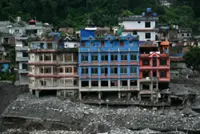
His survival by a whisker means a life tormented by the disaster, much like hundreds of others who lost their loved ones when a glacial collapse in the Langtang region on August 26 unleashed a devastating flood on the Bhotekoshi River.
After spending two days grieving, Sudip returned to the front line of the relief effort. Displaced people needed food and shelter, and the local unit was short of staff. Some people objected to his presence in relief distribution.
Sudip kept his cool. “We are educated and responsible people. In a disaster, we need to remain calm,” he said. “I survived by luck. For as long as I live, I will continue serving society and the people.”
Sudip works as a fourth-level officer in the enterprise development section of Uttargaya Rural Municipality. On August 26, he felt an air of unease.
He did not want to go out that morning. His uncle, who worked at the District Administration Office, warned him before he left. “Son, be careful. There is a flood coming.”
But Sudip felt he had a responsibility to the people around him. As a resident and municipal employee, he believed he needed to help warn villagers of the danger.
Pradip, his younger brother who was a seventh-level public health officer in the rural municipality, joined him. The brothers set out on motorcycles to warn people.
Sudip gave his motorcycle to Pradip, who handed it to health worker Maniram and sat behind him. Sudip travelled on another motorcycle with Janak, locally known as “Janak dai”.
From behind, his younger brother Pradip called out, “Brother, we need to make an announcement!”
Hearing him, Sudip took the microphone and began warning people about the approaching flood as they moved on.
Relief distribution process underway at Nilakantha Higher Secondary School in Uttargaya Rural Municipality-5 on Thursday.
At Khalte, Sudip warned Pradip not to get any farther. Pradip stopped there while Sudip and Janak continued towards Nayapul.
There they encountered Balaram Neupane, chief of the local health service, rushing back for safety.
“Friends, we won’t survive! We’ll die! Turn back, turn back!” he shouted out.
They turned around and accelerated back towards Khalte. Then came the delay that Sudip believes saved his life.
Buffaloes belonging to displaced members of the Tamang community, who were staying at a temporary camp, were blocking the road.
For roughly two seconds, according to Sudip, they could not move. When the animals cleared out, they continued towards Khalte. The flood struck from behind.
‘It came like a missile’
Sudip says what came down the valley did not feel like an ordinary flood.
“I don’t see it simply as a flood, and it wasn’t an ordinary wave,” he said. “It came like a missile, like artillery. It swept everything away. Nobody even had enough time to make a sound.”
Janak lost control of his motorcycle. He abandoned it and ran towards a field. Neupane ran uphill. The first wave was already behind them.
“Within five minutes of the flood arriving, our office was destroyed,” he said. “In those moments, chances hovered between death and survival. There was no time to pause even for breath.”
Sudip had managed to run for only four or five seconds uphill when the first wave hit. He thought his brother had escaped. Pradip was tall and long-legged. Sudip’s assumption that he could have outrun the water was wrong. He did not survive.
Pradip was 27, had recently built a house and had many plans for the future.
“We came from a poor family. We grew up wearing worn-out clothes and eating whatever food we could afford. We worked hard to build better lives for ourselves,” Sudip recalled.
Their uncle and aunt struggled to support his education, sometimes going without meals to pay for his studies. Pradip eventually earned a master’s in public health.
‘Perhaps I survived for a reason’
Sudip earns about Rs32,000 a month as a municipal employee. The experience has changed his perception of life.
“If we both brothers had died, our family would have been shattered,” he said. “Perhaps that terrifying wave threw me out saying, ‘Now you have to take responsibility for the family.’”
That sense of responsibility helped him overcome grief while people around him were hungry, displaced and needy. “I will help them as much as I can.” - Kathmandu Post/ANN