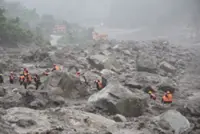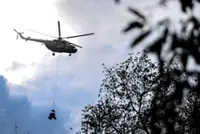
Rescuers are rushing to reach workers believed to be trapped in tunnels at hydropower sites buried in mud after catastrophic flooding in Nepal and China, as the death toll continued to rise and increasingly desperate families search for their loved ones.
The combined deaths in Nepal and China surpassed 900 yesterday, with more than 4,700 people missing, and a private-sector association representing power companies said at least 900 workers have been unaccounted for from 12 hydropower projects damaged by the floods in Nepal’s Rasuwa and Nuwakot districts.
Mohan Kumar Dangi, president of the Independent Power Producers’ Association, Nepal, said there is an estimation of at least 500 of the 900 missing workers trapped in the tunnels, although authorities have provided varying numbers and said several foreign teams were assisting Nepali rescuers.
At least one expert said the tunnels offered enough space for people to take refuge and that some workers could have access to oxygen. But others warned that the chances of finding survivors were diminishing.
Dangi said some workers had managed to make contact and call for help when the disaster struck last Wednesday, and some others who managed to flee reported to authorities and relatives that many of their colleagues were still in the tunnels.
But he added that, six days after the disaster, fears grew that some might have suffocated.
“We are working in search and rescue of the stranded people from hills, settlements and river areas,” said Brig-Gen Raja Ram Basnet, Nepal’s army spokesman.
Nepal’s disaster agency said yesterday that at least 903 deaths had been counted in that country, with around 4,247 people, including 592 foreigners, missing.
Workers shovelling mud from a flood-ravaged power station in Dhading, Nepal, said the station is a key node for providing power to over 20,000 people in the region.
Rescue efforts are focused on people trapped in the gigantic tunnels built for controlling the waterflow to produce hydropower, across multiple sites.
“The tunnels are built to access hydropower infrastructure and to divert water – an essential step to generate energy.
“They are big enough to drive trucks through,” said Jakob Steiner, a geoscientist at the University of Graz in Austria, who is currently based in Dhaka, Bangladesh.
“There is enough place for people to take refuge safely inside and from what we understand, they have managed to get oxygen to some of those stuck inside and are trying to rescue them now.
“It’s a race against time as people need food and water.”
In the Upper Trishuli-1 Hydropower Project, in the hard-hit Rasuwa district, at least 576 were missing, Dangi said, adding that around 300 of them were believed to be trapped inside the project’s tunnel.
Rescuers have been trying to find survivors for days, working through the rain.
At the Trishuli-3 Hydropower Project, crews were working to descend about 15m into the tunnel in an effort to reach those believed trapped inside, according to Basnet. — AP