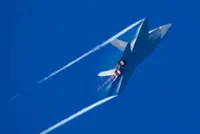
Taiwan’s first two F-16 Block 70 fighter jets from the United States are expected to arrive within days, with some analysts saying the improved models could give Taipei better odds against the People’s Liberation Army’s fifth-generation J-20 fighters.
The jets will be the first deliveries under a long-delayed NT$247.3 billion (US$7.76 billion) deal for 66 aircraft.
The two fighters, numbered 6727 and 6728, left a production facility in South Carolina on August 17. They stopped in Hawaii on Friday and will later fly to Guam, their final stop before heading to Chihhang Air Base in Taiwan’s eastern county of Taitung, according to Taiwanese military sources.
The sources said the aircraft could arrive by Thursday if weather permitted, but several typhoons along the trans-Pacific route could delay their journey until after Sunday.
The fighters are being flown by US pilots and require aerial refuelling and servicing during the journey. They have been fitted with conformal fuel tanks and three external fuel tanks to extend their range.
Their arrival will mark a milestone for a procurement programme that has suffered repeated delays since Washington approved the sale in 2019.
Deliveries were originally scheduled to begin in 2023, with all 66 aircraft due by the end of this year. But production line relocation, Covid-19 supply-chain disruptions, software issues and more recent flight-testing problems have pushed the programme well behind schedule.
Taiwanese Defence Minister Wellington Koo Li-hsiung said earlier this year that US defence contractor Lockheed Martin was producing 46 single-seat and 10 twin-seat F-16V Block 70 fighters for Taiwan. He did not give an update on the remaining 10 aircraft.
Under the military arrangement, the first batch will be stationed at Chihhang Air Base and operated by the Taiwanese air force’s Seventh Tactical Fighter Wing, which is responsible for defending the airspace over eastern Taiwan.
The Block 70 is a new configuration that has required extensive flight testing and calibration. Lockheed Martin has stepped up production, operating two shifts as it seeks to clear a global backlog.
Koo has acknowledged that the original completion target cannot be met, but has stopped short of saying whether all the remaining aircraft could be delivered by next year or 2028.
The new fighters will significantly expand an F-16 fleet that is at the centre of Taiwan’s air defences as the PLA increases aerial operations around the island.
Once all 66 fighters are delivered, they will join 139 older F-16A/B Block 20 aircraft that Taiwan has upgraded to the F-16V standard, giving the island more than 200 F-16s and making it one of the world’s largest operators of the type.
The upgraded Block 20s already feature the AN/APG-83 active electronically scanned array (AESA) radar, new mission computers, Link 16 data link networks and modernised cockpit systems.
The new Block 70s share many of those avionics and sensor capabilities, but their main advantages lie in their newly built airframes, more powerful engines and greater capacity for future upgrades.
The Block 70 has a structural service life of 12,000 flight hours, compared with about 8,000 hours for earlier F-16s.
Taiwan’s Block 70s are powered by F110-GE-129 engines producing about 29,000lbs (13,154kg) of thrust, while conformal fuel tanks can extend their range without occupying weapons stations, according to Lockheed Martin.
They also have greater electrical power, cooling and data-processing capacity to support future integration of advanced electronic warfare equipment, weapons and infrared search and track systems.
Military analysts said the improvements would be particularly important as Taiwan faced increasingly capable PLA aircraft, including the fifth-generation J-20 and newer J-35 stealth fighters.
Su Tzu-yun, a senior analyst at the government-funded Institute for National Defence and Security Research, said the AN/APG-83 radar was designed to detect targets with small radar cross-sections and could “improve the F-16V’s chances of detecting PLA stealth aircraft such as the J-20 and J-35”.
He estimated the probability of detecting such aircraft at “more than 60 per cent”, although actual performance would “depend heavily on range, angle, electronic warfare conditions and integration with other sensors”.
In 2023, the US also approved the sale of infrared search and track systems (IRST) for Taiwan’s F-16 fleet. Unlike radar, IRST passively detects heat signatures, potentially providing another way to locate stealth fighters designed to minimise their radar signatures.
But analysts cautioned that those capabilities did not necessarily give the F-16V an overall advantage against the J-20.
“As a fifth-generation stealth fighter, the J-20 was designed for low observability and long-range combat and carries advanced sensors and long-range air-to-air missiles,” said Max Lo, executive director of the Taipei-based Taiwan International Strategic Study Society.
He noted that the F-16V remained a fourth-generation platform despite its substantially upgraded radar, avionics and weapons.
“Its effectiveness against the J-20 would therefore depend less on a one-on-one comparison and more on Taiwan’s ability to combine ground and airborne sensors, data links, electronic warfare and air-defence systems to locate and engage targets,” Lo said.
Beijing sees Taiwan as part of China to be reunited by force if necessary. Most countries, including the US, do not recognise Taiwan as an independent state, but Washington opposes any attempt to take the self-ruled island by force and is committed to supplying it with weapons. -- SOUTH CHINA MORNING POST