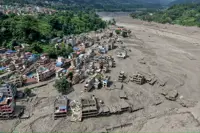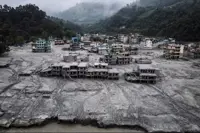
KATHMANDU: I was on my way to the Kantipur Publications office in Kathmandu on Wednesday (Aug 27) morning when my wife called.
“There’s been a flood in the Trishuli,” she said. “Something’s happened to Sole Bazaar and Betrawati — people are saying there’s nothing left. Everyone’s out on the road. There are videos of them panicking.”
I didn’t believe her. Sole is my village. I played in its lanes, worked its fields, walked its road to school every morning for years. If anyone should know that place, it’s me — so surely I would have known if something like this were possible. I hadn’t even heard that the rain had been unusually heavy. And this isn’t a settlement the river reaches, not even in a bad monsoon. I let it go. I had a news meeting at eleven, and I hurried on.
Betrawati Bazaar is where we shop, where the buses stop, where you can get on one and ride straight into Kathmandu. It’s where my parents used to wait for me, knowing I was on my way home. It’s the heart of the place: a Ram temple, a Krishna temple, the crowds that gathered for Ram Nawami and Krishna Ashtami. Being an old Newar settlement, it had its Gai Jatra too, and in recent years, bull-fighting at Maghe Sankranti that drew people from as far as Kathmandu.
All of that, I would soon learn, was already gone.
I opened a news site to check what my wife had told me, half expecting nothing. The headline read: Massive flood in the Trishuli. Something in my chest tightened. I called Niranjan, a journalist himself, whose family lives in Sole Bazaar — they’d moved down from the village once the bazaar grew, and his uncle lives even closer to the river. He picked up on the first ring.
“I just heard too, dai,” he said, the words coming out in one breath. “I can’t get through to anyone. Not Mummy, not Buwa, not my uncle, my aunt — nobody’s phone is even ringing.”
For the rest of my walk to the office, we called each other back and forth, each of us trying every number we had for home. Nothing went through. When I finally reached someone — an elder brother’s house — it was his wife who answered. “There’s nothing left in the village,” she said simply. “Most of the people are gone.”
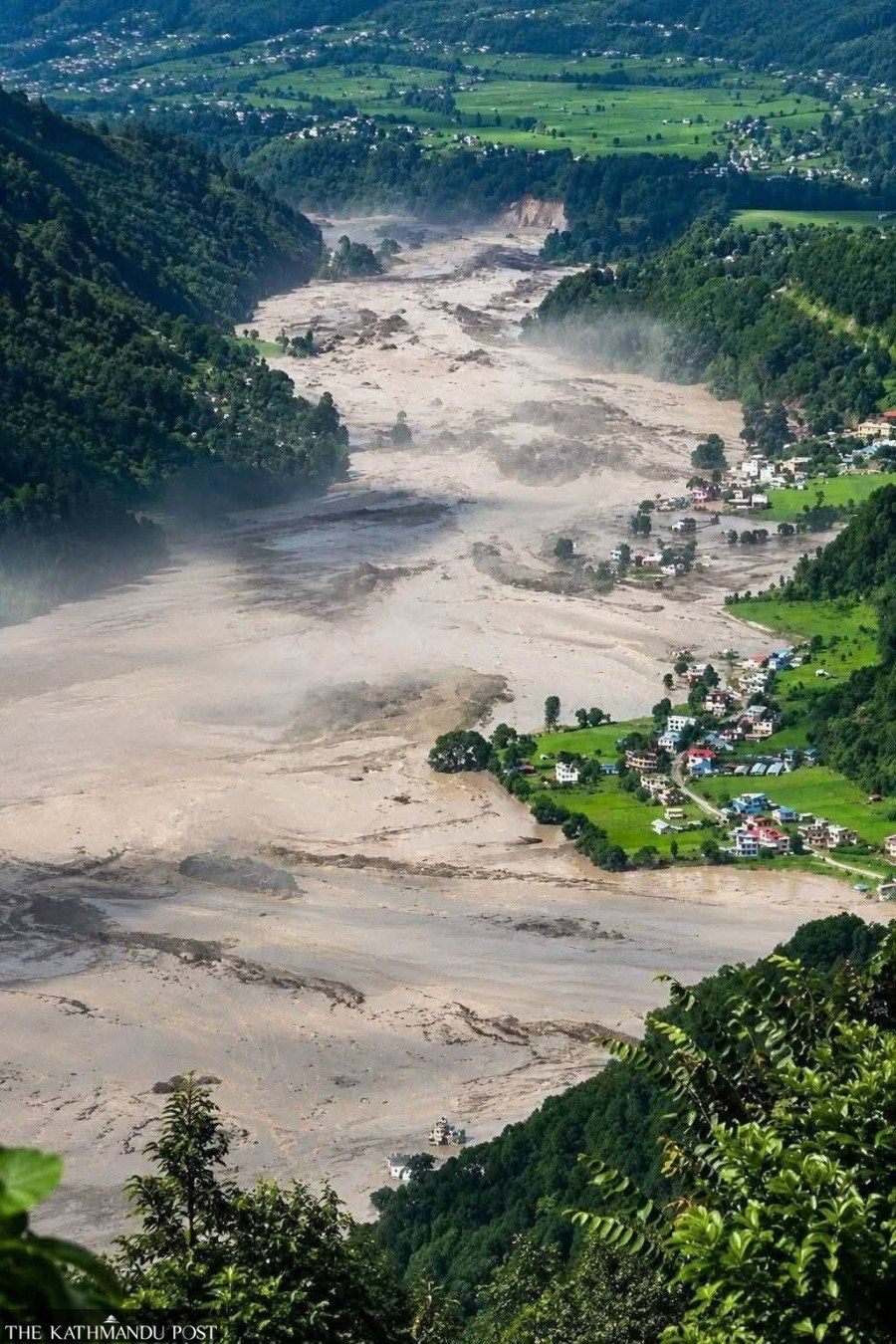
I couldn’t make myself believe it. Sole and Tupche sit nearly a hundred metres above the riverbed. No flood in living memory — in centuries, as far as anyone knew — had ever reached that high. I am 44 years old, and I have never once, in all that time, seen the river come for us. I have cousins there, neighbours, childhood friends. Everyone I have ever loved outside my own front door is from that village.
I began calling them, one by one. In a place like Sole, everyone is kin to everyone else, one way or another — and where blood doesn’t make the connection, age does, and you call the stranger dai or didi anyway, because that’s simply how it’s done there. Everyone belonged to me, and I belonged to everyone. Slowly, the videos and photographs started arriving on my phone. Nothing had prepared me for what they showed.
My eldest aunt was swept away. So was her son, my dai Madhu, and his wife. My other aunt — gone too, they told me. Her grandson Sijan and his wife, caught in the same water. His own son and daughter-in-law, unreachable, unaccounted for. My maternal uncle had gone out that morning to cut grass for the cattle. He never came back.
I called the ward chair, Rabindra Nepal. “Bhai, I came to the municipality office early this morning, and I’m stuck here now,” he told me. “There’s nothing left in the village. You can imagine the rest yourself.” Each call made it worse. Some people, he said, had scrambled up the cliffside and survived that way — by climbing, by luck. I reached a teacher at the local school nearby. “I can’t find my own family, bhai,” he said. “Ninety percent of the houses in Betrawati are gone. The school van was swept off too. There’s a boy near me with a broken leg. Another man beside him — broken leg, his eye is hurt badly. If you can get a helicopter here, please, send one.”
Then Niranjan’s uncle called. Niranjan’s father, mother, uncle, aunt, and his little sister Himani — all of them, taken by the water. “We’re finished, Arjun,” he said. “I'm hanging up now.” And he did.
Betrawati was never just a market town. It’s where Nepal and Tibet once signed a peace treaty after their war. It holds Uttar Ganga dham, a site sacred enough that thousands travel there every year on Pushya Amawasya to honour their dead. All of it — the temples, the treaty ground, the pilgrimage site — is rubble now.
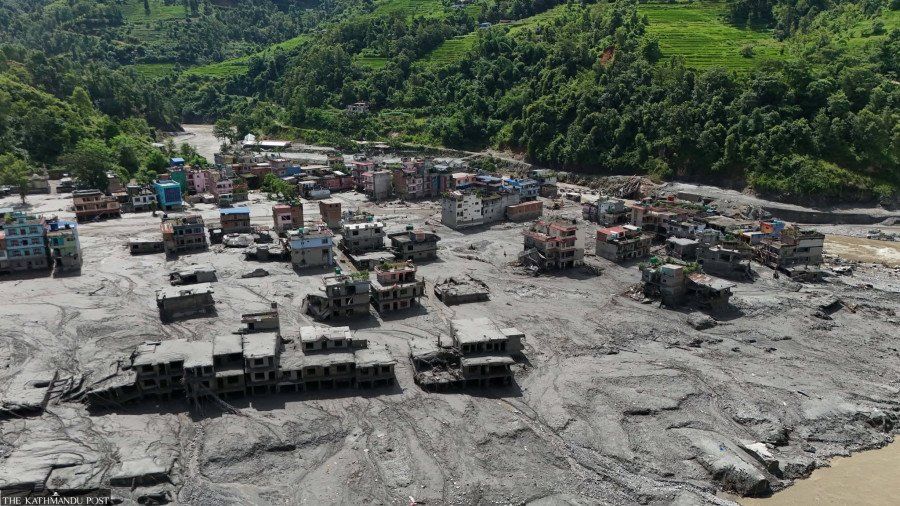
There is no road left, no electricity, no phone signal, no internet. Downstream, the flood took the headgate of the Trishuli hydropower station, and then the power station itself. I remember that even during the years of nationwide load-shedding, back in 2010-11, our village never once lost power. Now the whole district sits in the dark. I saw it myself, travelling with friends toward the district headquarters on Wednesday evening — not just my village, the entire district, swallowed by the dark. Villagers who’d come down to the headquarters that morning are stranded there now, with nowhere to go. The sick who’d come in for treatment are trapped at the hospital, unable to get home. A neighbour of mine stood near a rescue helicopter bound for the army training centre in Battar, begging to be let aboard. “My uncle and aunt were swept away,” he kept saying. “Their phones are dead. I don’t even know what’s happening to my own house.”
My eldest aunt’s older son is in Kathmandu, powerless to do anything from that distance. Her younger son had only just returned from working abroad — he hadn’t even made it back to the village before the water came. On the phone, people told me the children who’d survived by running couldn’t be brought out, that before anyone could even grieve for the mother and the brother and sister-in-law who were gone, the living still trapped in the village would have to be rescued first.
The flood did not only take the village. It took the road to the district headquarters, and with it, the road to the rest of the country. The market that fed us is gone, which means there is nowhere left to buy anything. The fields we planted are gone. And even the grain that families still have stored at home is grain they can no longer mill into rice or flour, because the mills are gone too.
The old bridge over the Trishuli, connecting Dhunge to Trishuli Bazaar, built all the way back in 2024 BS — gone. The newer bridge, built only a few years ago — gone. The Bhainse bridge, every suspension bridge across that river — all of it gone, and with it, any way to reach the district headquarters at all. The district hospital at Baghtar, so close and now so unreachable. Villages further out — Bhairamkot, Samari, Toksar, Deurali, Kispang, Kaule, Bhalche, Salme, and Tharpu across the border in Dhading — cut off entirely. The whole of Rasuwa district is severed from the road network. Looking at what’s left, it’s hard to imagine any of it being rebuilt soon.
“If someone falls sick now, I suppose they’ll just have to die at home,” one villager told me, his voice flat with grief. “How would you even get them to a hospital? There’s no road. No bridge. No vehicle can move.” People can’t even buy salt anymore. So many are displaced. So many are still missing, unaccounted for in the water. What happens now to the ones who survived, I don’t know. I set out almost a day and a half ago, meaning to reach the village myself. I have been stuck at the district headquarters in Bidur, unable to go any further.
I keep asking myself how long it will take before my village looks like my village again. Nobody has an answer. None of us has ever seen a flood like this one — a village this green, turned to ruin in the space of a few minutes. The old men keep saying it, over and over, as if saying it enough times might change the answer: Will this place ever become what it used to be? - The Kathmandu Post/ANN