




Mainland Chinese government vessel sightings around Taiwan have reached record levels for a third straight month, as Beijing expands its law enforcement footprint east of the island following the announcement in late May of Tokyo-Manila maritime boundary talks over the area.
Taiwan’s defence ministry said that in the first 24 days of August it detected mainland coastguard, survey and other official vessels a total of 118 times, surpassing the 117 reported in July and 111 in June.
Those numbers were far higher than in any previous month on record since Taiwan began releasing detection data in July 2024.
Before June, the highest count of mainland government ships in a single month was 50 in April 2025, according to a tally by the SCMP.
That record-breaking intensity of activity aligns with findings from an August 19 report by the Asia Maritime Transparency Initiative (AMTI), which noted a “more sustained and assertive presence” by mainland Chinese law-enforcement and survey vessels in waters east of Taiwan.
Using commercial automatic identification system data, AMTI – a programme of the Washington-based Centre for Strategic and International Studies – showed that the ships’ activity around Taiwan between June and August was concentrated in waters where Chinese, Japanese and Philippine maritime claims overlap. Almost no such activity had been observed in that area between January and late May.
Two China Coast Guard vessels accounted for much of the observable activity during that period, while a third had been patrolling the area since August 4, according to AMTI.
Within days of the Japan-Philippines announcement, mainland Chinese law-enforcement vessels hailed 198 commercial ships in the area, demanding information about their ports of call and crews, the report noted.
Crucially, Beijing’s operations extended well beyond the contested boundary zone. The AMTI report found that survey vessels often operated within 50 nautical miles (93km) of Taiwan – in waters the think tank described as “largely irrelevant to the Japan-Philippines delimitation”.
“The scale and character of China’s response suggest that these operations are not just about sending a signal to Tokyo and Manila,” the think tank noted, adding that Beijing might see an opportunity to establish a “semi-permanent presence” and exercise some form of jurisdiction east of Taiwan.
Beijing frames the operations differently. Its foreign ministry has condemned the Tokyo-Manila talks as “illegal, null and void” and asserted Beijing’s jurisdiction over the waters.
The China Coast Guard has separately described its patrols there as a “necessary response” to what it calls unilateral actions by Japan and the Philippines.
The push has also extended to civilian research missions.
In June, Beijing’s Ministry of Natural Resources said it carried out a three-day marine environmental survey in waters east of Taiwan, part of what state media said would now be an annual mission rather than the one-off surveys previously run in the area.
Beijing sees Taiwan as a breakaway province to be reunited by force if needed. Most countries, including the United States, do not see Taiwan as an independent state, but are opposed to any change to the status quo by force.
Taiwanese officials warned in early July that the sustained presence of mainland Chinese government vessels across parts of the first island chain aimed to establish a “new status quo”.
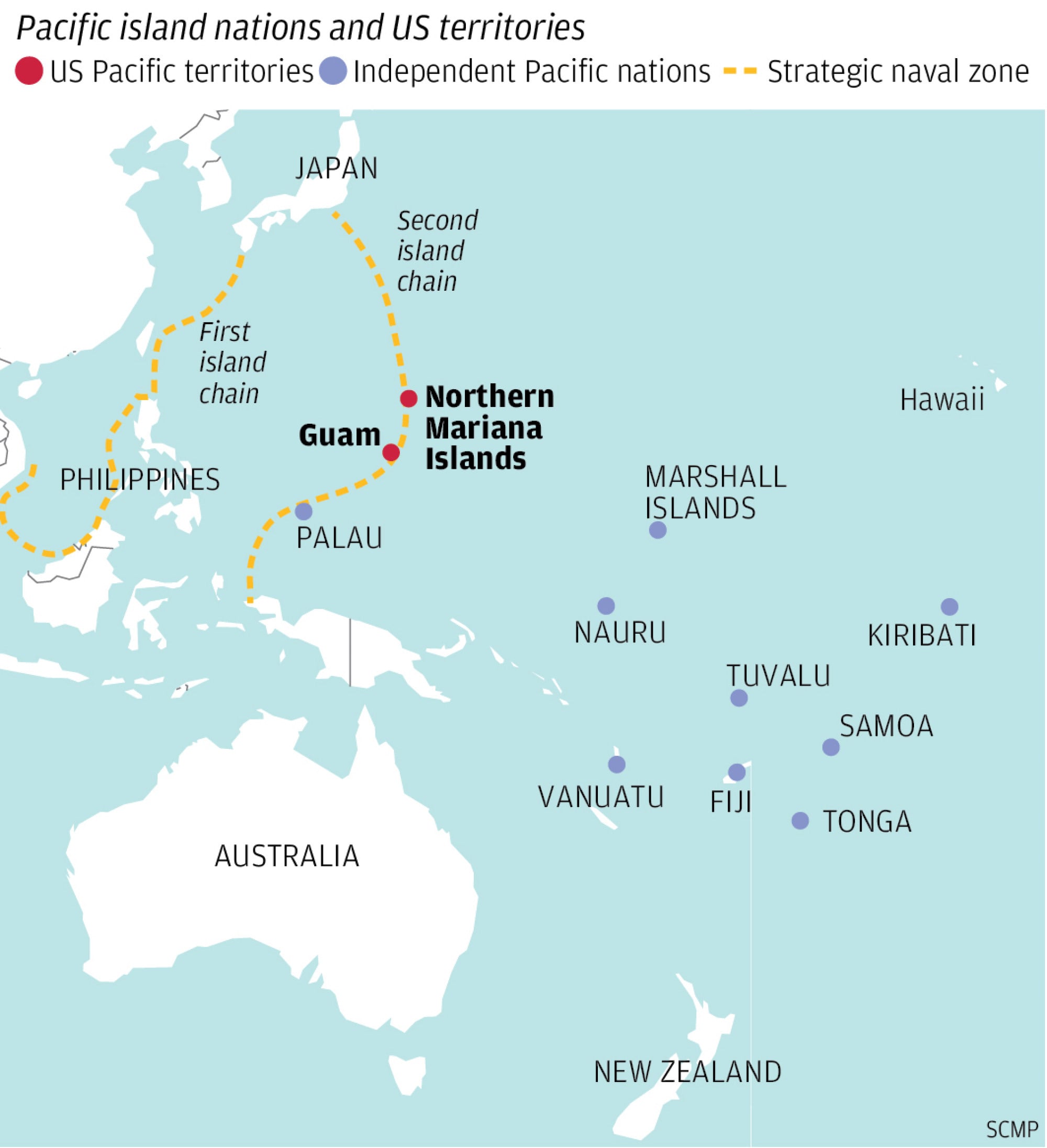
The first island chain, which stretches along the East Asian coastline from the Kuril Islands down to Borneo, divides mainland China’s near seas from the open Pacific Ocean.
Beyond asserting jurisdiction, sustained law-enforcement patrols east of Taiwan could act as a rehearsal for a maritime quarantine of commercial shipping by mainland China, AMTI said.
The survey operations in the area, meanwhile, could also have military uses. The report said that such missions could collect data on subsea environments that could inform undersea warfare capabilities, adding that the surveyed area would be a “critical battleground” in any Taiwan conflict.
Ultimately, the report’s authors argued, the pattern mirrored Beijing’s behaviour in other disputed maritime areas, where an expanded operational presence at sea had often outlasted the event Beijing said it was initially responding to.
That could make the present expansion particularly consequential.
The report pointed out that maritime delimitation was rarely a quick process, with the Japan-Philippines negotiations likely to be measured in years rather than months – potentially giving Beijing an equally extended justification for its operations.
“Whatever the original intent,” the report concluded, Beijing’s maritime forces were establishing a “more sustained and assertive presence” east of Taiwan. -- SOUTH CHINA MORNING POST


