




Chinese scientists have uncovered the world’s oldest verified amber in the northwestern Xinjiang region, revealing that ancient plants were producing protective resin 385 million years ago, long before most animal groups had emerged to damage them.
The amber – discovered in coal seams in West Junggar, part of an ancient zone where tectonic plates collided, grew and merged – pushes back the record by roughly 65 million years and challenges some long-held assumptions about the origins of plant resins.
Until now, the oldest known amber to have been isolated from rock and confirmed through chemical analysis dated to the Late Carboniferous period, around 320 million years ago, when the first herbivores also emerged.
The researchers, led by Luo Cihang, from the Chinese Academy of Sciences’ Nanjing Institute of Geology and Palaeontology, detailed their findings in a paper published by the peer-reviewed journal Science Advances on July 15.
According to the paper, the palaeontologists were initially sceptical when they found hundreds of microscopic pieces of what appeared to be amber preserved in a coal seam dating from the Middle Devonian period around 393 million to 383 million years ago.
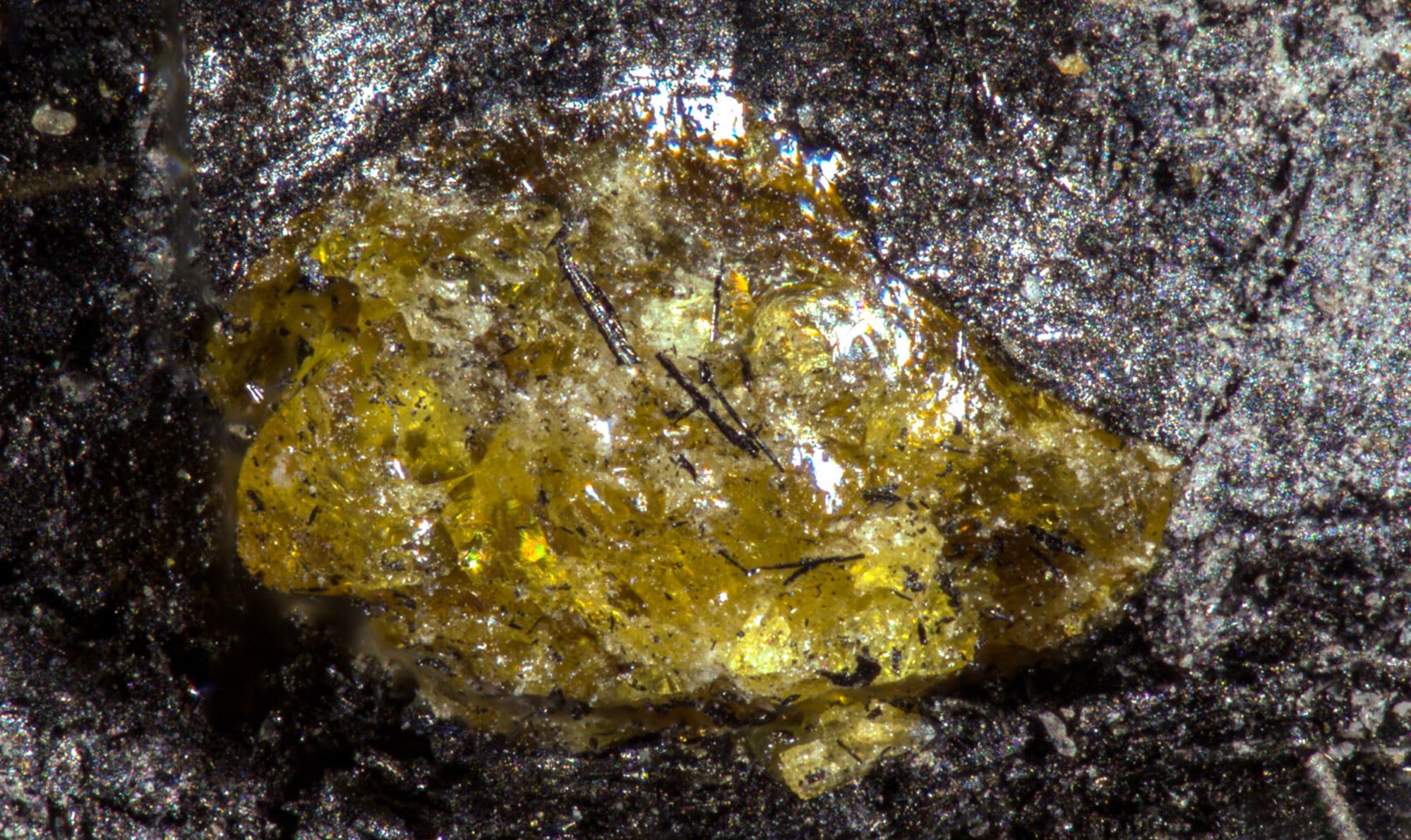
When Luo and his team travelled to Xinjiang in 2019, they did not expect the fossil samples they planned to examine and collect from the region’s unusual coal seam would yield the world’s oldest known amber, the paper said.
Even when the researchers shone an ultraviolet torch on the coal, revealing that parts of it emitted a striking blue fluorescence, they did not assume it meant the presence of amber – while a useful screening clue, it is not enough for an identification.
“Our first reaction was excitement, followed immediately by caution,” Luo said. To find 385 million-year-old amber would be extraordinary, pushing back the record and overturning some palaeontological assumptions, he said.
Amber is the result of complex geological processes that transform plant resins into a fossilised material that can preserve organic molecular signatures and even insects and other tiny organisms, earning its reputation as a time capsule of ancient ecosystems.
However, all previously confirmed records of discrete amber have been associated with seed plants – a more advanced group of flora that emerged and radiated extensively in the late Devonian age and encompasses nearly all modern trees.
The team isolated 241 pieces of the material from roughly 10kg (22lbs) of coal, with the largest specimen measuring around 1.5mm (0.06 inches). Most of the fragments were between 0.1mm and 0.5mm, with colours ranging from pale yellow to dark brown in natural light.
The team initially treated the microscopic particles as resin-like organic matter but later used advanced chemical analysis to confirm the fragments were amber, according to the paper.
The findings indicated that some non-seed producing vascular plants from the Middle Devonian period were already capable of producing resin through relatively complex biosynthetic pathways.
The discovery also carried broader ecological implications for the understanding of plant evolution, the researchers noted.
Early resin production may have functioned mainly in wound sealing and as a defence against pathogens, helping plants to survive physical damage and infection in Devonian terrestrial environments, the paper said.
“The early emergence of resin production may have promoted the ecological success of Devonian-Carboniferous terrestrial floras by enhancing protection and wound sealing,” the researchers noted.
“At that time, there were not yet many animal groups capable of damaging plants, so the origin of resin is more likely to have been linked to repairing physical damage caused by events such as wildfires or resisting fungal invasion,” Luo said. -- SOUTH CHINA MORNING POST



