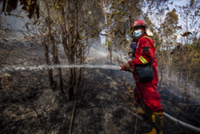
JAKARTA: One person has died in Central Java as wildfires continue to break out across Indonesia amid an intensifying dry season.
A 70-year-old farmer in Kedawung village, Batang regency, was killed after becoming trapped by flames while working in a sugarcane field on July 6, the Central Java Disaster Mitigation Agency (BPBD) revealed on Monday (July 27).
Agency head Bergas Catursasi Penanggungan said the fatality came amid a sharp increase in forest and land fires across the province.
“Central Java recorded 56 wildfire incidents over the past month, causing an estimated Rp 607 million [US$33,602] in losses. Most of these fires occurred in sugarcane plantations," he said on Monday.
Authorities said many of the incidents were triggered by residents burning household rubbish or agricultural waste, with the flames spreading rapidly in the hot and dry weather.
Central Java Police spokesperson Sr. Comr. Artanto urged residents to avoid open burning during the dry season.
"We urge the public not to burn land, rubbish or agricultural waste indiscriminately. During the dry season, fires can spread rapidly and become difficult to control," he said.
Wildfires have also flared in several other parts of the archipelago. In South Sumatra, dozens of firefighters are battling a fire that has been burning in Suka Maju village, Muara Enim regency, since Friday.
Alvi Gumara, Emergency and Logistics Division head at Muara Enim BPBD said joint firefighting teams had contained the blaze across five of the eight hectares affected.
"So far, we have managed to extinguish fires across 5ha, while the remaining area is still emitting smoke," Alvi said on Tuesday as quoted by state news agency Antara.
Firefighters are expected to resume operations on Wednesday to extinguish the remaining hot spots and prevent the fire from reigniting, he added.
The latest blaze adds to a growing number of forest and land fires across South Sumatra this year. BPBD data show the regency recorded 575 fire incidents between Jan. 1 and July 27, burning a combined 664.87 ha of land.
In West Java, a fire that broke out in Sumedang regency on Tuesday burned around 3ha of land in Cinanjung village, Tanjungsari district. The blaze was quickly brought under control by a joint team of firefighters and emergency personnel, preventing it from spreading to nearby areas.
Meanwhile, firefighters in West Kalimantan are continuing efforts to contain wildfires in Kubu Raya regency, where prolonged dry conditions have hampered suppression efforts.
Florensius Loren, commander of the Forest and Land Fire Control Brigade (Dalkarhutla) under the Kubu Raya Forest Management Unit (KPH), said dried-up drainage canals made it difficult for firefighters to access water to extinguish the blaze.
Despite the challenging conditions, teams on the ground are working to prevent the fire from spreading to surrounding areas and causing more extensive damage.
"In addition to firefighting operations, we continue to patrol fire-prone areas to detect hot spots as early as possible," Florensius said.
According to the National Disaster Mitigation Agency (BNPB), forest and land fires had burned a total of 28,680.47 ha in West Kalimantan as of July 25. Indonesia is expected to face a longer dry season this year as the impacts of El Nino intensify, bringing drier conditions from the Pacific Ocean to the archipelago.
As of late July, more than two-thirds of the country had entered the dry season, with most regions forecast to experience below-normal rainfall for the remainder of the year, according to the Meteorology, Climatology and Geophysics Agency (BMKG).
Coordinating Minister for Infrastructure and Regional Development Agus Harimurti Yudhoyono said the government had stepped up preparedness for forest and land fires in several high-risk provinces, including Riau, Jambi, South Sumatra, West Kalimantan, Central Kalimantan and South Kalimantan.
Agus said the government's response was focused on weather modification operations, aimed not only at suppressing hot spots but also at maintaining water levels in dams, reservoirs and lakes to ensure adequate water supplies throughout the dry season.
The government is also exploring the use of new technologies to improve the effectiveness of weather modification operations.
"In addition to conventional methods, we are considering the use of drones and other technologies to make these operations more efficient," Agus said on Wednesday, as quoted by Tempo.co. - The Jakarta Post/ANN