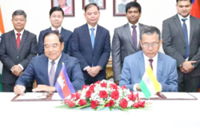
PHNOM PENH: Prime Minister Hun Manet (pic) has dismissed speculation that the government is planning to merge or abolish any of its ministries. He insisted that his government has no such policy, explaining that ongoing administrative reforms will strengthen state institutions by improving efficiency, eliminating overlapping functions and adapting to technological change.
While addressing a land title certificate distribution ceremony in Khsach Kandal district, Kandal province, this morning, July 29, Manet said he was surprised to learn of the rumours through social media, stressing that the government had never discussed dissolving any ministries or downgrading them into general departments.
“It is rather strange that I, as prime minister, only learned about it through Facebook,” he said.
“I would like to clarify that there is no such policy. We are not cutting ministries or institutions. The policy that we adopted from the beginning remains unchanged,” he added.
His remarks followed a series of social media posts claiming that the government planned to reduce the number of ministries by combining agencies with overlapping responsibilities and converting some ministries into general departments, while reassigning ministers to other positions.
Manet said the speculation had caused unnecessary concern among civil servants, prompting him to seek clarification from the Ministry of Civil Service, even though no such proposal had ever been submitted to the government.
“I asked the civil service ministry whether such an idea had ever been discussed in our meetings. I told them that if anyone was thinking about it, they should stop because that is not our policy,” he said.
Instead of restructuring ministries, Manet said each ministry and institution had been instructed to conduct functional reviews to determine whether internal departments could be streamlined, merged or strengthened to improve performance.
“The objective is to strengthen each institution, clarify responsibilities, eliminate overlapping functions and ensure they are aligned with the country’s economic, social and technological development,” he noted.
He stressed that reform should focus on making existing institutions more effective rather than expanding bureaucracy or making abrupt structural changes.
As an example, Manet pointed to the Ministry of Economy and Finance, where technological advances have rendered some traditional functions obsolete.
He noted that, decades ago, the treasury required an entire department dedicated to manually counting cash because government revenues were handled physically.
With the implementation of Cambodia’s Financial Management Information System (FMIS), tax revenues and expenditure data are now transmitted electronically in real time, eliminating the need for such work.
“There is no longer any need for a department to count money by hand,” Manet said.
“Instead, we now need units that can work with artificial intelligence,” he added.
The prime minister said government agencies should establish dedicated AI functions where necessary to prepare the civil service for the next phase of digital transformation.
“If we are entering the AI era but have no one responsible for AI while still counting money by hand, that would not be appropriate,” he noted.
Manet explained that administrative reform should remain flexible, allowing obsolete functions to be removed while creating new ones where justified by changing circumstances.
“The principle is simple: where functions overlap, they should be streamlined; where functions are outdated, they should be abolished; and where new responsibilities are needed, they should be created,” he said.
He emphasised that every proposal for organisational reform must be supported by clear justification and undergo rigorous scrutiny before receiving approval.
According to Manet, inter-ministerial committees and the civil service ministry carefully assess whether requests for new departments or organisational changes are genuinely necessary before they reach the prime minister’s office for final approval.
“We are accountable to the people and to the nation,” he said, adding “Every organisational adjustment must have a clear rationale.”
Manet also cautioned against comparing Cambodia’s administrative structure directly with those of other countries, noting that government systems differ according to national priorities.
He cited Australia, where trade falls under the same ministry as foreign affairs, while other countries combine industry and commerce under a single portfolio.
“What matters is not whether ministries are organised in the same way as elsewhere, but whether each institution performs its responsibilities effectively and cooperates well with others,” he said.
The prime minister said the government’s broader reform agenda remains centred on strengthening public institutions so they can deliver faster, more efficient and citizen-focused services.
He added that this includes reviewing administrative procedures that unnecessarily burden businesses, particularly small and medium-sized enterprises (SMEs), while maintaining safeguards for products that affect public health and safety.
For example, he said authorities could simplify approval procedures for low-risk products while continuing to require strict pre-market reviews for pharmaceuticals and chemical products.
Manet concluded by urging civil servants and the public not to be misled by unverified reports circulating online, saying the government would communicate openly whenever significant policy changes were made.
“Don’t think that we will dissolve ministries or turn them into general departments,” he said.
“That is not the direction of our reform. Our approach is to strengthen institutions, clearly define responsibilities and work together to serve the people better,” he added. - The Phnom Penh Post/ANN