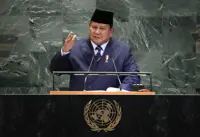
JAKARTA: President Prabowo Subianto's approval rating has fallen to barely 50 percent, marking a sharp drop from the strong public support he enjoyed during his first year in office as Indonesians grow increasingly pessimistic about the economy, politics and law enforcement, a new survey has found.
The survey, conducted by Saiful Mujani Research and Consulting (SMRC) this month, found that 51.1 percent of respondents approved of the President's performance, extending a downward trend in his approval rating from 81.2 percent in November last year to 66.4 percent in March.
Meanwhile, the number of those dissatisfied with his job performance has increased to 46.9 percent, compared to 31.7 percent in March this year and 16 percent in November 2025.
The findings are a stark contrast to Prabowo's first year in office, when his approval rating by various pollsters surpassed those of his predecessors, Joko "Jokowi" Widodo and Susilo Bambang Yudhoyono, at the same stage of their presidencies, which respondents mainly attributed to Prabowo's "firm leadership".
The SMRC surveyed nearly 750 voting-age respondents nationwide from July 5 to 19, with 80 percent contacted by telephone and the remainder through face-to-face interviews.
The survey had a 3.7 percent margin of error at a 95 percent confidence level.
During the survey's release on Sunday, SMRC executive director Deni Irvani said Prabowo's declining approval rating stemmed from worsening "public evaluations of the current state of the country's economy, politics and law enforcement".
Economic conditions received the most negative response among the three areas surveyed, with 49.4 percent of respondents rating the economy as either "bad" or "very bad".
Only 15.7 percent described current economic conditions as "good" or "very good", a sharp drop from 40 percent in November.
The share of respondents who were neutral remained at around 30 percent.
"There were more than three times as many respondents who viewed the economy negatively as those who saw it positively," Deni said.
"This confirms what many economists have argued: the headline economic growth figures do not necessarily reflect people's economic conditions on the ground," he added.
The survey comes as the Prabowo administration faces mounting economic challenges, including a weakening rupiah and purchasing power, as well as persistent concerns over policy uncertainty despite the government's insistence on continuing costly flagship programmes such as the free nutritious meal programme.
Public perceptions of Indonesia's political climate under Prabowo's leadership also worsened, according to the poll, with negative assessments reaching 42.8 percent compared with just 13.5 percent expressing positive views.
Some 33 percent of respondents were neutral, while the remainder did not respond.
The result marked a sharp reversal from November, when 35.8 percent of respondents viewed political conditions positively, while negative views stood at just 23 percent.
The share of those who were neutral or did not respond remained stable.
The survey also showed weakening public confidence in law enforcement, with only 26.4 percent of respondents viewing its current state positively, while 37.6 percent considered it poor.
Deni said the decline may reflect recent incidents that have fuelled concerns over shrinking civic space under Prabowo's administration, including the acid attack on rights activist Andrie Yunus by soldiers in May following his criticism of the military.
He added that the corruption case involving the free meals programme, implicating the former head and two deputies of the National Nutrition Agency (BGN), had likely contributed to the survey results.
"The findings confirm that the public senses the potential for corruption in the implementation of several government programmes, such as the free meals and Red and White Cooperative programmes," Deni said.
Another SMRC researcher, Saidiman Ahmad, pointed to the government's increasingly negative responses towards academics and government critics as another factor behind the growing public concerns.
Prabowo has drawn criticism in recent months for his response to dissent, including saying he wanted to put "unpatriotic" observers in order in March and referring to journalists as londo ireng, or "black Dutchmen", last week, prompting condemnation from press groups.
State Secretary Prasetyo Hadi and Government Communication Agency (Bakom) head Muhammad Qodari did not respond to requests for comment on Monday.- Jakarta Post/ANN