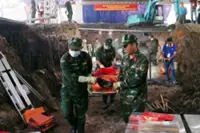
HO CHI MINH CITY: For 13 days, excavation teams worked through a single trench beneath Le Thi Rieng Park, carefully uncovering the remains of soldiers killed nearly six decades ago.
By July 18, they had recovered 100 sets of human remains, many believed to belong to South Vietnam Liberation soldiers killed during the 1968 Tet Offensive and buried en masse in what was then the City Cemetery.
The excavation has become the most visible symbol of an ambitious 500-day national campaign to recover and identify the country's missing war dead. In its first four months, the campaign had already recovered 1,421 sets of remains nationwide.
The effort was launched on April 2 at Quang Tri Citadel, one of the bloodiest battlegrounds of the war. Its clock formally runs from March 15 to the end of July 2027, a deadline chosen to coincide with the 80th anniversary of War Invalids and Martyrs' Day, the national commemoration of wounded veterans and the fallen.
The campaign has set specific targets: recover roughly 7,000 sets of remains; collect bone samples from about 230,000 unidentified graves in war cemeteries; complete DNA analysis on some 18,000 of those samples; build a national genetic database of relatives of fallen soldiers; and accelerate the clearance of unexploded ordnance from priority zones along the northern border.
The arithmetic behind the campaign explains its urgency. More than 1.2 million soldiers were killed in the wars of the last century and are recognised by the State as war martyrs, but just over 1 million sets of remains have been gathered into cemeteries over the decades.
Roughly 175,000 have never been found, while nearly 300,000 graves hold remains recovered long ago but never identified.
Against that backdrop, the campaign's running totals, reported by the national steering committee on July 18, stood at 1,421 sets of remains recovered since mid-March. Of these, 397 were found in Vietnam, 174 in Laos and 850 in Cambodia, where dedicated military recovery units known as K teams have searched former battlefields for decades.
Two such teams from the southern province of An Giang have recovered 6,871 sets of remains since 2001, including 170 during last year's dry season.
Sampling teams had collected samples from more than 63,400 unidentified graves. Almost 70 per cent yielded material viable for testing. They had also collected 93,464 DNA samples from relatives, of which 53,036 had already been analysed and entered into the database.
Demining units had cleared 8,462 of a planned 22,725 hectares, including four-fifths of the priority zone at Vi Xuyen, historically in Ha Giang Province and now part of Tuyen Quang following the 2025 administrative merger. The area was the scene of fierce border fighting in the 1980s.
The domestic tally is being assembled site by site, across terrain ranging from limestone karst to urban parkland.
In Da Nang on July 14, the remains of five liberation soldiers, recovered from a collapsed mountain cave 57 years after an air strike by US-Saigon forces, were reburied with honours.
In neighbouring Quang Ngai Province, where 13,656 of the province's 37,689 war graves contain unidentified remains, a verified roadside site has yielded three sets of remains so far. Excavation is planned to continue through the end of 2026.
The manpower involved is on a corresponding scale: 32 recovery teams comprising more than 1,500 soldiers; 360 demining units with about 5,000 personnel and 1,300 devices; and more than 300 DNA sampling teams with roughly 3,500 staff members.
Every bone sample is logged in a tracking system developed by Viettel, designed to keep millions of specimens traceable from graveside to laboratory and prevent mix-ups.
Modern methods are where the campaign differs most sharply from past practice. While earlier searches relied heavily on veterans' memories, teams now cross-reference wartime coordinates with terrain data, use ground-penetrating radar to survey sites and convene formal verification panels before excavation begins.
The Ho Chi Minh City site was located using this approach. Architect Nguyen Xuan Thang spent eight years triangulating three wartime press photographs against old water towers and satellite imagery. Robert Connor, an American veteran who once guarded Bien Hoa Air Base and whose chance discovery on Google Earth in 2016 led to the discovery of a mass grave containing about 150 liberation fighters there, provided corroborating details.
The archival research goes deeper still. A Texas Tech University project that manages 2.7 million pages of documents captured on wartime battlefields, with an estimated 30 million more pages of US records still being examined, provided the city with burial maps, a decoded dossier and three soldiers' personal effects on July 9.
Identification relies on genetics. A next-generation sequencing method known as NGS-SNP, developed by the national science academy with support from the International Commission on Missing Persons and US development assistance, examines more than 5,000 genetic markers. It can match DNA fragments as short as 50 to 70 base pairs with relatives up to four generations removed on both parental lines.
In a pilot project at a war cemetery in Cao Bang Province, the method increased the share of bones yielding usable DNA from roughly one-fifth under older methods to more than 80 per cent. It produced viable profiles from 54 of 58 sets of remains and delivered two confirmed identifications in its first round.
The matching system is also being built rapidly. A national Gene Bank for relatives, established in 2024 under the Ministry of Public Security, collected more than 51,000 samples by the end of its first year of operation in mid-2025.
A month-long national campaign launched at the end of June aims to collect 250,000 more samples, rising to 300,000 by the end of the year.
Thanh Hoa Province was the first to report full completion. Ha Tinh collected more than 16,300 samples in five days, Hue processed 2,866 across nine sites in three days, and Can Tho launched a three-site campaign on July 18 to collect another 2,700 samples, with shuttle vans provided for elderly relatives.
As of June 24, DNA testing had formally restored the names of 25 fallen soldiers.
That figure illustrates the gap between the two stages of the process. Of the thousands of bone samples collected, the Military Forensic Institute had completed testing on 210 of the 10,129 samples it had received by July 18.
Recovery has outpaced identification so far, a pattern officials attribute to the scale and complexity of DNA analysis rather than to any single bottleneck.
Deputy Prime Minister Pham Thi Thanh Tra, who chairs the steering committee overseeing the campaign, has likened the work to something "harder than finding a needle at the bottom of the sea". She has also warned that living memory of burial sites is fading and will be far scarcer within five to seven years.
A prime ministerial dispatch on July 8 acknowledged that results, although accelerating, remained far short of the campaign's end goals and ordered provinces and cities to speed up the work.
Le Thi Rieng Park in Ho Chi Minh City distils the entire campaign — its scale, methods and human cost — into a single trench.
The trench, cut on July 6, now runs about 30 metres long and three metres deep. Five teams from the surrounding military region are working at the site, including one formed specially for the task. Officials estimate that the area may hold about 900 fallen soldiers across three burial trenches. Only the first had been opened by July 18.
Prime Minister Le Minh Hung opened the excavation in early July with a pledge to bring the martyrs home "at any cost".
Less than two weeks later, Party General Secretary and State President To Lam inspected the site, urging teams to combine DNA analysis with artificial intelligence and geophysical technology and calling for the approach to be replicated nationwide.
The site had produced one tentative identification by mid-July: Huynh Van Quen, a liberation fighter identified through a unit transfer order that remained legible after 58 years inside a plastic sleeve.
His fiancée, Nguyen Thi Le, now 79, never married after he failed to return from the 1968 Offensive. On July 18, authorities in the southern province of Tay Ninh formally recognised her as his widow, with a monthly survivor's allowance payable from August 1.
DNA confirmation, matched against samples from his two younger brothers, is expected by early August.
The campaign's target is 7,000 sets of remains. The harder number lies behind it: how many of those still waiting for a name will live long enough to hear one. - VNS/ANN