VIENTIANE: The government aims to lift economic growth to 5.5 per cent by the end of 2026, building on a growth rate of 5 per cent in the first half of the year.
Despite global economic uncertainty, inflationary pressures, and natural disasters, Laos recorded Gross Domestic Product growth of 5 per cent in the first six months of 2026, equivalent to 199,987 billion kip and achieving 48 per cent of the target for the whole of the year.
The service sector led growth at 5.3 per cent, followed by industry at 5.1 per cent and agriculture at 4.3 per cent.
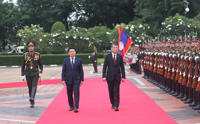
Prime Minister Sonexay Siphandone outlined the government’s economic performance and priorities during the opening of the first Extraordinary Session of the National Assembly’s 10th legislature on Monday (July 6).
The PM said the government would focus on maintaining macroeconomic stability and accelerating growth. Another goal is to raise per capita gross national income to about US$2,238 by the end of the year.
To support growth, the government plans to increase exports from key sectors. Hydropower projects will operate at full capacity during the rainy season to generate electricity exports worth US$2.83 billion. Mineral exports are expected to reach US$2.18 billion, while agricultural exports are targeted at US$1.9 billion through greater processing and higher-value production.
The Prime Minister said the government would continue to modernise tax collection, expand the tax base, and tighten measures against revenue leakage to strengthen state finances. He said these efforts would support public debt repayment while reducing reliance on borrowing.
Dr Sonexay acknowledged that the economy continues to face significant external challenges, including global trade tensions, conflict in the Middle East, fuel supply pressures, and recurring natural disasters.
“This situation has created many challenges for the implementation of our National Socio-Economic Development Plan in the first 6 months of 2026,” he said.
These factors led to inflation being recorded at around 8 percent during the first half of the year, well above the National Assembly’s target of 5 percent.
The Prime Minister also pointed to several internal weaknesses that continue to slow economic progress.
He said efforts to build an independent and self-reliant economy remain slow, while the country’s production potential has yet to be fully developed in terms of both domestic supply and exports.
He also highlighted continuing tax evasion, the smuggling of vehicles and goods, and delays in modernising the revenue collection system, which have limited the government’s ability to strengthen domestic revenue and repay public debt.
Despite these challenges, several key economic indicators improved during the first half of the year.
State budget revenue reached 44,956 billion kip, equal to 54 percent of the total target for 2026 and 19 per cent higher than the same period last year.
Foreign reserves remained strong, covering 5.17 months of imports, exceeding the government’s target.
To ease fuel shortages, the government allocated US$414.4 million in foreign currency to import fuel and reduced both the fuel consumption tax and contributions to the fuel fund.
Dr Sonexay said these measures had restored fuel supplies and led to a gradual price decline.
The value of foreign trade reached US$10.11 billion during the first half of the year, although down by 10.2 per cent from the same period in 2025. Exports totalled US$5.63 billion while imports reached US$4.47 billion, generating a trade surplus of US$1.16 billion.
The decline in exports was mainly due to a 60.5 per cent fall in solar panel exports after the United States raised import tariffs.
Investment and tourism continued to show positive momentum.
The government approved 68 Lao and foreign privately funded development projects worth a combined US$9.08 billion, mainly in the electricity and construction sectors.
Tourism also continued its recovery, with 2.1 million foreign visitors recorded in the first six months of the year, an increase of 8 over the same period last year. The sector generated more than US$960 million in revenue, while 1.3 million trips by domestic travellers were recorded.
The Prime Minister said the government would intensify efforts across all sectors in the second half of the year to achieve economic targets, maintain financial stability, and improve people’s standard of living, despite continuing global economic uncertainty. - Vientiane Times/ANN