




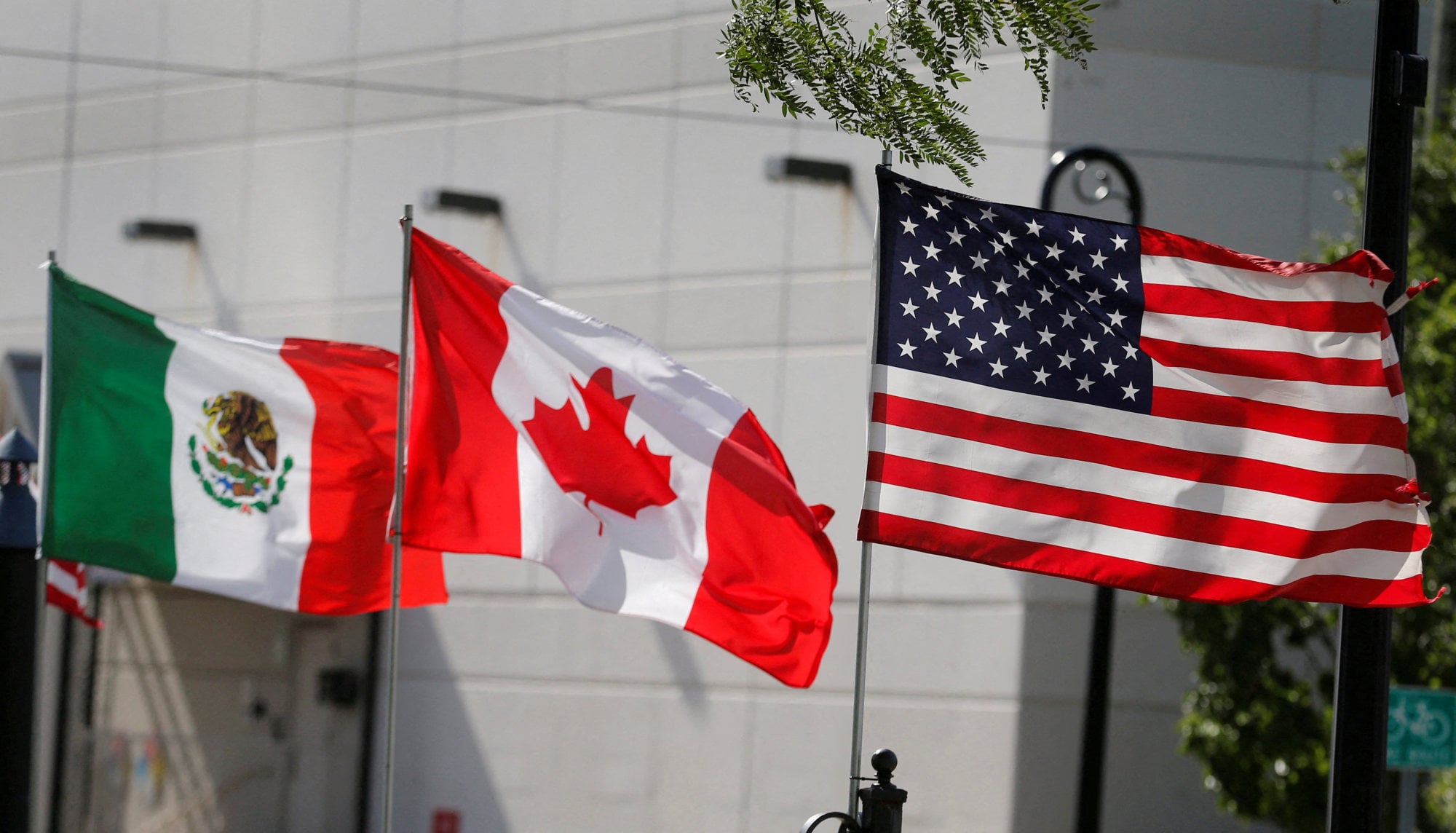
The United States was expected to formally decline to extend its free-trade agreement with Mexico and Canada on Wednesday, starting a years-long process that could wind down the trade zone unless the three governments agree on sweeping changes.
Trade chiefs from the three countries were due to meet virtually on the sixth anniversary of the United States-Mexico-Canada Agreement, with Washington widely expected not to confirm that it wants to keep the pact in its current form.
The move stops short of withdrawal, but would open a review that analysts say has become a contest over how far the Trump administration can curb Chinese access to the North American market.
Mexican President Claudia Sheinbaum on Tuesday said she had signed a letter calling for the deal to be extended for 16 years, while Canadian Prime Minister Mark Carney said he expected a “constructive exchange” but no agreements to sign.
“The priority is to get a new deal. We’re ready to negotiate an improvement of this agreement,” the Canadian leader said.
US Trade Representative Jamieson Greer, who has scheduled a third round of talks with Mexico for the week of July 20, has made clear he intends to keep pressing for changes.
President Donald Trump has meanwhile imposed tariffs of 25 per cent on Canadian and Mexican cars and parts and 50 per cent on steel and aluminium, stripping away much of the duty-free access the pact was meant to guarantee.
A 16-year clock
The USMCA replaced the North American Free Trade Agreement in 2020 and governs an integrated market worth some US$1.8 trillion a year that supports an estimated 17 million jobs.
Its rules reach deep into industry, requiring that 75 per cent of a vehicle’s content originate in North America to move duty-free and binding together supply chains in which parts cross borders repeatedly before a finished product is sold.
The agreement runs for 16 years and is due to expire in July 2036 unless all three governments confirm, in writing and through their heads of government, that they want it to continue.
A deal on Wednesday would have reset that clock to 2042. Because Washington was expected to hold back, the treaty would not lapse straight away, but the three sides face annual reviews until they reach an agreement or it expires in 2036 – a decade of recurring uncertainty that businesses had hoped to avoid.
The process is separate from a termination clause that any party could trigger to leave within six months.
Two paths on China
The push to keep Chinese goods out of North America has already strained Mexico’s relationship with Beijing.
Mexico City has imposed tariffs of up to 50 per cent on more than 1,400 categories of Asian goods since January, drawing a retaliation threat from China, which said the measures hit more than US$30 billion in its exports.
The Mexican government also shelved a planned BYD plant under US pressure, even as Chinese manufacturers including Hisense, TCL and BOE have built an export cluster in Baja California that US officials have singled out as a back door into their market.
Canada has pulled in the opposite direction, deepening ties with Beijing as the review loomed.
Carney struck a partnership with China in January that cut tariffs on Chinese electric vehicles to about 6 per cent and admitted 49,000 of them this year in exchange for relief on Canadian canola.
The bet on diversification drew a “problematic” verdict from Greer and, analysts warn, has hardened the US position rather than softened it.
Erosion, not collapse
Diego Marroquin Bitar, a fellow with the Americas Programme at the Centre for Strategic and International Studies who works on its USMCA initiative, said the refusal to extend was procedural rather than hostile.
The US was “not going to rubber-stamp” the pact, he said, citing Greer’s congressional testimony, adding that the review was the vehicle to force the changes Washington wants.
The bigger threat, in his view, was slower and harder to see.
“The real danger is erosion of the agreement,” Marroquin said, as companies delay investment because they do not know what the rules would be.
China will sit at the core of those demands.
“Front and centre is economic security, how Mexico, the United States and Canada engage with China,” he said, describing the opening negotiating rounds as focused on shielding supply chains from coercion by non-market economies and on screening foreign investment for security risks.
Washington has not decided how far it will go, however, leaving Mexico and Canada unsure whether the US wants to restrict Chinese capital and goods across the region or accommodate a world in which each power tends its own sphere.
“It is not the same thing if China is investing in a furniture facility in Nuevo Leon” as Huawei building telecoms or border infrastructure, Marroquin said. The likely outcome, he suggested, was not an outright ban, which Mexico’s sovereignty would not permit, but an “alignment of economic-security rules for guaranteed access to the US market”.
Margaret Myers, who leads the Johns Hopkins SAIS Institute for America, China and the Future of Global Affairs and advises the Inter-American Dialogue on China-Latin America relations, said the China question was never absent but was not the only factor to explain the decision.
She argued that the motivation looked more like a broader push to bring manufacturing home than a response to Beijing, and said it was “puzzling at a moment of high prices and strained affordability”.
“Mexico has already done much of what Washington asked, eliminating incentives for Chinese firms, placing tariffs on sensitive goods and watching Chinese investment fall,” she said.
Failure to extend would carry steep and lasting costs, Myers warned, rippling from car manufacturing to the food on grocery shelves and leaving Mexico and Canada little choice but to look elsewhere for other partners in the western hemisphere and beyond.
“But this will be a long-term and very painful process in which supply chains are reoriented and diversification is essentially forced upon North America,” she said. -- SOUTH CHINA MORNING POST


