




With SpaceX completing the biggest public offering in history, Elon Musk’s reusable chemical rockets seem to be the only game in town for getting to space.
But halfway around the globe, a little-known Chinese town tucked against the Tibetan Plateau could change all that.
In late March, the government of the city of Ziyang said a research facility successfully tested a high-temperature superconducting navigation system, which they said was a breakthrough in electromagnetic rocket launch technology.
Through this and several other similar programmes across the nation, Chinese scientists are working on a way to catapult rockets off the ground using electricity, before the chemical engines ever kick in.
“The concept of building an electromagnetic launch orbit in the high-altitude and thin-air areas of the Qinghai-Tibet Plateau was proposed by some particularly bold and talented young people within China’s space industry more than two decades ago,” a Beijing-based space scientist said last week. He spoke on the condition of anonymity as he was not authorised to speak to the media.
“Many difficulties will be encountered during the implementation of this project, but it is feasible from an engineering perspective.”
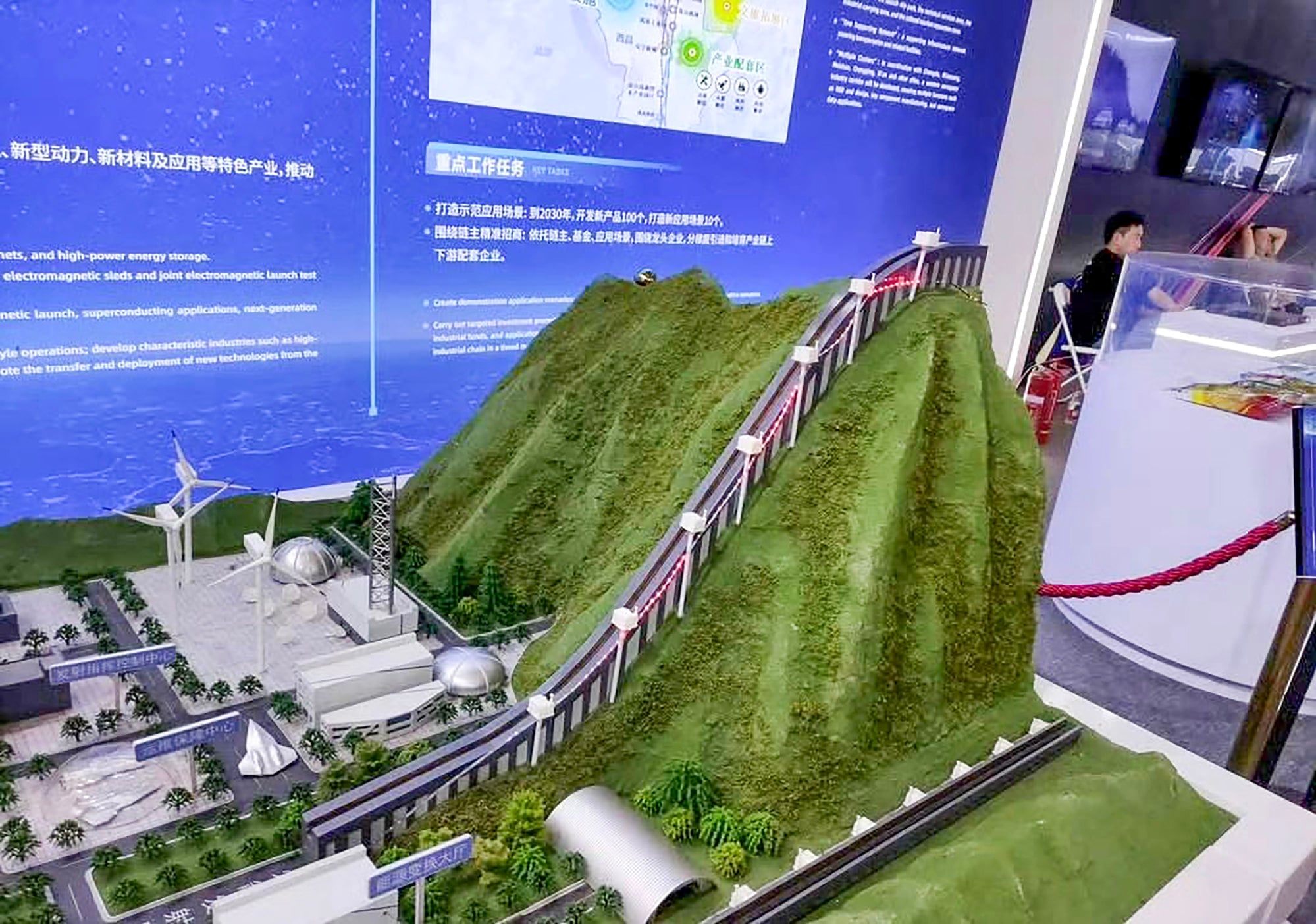
According to Ziyang Daily, the proposed system followed a “superconducting magnetic levitation plus electromagnetic propulsion and launch vehicle” architecture.
The project was being developed through the Ziyang Commercial Aerospace Launch Technology Research Institute, established in 2023 by HIWING Technology Academy of China Aerospace Science & Industry Corporation (CASIC).
Based on reports from Sichuan Online, the approach could dramatically increase launch frequency while significantly reducing costs.
Construction plans include energy storage facilities, power distribution systems, rocket integration and testing areas, launch tracks and terminal protection facilities, all aimed at demonstrating a complete commercial electromagnetic launch system.
These developments were largely built on a milestone in 2019 when a team led by Chinese electromagnetic engineering pioneer Ma Weiming applied for a patent titled “A space launch system and method based on electromagnetic ejection”.
The patent described converting electrical energy into an electromagnetic force to accelerate rockets along a launch track to several times the speed of sound before ignition.
This way, the system would reduce fuel consumption, lower launch mass and simplify rocket design.
It said the system could replace the traditional first stage of a rocket, allowing engines to ignite only after reaching high altitude.
According to the patent, the approach could solve three long-standing problems in space launch: high costs, limited flexibility and the inability to sustain high-frequency operations.
Researchers estimated that launch costs could be reduced by an order of magnitude compared with conventional systems.
One of the patent’s central claims was that electromagnetic acceleration would eliminate much of the first-stage propulsion system, traditionally one of the most expensive components of a rocket.
Such ambitions would challenge a launch model that had remained largely unchanged since the dawn of the space age. From the Soviet Union’s Sputnik programme to Nasa’s Apollo missions and from Europe’s Ariane rockets to SpaceX’s Falcon and Starship vehicles, access to space has depended almost entirely on chemical propulsion.
A similar transformation has already occurred in the car industry. For more than a century, cars relied almost entirely on internal combustion engines. Now China’s fully electric vehicles are taking global markets by storm.
SpaceX still follows the conventional model, similar to the early hybrid vehicles such as the Prius, which recycled fuel energy with tiny batteries. Its Starship and Falcon rockets carry all of the energy required for launch in the form of chemical propellants.
Ziyang’s electromagnetic launch concept would move part of that energy infrastructure onto the ground, drawing electricity from external power systems before lift-off.
In theory, the economics could become increasingly attractive if launch sites were connected to China’s rapidly expanding low-carbon electricity network, including hydroelectric, nuclear, wind and solar generation.
There are increasing discussions on Chinese social media about the future launch tracks to be built on the Tibetan Plateau, where thinner air would reduce aerodynamic drag and improve launch efficiency.
High-altitude locations offer obvious advantages: lower air density reduces heating and drag during the acceleration phase, effectively moving part of the launch process closer to near-space conditions.
The engineering challenges remain formidable, according to some experts in the industry.
A practical system would require kilometres of precisely aligned launch track, massive energy-storage infrastructure capable of delivering enormous bursts of power, advanced guidance and control systems, and rockets able to withstand extreme acceleration forces during launch, they added. -- SOUTH CHINA MORNING SEA


