




SINGAPORE: A 13-year-old white Bengal tiger at the Night Safari was euthanised on July 1 after a battle with cancer.
The animal, called Pasha, had been in declining health. Towards the end, he was no longer responding to treatment or able to enjoy a good quality of life, said Mandai Wildlife Group, which runs the Night Safari, in a statement on July 2.
“Following a comprehensive veterinary assessment, our teams made the difficult decision to humanely euthanise him to prevent further suffering,” said Mandai Wildlife Group veterinarian Trent Van Zanten.
At 13, Pasha was considered to be in his senior years.
He had been under long-term veterinary care for several age-related health challenges, including severe osteoarthritis, which affected his mobility and caused him pain, said Van Zanten.
Pasha was diagnosed with lymphoma, a progressive form of cancer, in 2026.
“Following the diagnosis, our animal care and veterinary teams worked closely to explore viable treatment options to keep him comfortable,” Van Zanten said.
“While there were periods of stability, Pasha’s condition progressively declined despite ongoing support,” he added.
As Pasha’s illness progressed, his care team focused on palliative care to help manage his pain. The animal’s quality of life was also closely monitored.
Pasha’s health declined further in his final days, and it became clear that his welfare was compromised, Van Zanten said.
The tiger was surrounded by the team who cared for him when he died, said Mandai Wildilfe Group curator Anand Kumar.
Born under human care, Pasha arrived in Singapore in 2015 from Indonesia’s Batu Secret Zoo, along with his sister Keysa. He did not have any offspring.
Quiet and introverted by nature, Pasha had his own unique way of showing affection, said Kumar.
“He would greet us with soft chuffs in the morning, just like a cat’s purr, or rub against the mesh whenever we approached his den.”
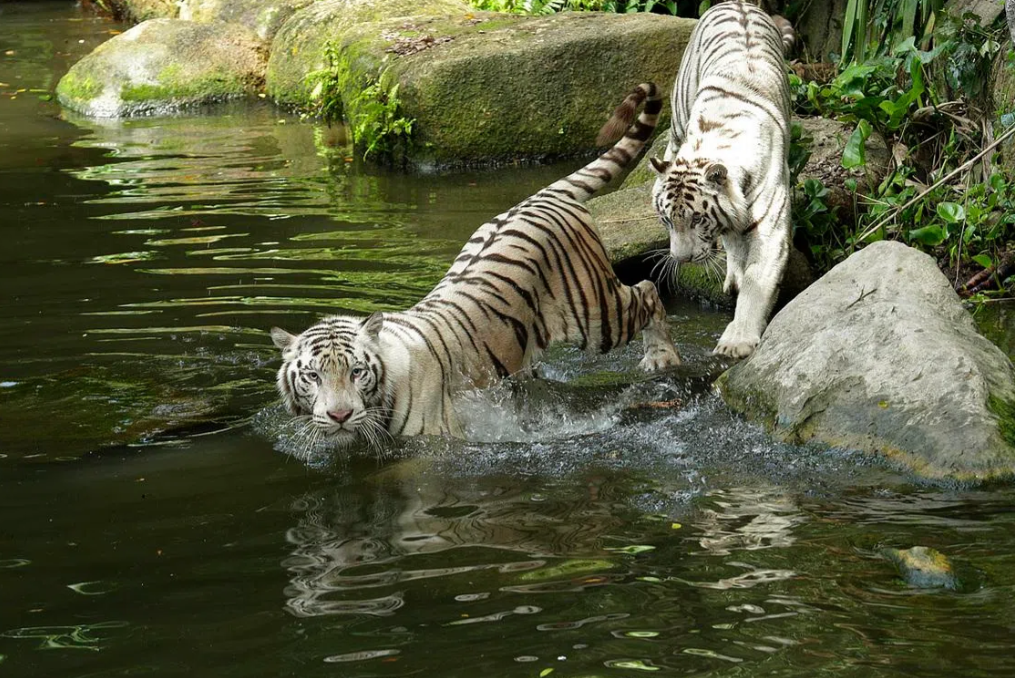
Pasha grew up alongside Keysa, and the two shared an “incredibly strong bond” despite their contrasting personalities.
This is rare for tigers, given their solitary nature, said Kumar, adding that the siblings were often seen playing together, resting side by side, or rubbing their heads together.
He recalled Pasha’s “great love for his enrichment toys”, including his boomer balls – a hard-plastic toy ball – which he would guard closely.
Everyone knew that Pasha would get first dibs whenever the toys were introduced into the enclosure, Kumar said. Keysa would patiently wait her turn.
“Pasha was part of our lives for many years, and saying goodbye has been difficult for the team,” Kumar said.
“He will be deeply missed by all of us who had the privilege of caring for him. Our team will continue to monitor Keysa closely as she adjusts to life without her brother.”
Keysa is now the sole white tiger under Mandai Wildlife Group’s care.
White tigers, also known as Bengal tigers, carry a rare genetic mutation that results in their white coat, blue eyes and brown stripes.
They can be found in the same litter as orange-coloured tiger cubs. They are neither a separate species or subspecies of tigers, nor albinos.
All white tigers under human care today descended from a common ancestor – Mohan, the first white tiger cub caught in India, according to Mandai Wildlife Reserve’s website.
Mohan, who was brought to the Maharajah’s palace, mated with an orange-coloured tigress to produce a litter of 10 cubs – all of which had an orange coat.
Mohan later went on to mate with a female from this litter. Together, they produced four white cubs, which started the breeding of white tigers under human care.
Mandai Wildlife Group said its commitment to tiger conservation continues through the Malayan tiger, a critically endangered species.
These efforts focus on regional breeding programmes and raising greater awareness of the threats facing these tigers in the wild, added the group, which also runs the Singapore Zoo, Bird Paradise, River Wonders, and Rainforest Wild Adventure. - The Straits Times/ANN


